
 África
 Asia
Asia Europa
 América do Sur
 Australia e Oceanía
 Antártida
 Océano Pacífico
 Océano Atlántico
 Océano Índico
 Océano Glacial Ártico
 Mar Mediterráneo
 Mar Vermello
 Mar Caribe
 Mar do Coral
 Mar da China Meridional
 Mar de Filipinas
 Mar de Andamán
 Mar do Norte
 Mar de Timor e de Arafura
 Golfo de Bengala
 Golfo de California
Geography cone
 Pica
PicaThe geography cone is a predatory sea snail that lives on shallow tropical reefs in the Indo-Pacific. It hunts small fish. Its venom is strong enough to kill a person, which makes it one of the most dangerous cone snails.1


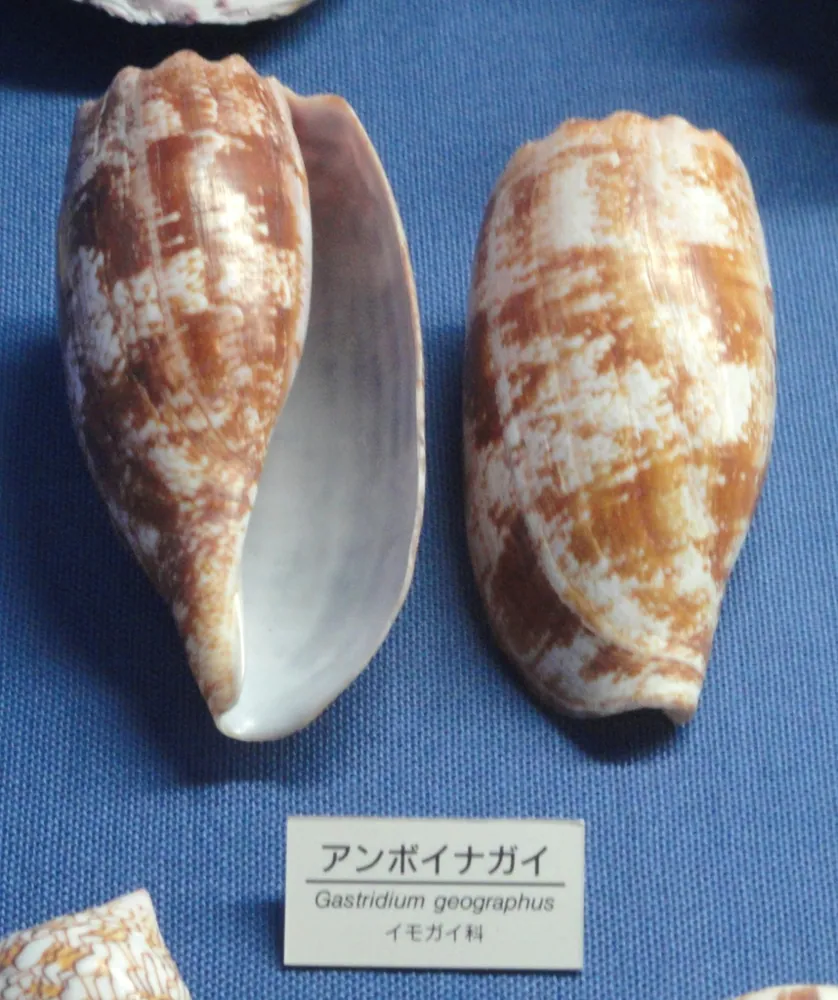
 Como recoñecelo
- Broad, thin shell that is cylindrically inflated, usually 10 to 15 cm long1
- Ground colour is pink or violet-white, sometimes reddish1
- Mottled pattern of chestnut or chocolate brown, usually forming two irregular bands1
- Wide pink or violet-white opening and numerous shoulder ridges or spines1
Adoita confundirse con: Compared with other cone shells of a similar size, the geography cone has a noticeably wider, more convex middle and a flattened spire. Its walls are also thinner and lighter.1
Poder da pezoña
A pezoña sae por un ferrete.
Que fai a súa pezoña?
Its venom is a complex mix of hundreds of different toxins, delivered through the harpoon-like tooth. It has the most toxic sting known among cone snails. Even the most venomous cone snails take about one to five hours to kill a healthy adult, but medical care must still be prompt.1
Que perigoso é para as persoas?
Perigo para as persoas: MortalUn dos animais máis perigosos do mundo.There are reports of about 36 human deaths over the past 300 years. Live specimens should be handled with extreme caution.1
Que fai cando ten medo?
Most of the venom's toxic compounds are believed to be used for defence rather than feeding.1
 Se pica
- There is no antivenom for a cone snail sting. Treatment consists of keeping the victim alive until the symptoms wear off, so prompt medical care is essential.1
- Inmobilización con presión: envolve cunha venda elástica firme a mordedura e despois todo o membro cara arriba, ponlle unha férula e mantén a persoa completamente quieta ata que chegue a axuda.
- Un polbo de aneis azuis ou un caracol cono poden facer que unha persoa deixe de respirar mentres aínda está consciente: pide axuda e prepárate para darlle respiracións de rescate ata que a ambulancia se faga cargo.
Chama sempre primeiro ao teu número de emerxencias (112, 000, 911). Isto son consellos xerais de primeiros auxilios, non consello médico. Primeiros auxilios básicos
 Mantente a salvo
- Nunca toques, collas nin molestes un animal salvaxe, aínda que sexa pequeno e aínda que pareza durmido ou morto.
- Déixalle espazo. Se atopas un, mantén a calma, recúa amodo e déixao ir polo seu camiño.
- Se un te pica: mantén a calma, non te movas, chama ao teu número de emerxencias (112, 000, 911) ou vai rápido a un hospital. Lembra como era, unha foto axuda.
Non vai a por ti. Usa a súa pezoña para cazar comida ou para defenderse, e prefire con moito agocharse. Máis sobre como estar a salvo
En que lugar do mundo?
Que tamaño ten?
Canto mide?
 mide coma 5 pezas de construción de xoguete en fila
 máis lento ca un caracol de xardín
Que tamaño ten Geography cone comparado CONTIGO?
Só son contas no teu navegador. Non se garda nin se envía nada a ningures.
Que rápido é?

Datos
Its venom contains a form of insulin, which it uses to stun fish. Once the venom passes through a fish's gills, the fish goes into hypoglycaemic shock (a dangerous drop in blood sugar).1
Apart from the tulip cone snail, no other known living thing is known to use its own biological insulin as a weapon.1
Research shows that some proteins from cone snail venom can be up to 10,000 times more effective than morphine as painkillers, without morphine's addictive properties and side effects.1
Of the venom's 100 to 200 toxic peptides, only 15 to 20 are used for feeding.1
Adult geography cones can fall prey to sea turtles, rays, birds and human shell collectors.1
Desmontamitos
Mito: The nickname 'cigarette snail' means a sting gives you just enough time to smoke a cigarette before you die.
Verdade: This is a gallows humour exaggeration. Even the most venomous cone snails take about one to five hours to kill a healthy human.1
De onde veñen os datos
- Conus geographus (Wikipedia (CC BY-SA 4.0))
- Conus geographus (iNaturalist): nomes e clasificación.
- Venom Wiki: o nivel de perigo, o tamaño típico e a velocidade estimada son nosos. Mira como os calculamos: Como valoramos o perigo.
Cada dato desta páxina ten un número que leva á súa fonte. Se nos equivocamos nalgo, sentímolo, somos fans dos animais, non unha revista científica. Dínolo en [email protected] e arranxarémolo.
 O escorpión ten fame! Venom Wiki é un proxecto dunha soa persoa: gratis, sen anuncios e sen rastrexadores. Unha pequena propina axuda a mantelo en liña.Dálle de comer ao escorpión
Máis do mesmo grupo: Caracois cono e polbos
 Greater blue-ringed octopus
 Southern blue-ringed octopus
 Blue sea dragon
 Common octopus
 Giant Pacific octopus
 Blue-lined octopus
Tamén vive en: Océano Índico
 Australian box jellyfishMedusas e outros picadores do marMortalNon tocar
 Hawksbill sea turtleOutros animais velenososPode matar
 Irukandji jellyfishMedusas e outros picadores do marPode matarNon tocar
 Reef stonefishPeixes pezoñentosPode matarNon tocar
 Crown-of-thorns starfishOurizos, estrelas e vermesPrecisa un médicoNon tocar
 Portuguese man o' warMedusas e outros picadores do marPrecisa un médicoNon tocar