
 África
 Asia
Asia Europa
 América do Sur
 Australia e Oceanía
 Antártida
 Océano Pacífico
 Océano Atlántico
 Océano Índico
 Océano Glacial Ártico
 Mar Mediterráneo
 Mar Vermello
 Mar Caribe
 Mar do Coral
 Mar da China Meridional
 Mar de Filipinas
 Mar de Andamán
 Mar do Norte
 Mar de Timor e de Arafura
 Golfo de Bengala
 Golfo de California
Mount Kenya bush viper
 Morde
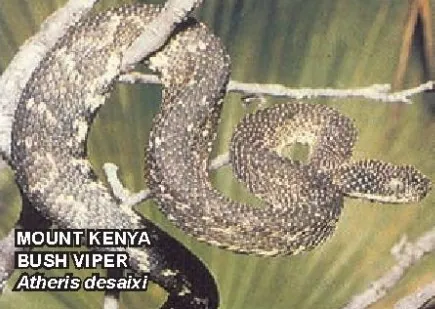
MordeThe Mount Kenya bush viper is a venomous snake with a striking black and yellow pattern. It lives only in Kenya, in two small, separate areas of forest. Its bite can cause serious swelling and bleeding problems, so it is important to know it.1



 Como recoñecelo
- Ground colour is greenish-black to charcoal-black, with each scale tipped in yellow or yellowish-green, giving a speckled look.1
- Some scales form a series of loops along the sides, which may join into zigzag patterns towards the back.1
- The underside is yellow near the front, fading to purplish-black towards the rear and under the tail.1
- Young snakes are mainly yellow with a white-tipped tail. They darken as they grow and reach adult colours at about 30 cm.1
- Adults are usually 40 to 60 cm long, including the tail.1
Poder da pezoña
A pezoña sae polos seus cairos ou dentes cando morde.
Que fai a súa pezoña?
Its venom contains powerful anticoagulants, which are substances that stop blood from clotting properly. A bite causes significant swelling and pain. Poor clotting may be severe enough to need blood transfusions.1
Que perigoso é para as persoas?
Perigo para as persoas: GraveUnha mordedura precisa un médico. As mortes son moi raras.In the one recorded bite, a Kenyan collector was bitten on a finger by an adult snake. The bite caused significant swelling and pain, and he made a full recovery. The snakes are relatively large for their genus, so a bite should be taken seriously.1
Que fai cando ten medo?
When captured, it strikes readily and struggles vigorously. It may also give a threat display, rubbing its coils and keeled scales together to make a loud hiss.1
 Se morde
- Because the venom can stop blood clotting, any bite should be treated as serious and needs urgent medical care. In the one recorded bite, a tourniquet was applied and an unknown antivenin was given, but the antivenin probably made no difference.1
- Mantén a persoa quieta e tranquila, mantén o membro mordido á altura do corazón, quítalle aneis e cousas apertadas e vai rápido a un hospital.
Chama sempre primeiro ao teu número de emerxencias (112, 000, 911). Isto son consellos xerais de primeiros auxilios, non consello médico. Primeiros auxilios básicos
 Mantente a salvo
- Nunca toques, collas nin molestes un animal salvaxe, aínda que sexa pequeno e aínda que pareza durmido ou morto.
- Déixalle espazo. Se atopas un, mantén a calma, recúa amodo e déixao ir polo seu camiño.
- Se un te morde: mantén a calma, non te movas, chama ao teu número de emerxencias (112, 000, 911) ou vai rápido a un hospital. Lembra como era, unha foto axuda.
Non vai a por ti. Usa a súa pezoña para cazar comida ou para defenderse, e prefire con moito agocharse. Máis sobre como estar a salvo
En que lugar do mundo?
Que tamaño ten?
Canto mide?
 mide coma 4 bananas postas en fila
 podería percorrer 100 metros en 110 segundos (o humano máis rápido precisa 9,6)
Que tamaño ten Mount Kenya bush viper comparado CONTIGO?
Só son contas no teu navegador. Non se garda nin se envía nada a ningures.
Que rápido é?


Datos
Its coloration gives it excellent camouflage in the forest, so it is very hard to spot.1
Its speckled, looped pattern changes from juvenile yellow to adult black and yellow as it grows.1
It is arboreal, which means it lives in trees and bushes, moving slowly and deliberately among the branches.1
Captive snakes soon calm down, and their threat display disappears.1
Para expertos en pezoñas
- Nome científico
- Atheris desaixi
- Grupo
- Víboras e outras serpes da familia
- Familia
- Viperidae2
- Orde
- Squamata
- Continentes
- África
- Crías
- It gives birth to live young. One recorded female gave birth to 13 offspring in August, each measuring 17 to 21 cm.1
- Como lle vai na natureza
- Endangered on the IUCN Red List (as of 2019). Listed in Appendix II of CITES, so international trade is regulated by permit.1
- Perigo para as persoas
- 3 / 5: Grave3
De onde veñen os datos
- Atheris desaixi (Wikipedia (CC BY-SA 4.0))
- Atheris desaixi (iNaturalist): nomes e clasificación.
- Venom Wiki: o nivel de perigo, o tamaño típico e a velocidade estimada son nosos. Mira como os calculamos: Como valoramos o perigo.
Cada dato desta páxina ten un número que leva á súa fonte. Se nos equivocamos nalgo, sentímolo, somos fans dos animais, non unha revista científica. Dínolo en [email protected] e arranxarémolo.
 O escorpión ten fame! Venom Wiki é un proxecto dunha soa persoa: gratis, sen anuncios e sen rastrexadores. Unha pequena propina axuda a mantelo en liña.Dálle de comer ao escorpión
Máis do mesmo grupo: Víboras e outras serpes da familia
 Puff adderVíboras e outras serpes da familiaMortal
 Gaboon viperVíboras e outras serpes da familiaPode matar
 Northeast African carpet viperVíboras e outras serpes da familiaMortal
 West African carpet viperVíboras e outras serpes da familiaMortal
 Rhinoceros viperVíboras e outras serpes da familiaPode matar
 West African Gaboon viperVíboras e outras serpes da familiaPode matar
 Black mamba
 Deathstalker
 Egyptian cobra
 Boomslang
 Fat-tailed scorpion
 Western honey bee