
 África
 Asia
Asia Europa
 América do Sur
 Australia e Oceanía
 Antártida
 Océano Pacífico
 Océano Atlántico
 Océano Índico
 Océano Glacial Ártico
 Mar Mediterráneo
 Mar Vermello
 Mar Caribe
 Mar do Coral
 Mar da China Meridional
 Mar de Filipinas
 Mar de Andamán
 Mar do Norte
 Mar de Timor e de Arafura
 Golfo de Bengala
 Golfo de California
South American bushmaster
 Morde
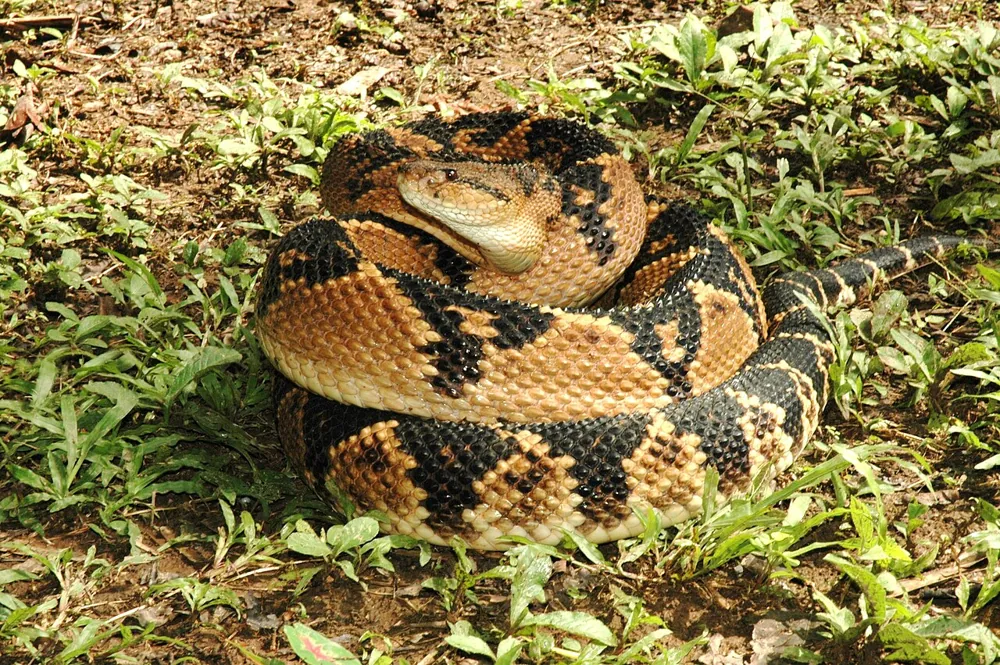
MordeThe South American bushmaster is one of the longest vipers in the world, and it is the longest venomous snake in the Western Hemisphere. It lives in the equatorial forests east of the Andes and on the island of Trinidad. Its bite is dangerous, so it is important to know what it looks like.1



 Como recoñecelo
- Its ground colour is yellowish, reddish or grey-brown.1
- Dark brown or black blotches run along the body, forming inverted triangles on the sides.1
- Adults are usually 2 to 2.5 m long, and 3 m is not unusual.1
- The head is broad and clearly separate from the narrow neck.1
- The tail is short and ends in a spine. When alarmed it vibrates the tail, which makes a loud rustling in undergrowth.1
Adoita confundirse con: It is similar in appearance to rattlesnakes. It has no rattle, so its tail vibration sounds like rustling leaves rather than a rattle.1
Poder da pezoña
A pezoña sae polos seus cairos ou dentes cando morde.
Que fai a súa pezoña?
Its venom breaks down tissue, stops blood from clotting, and can cause bleeding. It also has effects on the nerves. At the bite there is pain, swelling, bruising, blisters and skin death. Whole-body effects include low blood pressure, dizziness, vision problems, a slow heartbeat, vomiting, diarrhoea and kidney failure.1
Que perigoso é para as persoas?
Perigo para as persoas: Moi perigosoPode matar a unha persoa que non reciba tratamento.Its bites are often fatal. Lab tests show its venom is weak, but the mortality rate of bite victims is high. In reported cases, a 7-year-old boy in Brazil died about 15 minutes after being bitten, and a 5-year-old child in Mato Grosso went into shock about 30 minutes after a bite and died within 90 minutes.1
Que fai cando ten medo?
When threatened it vibrates its tail, which makes a loud rustling sound in the undergrowth.1
 Se morde
- Mantén a persoa quieta e tranquila, mantén o membro mordido á altura do corazón, quítalle aneis e cousas apertadas e vai rápido a un hospital.
Chama sempre primeiro ao teu número de emerxencias (112, 000, 911). Isto son consellos xerais de primeiros auxilios, non consello médico. Primeiros auxilios básicos
 Mantente a salvo
- Nunca toques, collas nin molestes un animal salvaxe, aínda que sexa pequeno e aínda que pareza durmido ou morto.
- Déixalle espazo. Se atopas un, mantén a calma, recúa amodo e déixao ir polo seu camiño.
- Se un te morde: mantén a calma, non te movas, chama ao teu número de emerxencias (112, 000, 911) ou vai rápido a un hospital. Lembra como era, unha foto axuda.
Non vai a por ti. Usa a súa pezoña para cazar comida ou para defenderse, e prefire con moito agocharse. Máis sobre como estar a salvo
En que lugar do mundo?
Que tamaño ten?
Canto mide?
Canto pesa?
 mide coma 4 cans do fociño á cola
 mide coma 20 bananas postas en fila
 pesa máis ou menos coma un gato doméstico
 podería percorrer 100 metros en 71 segundos (o humano máis rápido precisa 9,6)
Que tamaño ten South American bushmaster comparado CONTIGO?
Só son contas no teu navegador. Non se garda nin se envía nada a ningures.
Que rápido é?


Datos
It is the longest viper in the world.1
It is the third longest venomous snake in the world, after the king cobra and the black mamba.1
Stress also lowers its venom yield. One specimen's yield fell from 233 mg to 64 mg while it was kept in captivity.1
Its name Lachesis comes from one of the three Fates of Greek mythology, who was said to decide how long a person would live.1
It rarely lives long in captivity, because stress makes it unwell.1
Desmontamitos
Mito: Its venom is weak, so its bite is not very serious.
Verdade: Lab tests show low toxicity, but bite victims die at a high rate, so the bite is very dangerous.1
De onde veñen os datos
- Lachesis muta (Wikipedia (CC BY-SA 4.0))
- Lachesis muta (iNaturalist): nomes e clasificación.
- Venom Wiki: o nivel de perigo, o tamaño típico e a velocidade estimada son nosos. Mira como os calculamos: Como valoramos o perigo.
Cada dato desta páxina ten un número que leva á súa fonte. Se nos equivocamos nalgo, sentímolo, somos fans dos animais, non unha revista científica. Dínolo en [email protected] e arranxarémolo.
 O escorpión ten fame! Venom Wiki é un proxecto dunha soa persoa: gratis, sen anuncios e sen rastrexadores. Unha pequena propina axuda a mantelo en liña.Dálle de comer ao escorpión
 Terciopelo
 Eyelash viper
 Golden lancehead
 Common lancehead
 Jararaca
 Jararacussu
 Golden poison frog
 Brazilian wandering spider
 Cane toad
 Peruvian giant centipede
 Bullet ant
 Common vampire bat