
 Afirka
 Asiya
Asiya Turai
Turai Kudancin Amurka
 Ostareliya da Oceania
 Antatika
 Tekun Pasifik
 Tekun Atlantika
 Tekun Indiya
 Tekun Arctic
 Bahar Rum
 Bahar Maliya
 Tekun Caribbean
 Tekun Coral
 Tekun Kudancin China
 Tekun Philippines
 Tekun Andaman
 Tekun Arewa
 Tekun Timor da Arafura
 Gaɓar Tekun Bengal
 Gaɓar Tekun California
False water cobra
 Cizo
CizoThe false water cobra is a large snake that lives in South America. It is named after true cobras because it flattens its neck to look bigger when threatened, but it is not a true cobra. It is mildly venomous, and its bites rarely cause serious harm to people.1



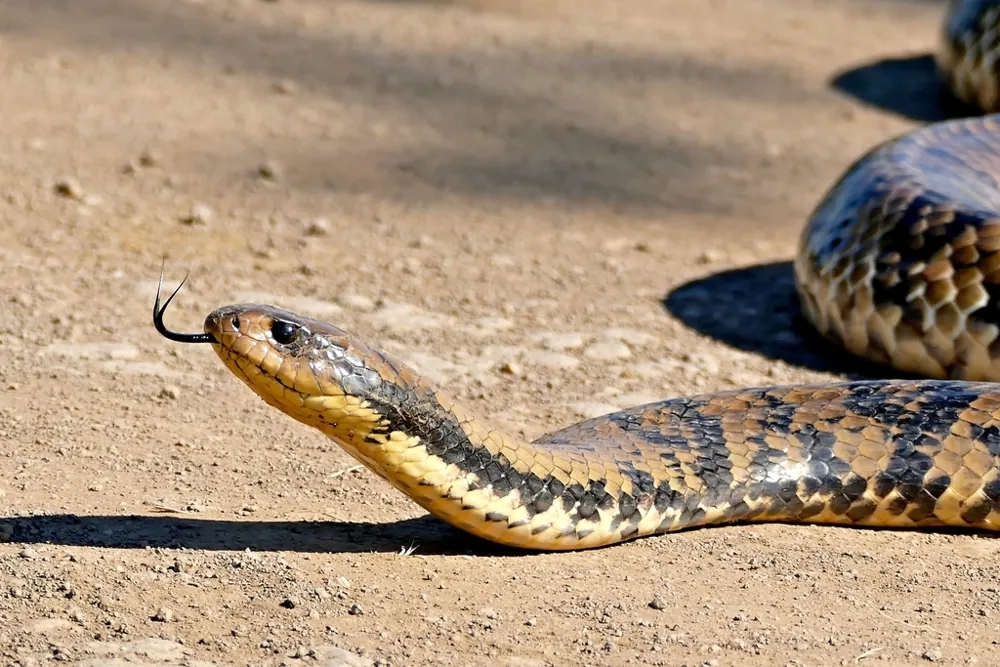
 Yadda za ka gane shi
- Background colour is olive green or brown, with dark spots and bands over much of the body.1
- Bands and colour grow darker towards the tail.1
- Large eyes with round pupils. The tongue is black.1
- Belly is yellow or brown with dark flecks, which form three dotted lines. Males tend to be yellow underneath and females brown.1
- Hatchlings and juveniles are much darker and lack the dark eyes of adults.1
Ana yawan rikita shi da: Its pattern and colouring look somewhat like those of true water cobras (Boulengerina). The easiest difference to see is the hood: when threatened, the false water cobra stays horizontal, while a true cobra rears up.1
Ƙarfin dafi
Dafi yana fitowa ta haƙoransa na dafi ko haƙoransa idan ya ciza.
Me dafinsa yake yi?
This snake has enlarged rear teeth that are not grooved, and they are linked to a gland that produces oral secretions with proteolytic activity, meaning they break down proteins. In the few serious cases, symptoms included severe swelling, bruising, numbness, itching and dizziness. Most bites cause only mild pain and minor swelling.1
Yaya haɗarinsa yake ga mutane?
Haɗari ga mutane: Mai raɗaɗiYana iya yin ciwo sosai, amma kusan bai taɓa zama mai tsanani ba.Many bites have been recorded, but only four cases of significant reaction in humans are reported for this species. It is considered mildly venomous.1
Me yake yi idan ya ji tsoro?
When threatened, it flattens its neck like a cobra, and can flatten lower parts of its body too, to look larger and more intimidating.1
 Idan ya ciji
- Ka wanke wurin cizon, ka sa mutumin ya natsu kuma ka nemi taimakon likita. Wasu nau'o'i (kamar boomslang) na iya kisa bayan sa'o'i.
Kullum ka fara kiran lambar gaggawa (112, 000, 911). Wannan jagorar agajin gaggawa ce ta gaba ɗaya, ba shawarar likita ba. Muhimman abubuwan agajin gaggawa
 Kiyaye lafiya
- Kada ka taɓa, kada ka kama, kada ka tsokani dabbar daji, ko da ƙarama ce, kuma ko da tana kama da tana barci ko ta mutu.
- Ka ba shi sarari. Idan ka haɗu da ɗaya, ka natsu, ka koma baya a hankali kuma ka bar shi ya bi hanyarsa.
- Idan ɗaya ya ciji ka: ka natsu, ka zauna ba motsi, ka kira lambar gaggawarka (112, 000, 911) ko ka je asibiti da sauri. Ka tuna yadda yake, hoto yana taimakawa.
Ba ya neman cutar da kai. Yana amfani da dafinsa don kama abinci ko don kare kansa, kuma ya fi son ya ɓuya. Ƙarin bayani game da kiyaye lafiya
Yaya girmansa yake?
Yaya tsawonsa yake?
Yaya nauyinsa yake?
 tsawon karnuka 3 daga hanci zuwa wutsiya
 tsawon ayaba 17 a jere
 kusan nauyin kyanwar gida
 zai iya gudun mita 100 cikin daƙiƙa 54 (mutum mafi sauri yana buƙatar 9,6)
Yaya girman False water cobra yake idan aka kwatanta da KAI?
Lissafi ne kawai a cikin burauzarka. Ba a adana komai ko a aika ko'ina.
Yaya saurinsa yake?


Bayanai
Captive-bred individuals can become quite tame and trusting, and many show a high level of intelligence.1
Temperaments vary a lot: some individuals are docile, while others are defensive or even aggressive.1
Males are much smaller than females, a difference called sexual dimorphism.1
It is mainly active during the day, which gives it good daytime vision thanks to its large eyes.1
Mai karya tatsuniya
Tatsuniya: It is a true cobra.
Gaskiya: It is not a true cobra. It hoods in a similar way, but stays horizontal instead of rearing up.1
Inda bayanan suka fito
- Hydrodynastes gigas (Wikipedia (CC BY-SA 4.0))
- Hydrodynastes gigas (iNaturalist): sunaye da rarrabuwa.
- Venom Wiki: matakin haɗari, girman al'ada da ƙiyasin sauri namu ne. Ga yadda muke lissafa su: Yadda muke auna haɗari.
Kowane bayani a wannan shafi yana da lamba da ke nuna tushensa. Idan mun yi kuskure, ka yi haƙuri, mu masoya dabbobi ne, ba mujallar kimiyya ba. Ka gaya mana a [email protected] kuma za mu gyara.
 Kunama tana jin yunwa! Venom Wiki aikin mutum ɗaya ne: kyauta, ba talla kuma ba masu bin diddigi. Ɗan ƙaramin kyauta yana taimakawa wajen ci gaba da kasancewarsa a intanet.Ciyar da kunama
Ƙari daga rukuni ɗaya: Macizai masu haƙoran baya
 Baron's green racerMacizai masu haƙoran bayaCiwo kawai
 Brown vine snakeMacizai masu haƙoran bayaMarar lahani
 Green vine snakeMacizai masu haƙoran bayaMarar lahani
 Lichtenstein's green racerMacizai masu haƙoran bayaYana buƙatar likita
 Peruvian slender snakeMacizai masu haƙoran bayaYana buƙatar likita
 Chilean green racerMacizai masu haƙoran bayaCiwo kawai
 Golden poison frog
 Terciopelo
 Brazilian wandering spider
 Eyelash viper
 Golden lancehead
 South American bushmaster