
 Afirka
 Asiya
Asiya Turai
Turai Kudancin Amurka
 Ostareliya da Oceania
 Antatika
 Tekun Pasifik
 Tekun Atlantika
 Tekun Indiya
 Tekun Arctic
 Bahar Rum
 Bahar Maliya
 Tekun Caribbean
 Tekun Coral
 Tekun Kudancin China
 Tekun Philippines
 Tekun Andaman
 Tekun Arewa
 Tekun Timor da Arafura
 Gaɓar Tekun Bengal
 Gaɓar Tekun California
Oriental fire-bellied toad
 Guba a fatarsa
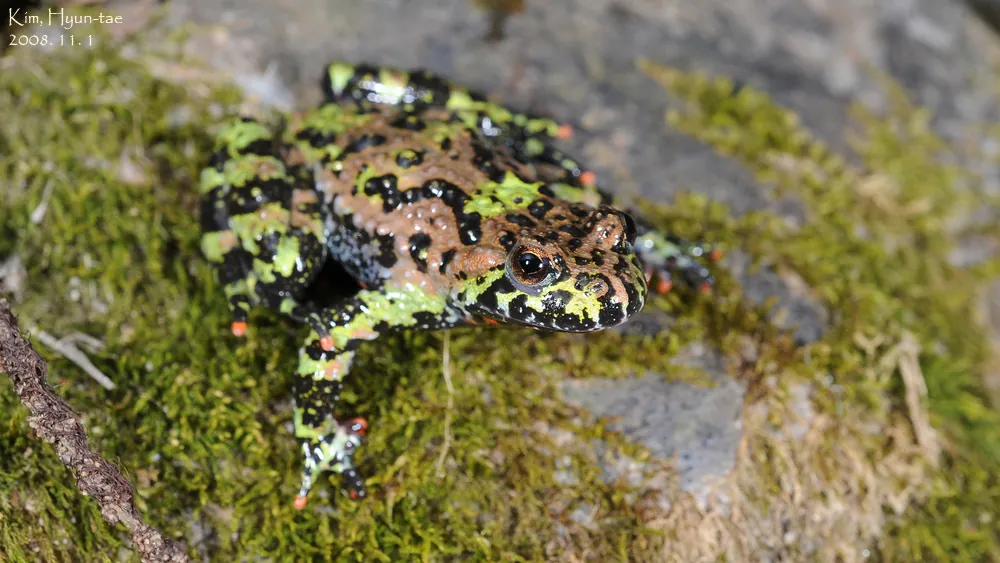
The Oriental fire-bellied toad is a small frog that lives in northeastern Asia, mostly near slow streams, ponds and forests. Its bright belly is a warning: when it is disturbed, it gives off a mild toxin through its skin. It is common across much of its range.1



 Yadda za ka gane shi
- Bright grey, brownish or green upper skin with black mottling.1
- Bright yellow, red or orange-red belly, mottled with dark spots.1
- Red finger and toe tips are usually present.1
- Skin on the upper side is covered in small bumps called tubercles, which give it a toad-like look.1
- Adults are about 3.8 to 5.1 cm long.1
Ana yawan rikita shi da: It is often mistaken for a toad, but it is not a true toad. Compared with other Bombina frogs, it has no gular sacs (throat pouches), its belly is usually more red than yellow, and it has bright finger tips.1
Ƙarfin guba
Fatarsa tana da guba. Yana da haɗari a taɓa shi, a lasa shi ko a ci shi.
Me gubarsa take yi?
The toad's skin releases a milky, mildly toxic substance when it is disturbed or frightened, mostly from the hind legs and sometimes the belly. Its toxins are described as mild, and the toxin does not pose a significant threat to human health. Captive toads are generally less toxic than wild ones, because their diet in the wild adds to their toxicity.1
Yaya haɗarinsa yake ga mutane?
Haɗari ga mutane: Mai sauƙiKamar harbin ƙudan zuma ko ƙasa da haka. Kusan ba shi da lahani ga mutane.The toxin does not pose a significant threat to human health, but its skin mucus can cause discomfort to the mouth and eyes if the toad is handled.1
Me yake yi idan ya ji tsoro?
When threatened, it releases toxin from its skin, lies on its back to show its brightly coloured belly, and arches its head and holds up its limbs as a warning.1
 Idan wani ya taɓa shi ko ya ci shi
- Idan wani ya taɓa ɗaya: a wanke hannaye sosai kuma kada a taɓa idanu ko baki. Idan yaro ko dabbar gida ya lasa ko ya ci ɗaya: ka kira cibiyar guba ko lambar gaggawa.
Kullum ka fara kiran lambar gaggawa (112, 000, 911). Wannan jagorar agajin gaggawa ce ta gaba ɗaya, ba shawarar likita ba. Muhimman abubuwan agajin gaggawa
 Kiyaye lafiya
- Kada ka taɓa, kada ka kama, kada ka tsokani dabbar daji, ko da ƙarama ce, kuma ko da tana kama da tana barci ko ta mutu.
- Ka ba shi sarari. Idan ka haɗu da ɗaya, ka natsu, ka koma baya a hankali kuma ka bar shi ya bi hanyarsa.
- Idan ka taɓa shi ko ka ci shi: kada ka goge idanunka ko bakinka, ka wanke hannayenka kuma ka nemi taimakon likita.
Ba ya neman cutar da kai. Gubarsa tana nan ne kawai don kada wani abu ya cinye shi. Ƙarin bayani game da kiyaye lafiya
Yaya girmansa yake?
Yaya tsawonsa yake?
Yaya nauyinsa yake?
 ya fi ɗan yatsanka gajarta
 zai iya gudun mita 100 cikin daƙiƙa 180 (mutum mafi sauri yana buƙatar 9,6)
Yaya girman Oriental fire-bellied toad yake idan aka kwatanta da KAI?
Lissafi ne kawai a cikin burauzarka. Ba a adana komai ko a aika ko'ina.
Yaya saurinsa yake?


Bayanai
Unusually for a frog, this species has no eardrum or resonator, and it makes its calls by inhaling.1
In experiments, these toads learned to solve mazes using water as a reward, which other frog types did not manage.1
Its skin contains bombesin, a peptide that affects stomach function in mammals. It was first found in its relative, the European fire-bellied toad.1
Males call to females with a light sound that is compared to a musical triangle.1
Grass snakes and other water-dwelling snakes are known to eat these toads without any ill effect.1
In captivity they often live for around 12 years, and some have lived up to 30 years.1
Mai karya tatsuniya
Tatsuniya: It is a true toad.
Gaskiya: It is not a true toad, although its bumpy skin gives it a toad-like appearance.1
Don ƙwararru a kan dafi
Inda bayanan suka fito
- Oriental fire-bellied toad (Wikipedia (CC BY-SA 4.0))
- Bombina orientalis (iNaturalist): sunaye da rarrabuwa.
- Venom Wiki: matakin haɗari, girman al'ada da ƙiyasin sauri namu ne. Ga yadda muke lissafa su: Yadda muke auna haɗari.
Kowane bayani a wannan shafi yana da lamba da ke nuna tushensa. Idan mun yi kuskure, ka yi haƙuri, mu masoya dabbobi ne, ba mujallar kimiyya ba. Ka gaya mana a [email protected] kuma za mu gyara.
 Kunama tana jin yunwa! Venom Wiki aikin mutum ɗaya ne: kyauta, ba talla kuma ba masu bin diddigi. Ɗan ƙaramin kyauta yana taimakawa wajen ci gaba da kasancewarsa a intanet.Ciyar da kunama
Ƙari daga rukuni ɗaya: Kwaɗi masu guba, toad da newt
 Japanese fire-bellied newtKwaɗi masu guba, toad da newtYana buƙatar likitaKada ka taɓa
 Common toadKwaɗi masu guba, toad da newtCiwo kawaiKada ka taɓa
 Asian common toadKwaɗi masu guba, toad da newtYana buƙatar likitaKada ka taɓa
 Asiatic toadKwaɗi masu guba, toad da newtCiwo kawaiKada ka taɓa
 Emperor newtKwaɗi masu guba, toad da newtCiwo kawaiKada ka taɓa
 Himalayan newtKwaɗi masu guba, toad da newtCiwo kawaiKada ka taɓa
 Deathstalker
 Indian cobra
 Indian saw-scaled viper
 King cobra
 Puff adder
 Kububuwar Russell