
 Afirka
 Asiya
Asiya Turai
Turai Kudancin Amurka
 Ostareliya da Oceania
 Antatika
 Tekun Pasifik
 Tekun Atlantika
 Tekun Indiya
 Tekun Arctic
 Bahar Rum
 Bahar Maliya
 Tekun Caribbean
 Tekun Coral
 Tekun Kudancin China
 Tekun Philippines
 Tekun Andaman
 Tekun Arewa
 Tekun Timor da Arafura
 Gaɓar Tekun Bengal
 Gaɓar Tekun California
South American rattlesnake
 Cizo
CizoThe South American rattlesnake is a large, highly venomous pit viper. It lives across much of South America, except the Andes Mountains, and also on some Caribbean islands. It is the most widely spread member of its genus, which is why it matters to people in so many places.1


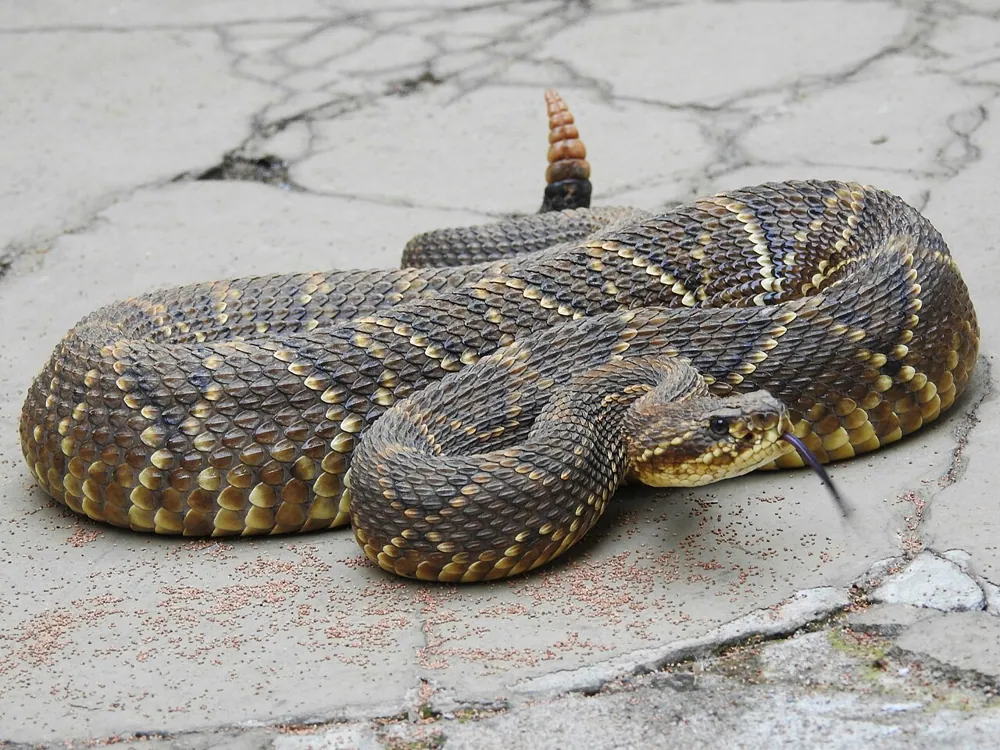
 Yadda za ka gane shi
- Two distinct stripes start at the base of the head, and the colour between the lines is lighter than the stripes.1
- Body colour and pattern vary, but most have 18 to 32 dark diamond or rhombic spots along the back.1
- The head has a dark brown bar at the top and a dark band behind the eye.1
- The tail is usually grey, with dark, faint crossed bands.1
- The belly is white or yellowish with light grey spots, getting darker towards the tail.1
Ƙarfin dafi
Dafi yana fitowa ta haƙoransa na dafi ko haƙoransa idan ya ciza.
Me dafinsa yake yi?
Its venom contains neurotoxins, which attack the nerves, and myotoxins, which damage muscle. These cause progressive paralysis, including impaired or lost vision, hearing problems, drooping eyelids and weakness in the neck muscles, which can become so limp that the head appears broken. Breathing can eventually be stopped by paralysis, and the muscle damage can cause dark urine.1
Yaya haɗarinsa yake ga mutane?
Haɗari ga mutane: Mai haɗari sosaiYana iya kashe mutumin da bai samu magani ba.It is a highly venomous snake. The mortality rate is 72% for bite cases without specific serum treatment, and 11% for cases with it. Acute kidney failure is considered the main cause of death.1
 Labari mai daɗi: likitoci suna da magani (antivenom) ko jinya don wannan.1
Me yake yi idan ya ji tsoro?
It is highly alert and gives little warning before it strikes, but it is seldom aggressive towards people.1
 Idan ya ciji
- Specific serum treatment (antivenom) greatly lowers the death rate, so a bite needs urgent hospital care to give it.1
- Ka sa mutumin ya zauna ba motsi kuma ya natsu, ka ajiye gaɓar da aka ciza a daidai matakin zuciya, ka cire zobba da abubuwa masu matsi, kuma ku je asibiti da sauri.
Kullum ka fara kiran lambar gaggawa (112, 000, 911). Wannan jagorar agajin gaggawa ce ta gaba ɗaya, ba shawarar likita ba. Muhimman abubuwan agajin gaggawa
 Kiyaye lafiya
- Kada ka taɓa, kada ka kama, kada ka tsokani dabbar daji, ko da ƙarama ce, kuma ko da tana kama da tana barci ko ta mutu.
- Ka ba shi sarari. Idan ka haɗu da ɗaya, ka natsu, ka koma baya a hankali kuma ka bar shi ya bi hanyarsa.
- Idan ɗaya ya ciji ka: ka natsu, ka zauna ba motsi, ka kira lambar gaggawarka (112, 000, 911) ko ka je asibiti da sauri. Ka tuna yadda yake, hoto yana taimakawa.
Ba ya neman cutar da kai. Yana amfani da dafinsa don kama abinci ko don kare kansa, kuma ya fi son ya ɓuya. Ƙarin bayani game da kiyaye lafiya
Yaya girmansa yake?
Yaya tsawonsa yake?
 tsawon kyanwoyin gida 4 daga hanci zuwa wutsiya
 tsawon ayaba 11 a jere
 zai iya gudun mita 100 cikin daƙiƙa 90 (mutum mafi sauri yana buƙatar 9,6)
Yaya girman South American rattlesnake yake idan aka kwatanta da KAI?
Lissafi ne kawai a cikin burauzarka. Ba a adana komai ko a aika ko'ina.
Yaya saurinsa yake?


Bayanai
The lethal dose for a 60 kg human is possibly 18 mg, while a snake's venom yield is 20 to 100 mg.1
Crotoxin, a neurotoxin, makes up about 48.5% to 89.4% of the venom proteins in one subspecies, though it is typically 60% to 70%.1
It is the most widely distributed member of its genus, and seven subspecies are currently recognised.1
It is more active at dusk and in the early hours of the morning.1
Males compete for access to females from the end of summer, with mating in autumn and the young born the following spring or summer.1
Mai karya tatsuniya
Tatsuniya: Yellow venom means the bite damages blood and tissue, and white venom means it attacks the nerves.
Gaskiya: Venom colour does not determine the type. Colour depends on pigments in the venom, not on whether it is haemorrhagic or neurotoxic.1
Don ƙwararru a kan dafi
- Sunan kimiyya
- Crotalus durissus
- Rukuni
- Rattlesnakes
- Iyali
- Viperidae2
- Tsari
- Squamata
- Nahiyoyi
- Kudancin Amurka
- Jarirai
- It gives birth to live young (ovoviviparous), usually four to eight at a time. In Roraima, Brazil, gestation has been reported to last five months, with up to 14 young.1
- Haɗari ga mutane
- 4 / 5: Mai haɗari sosai3
Inda bayanan suka fito
- Crotalus durissus (Wikipedia (CC BY-SA 4.0))
- Crotalus durissus (iNaturalist): sunaye da rarrabuwa.
- Venom Wiki: matakin haɗari, girman al'ada da ƙiyasin sauri namu ne. Ga yadda muke lissafa su: Yadda muke auna haɗari.
Kowane bayani a wannan shafi yana da lamba da ke nuna tushensa. Idan mun yi kuskure, ka yi haƙuri, mu masoya dabbobi ne, ba mujallar kimiyya ba. Ka gaya mana a [email protected] kuma za mu gyara.
 Kunama tana jin yunwa! Venom Wiki aikin mutum ɗaya ne: kyauta, ba talla kuma ba masu bin diddigi. Ɗan ƙaramin kyauta yana taimakawa wajen ci gaba da kasancewarsa a intanet.Ciyar da kunama
 Uracoan rattlesnake
 Eastern diamondback rattlesnake
 Timber rattlesnake
 Western diamondback rattlesnake
 Sidewinder
 Mojave rattlesnake
 Golden poison frog
 Terciopelo
 Brazilian wandering spider
 Eyelash viper
 Golden lancehead
 South American bushmaster