
 Afrika
 Ázsia
Ázsia Európa
 Dél-Amerika
 Ausztrália és Óceánia
 Antarktisz
 Csendes-óceán
 Atlanti-óceán
 Indiai-óceán
 Északi-sarki-óceán
 Földközi-tenger
 Vörös-tenger
 Karib-tenger
 Korall-tenger
 Dél-kínai-tenger
 Fülöp-tenger
 Andamán-tenger
 Északi-tenger
 Timor-tenger és Arafura-tenger
 Bengáli-öböl
 Kaliforniai-öböl
Bluespotted ribbontail ray
 Csípések
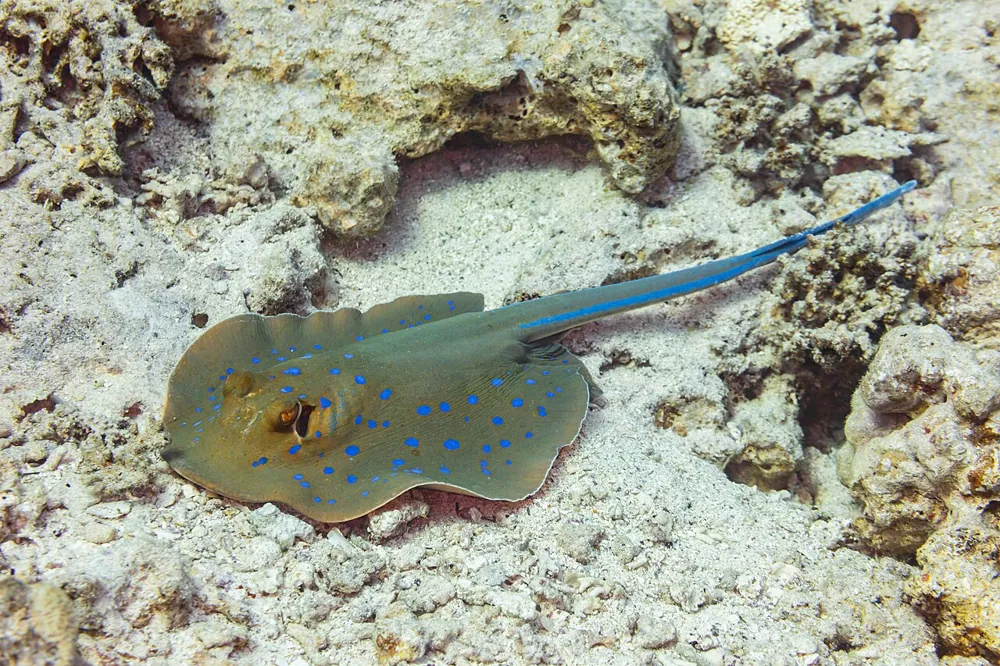
The bluespotted ribbontail ray is a small stingray with bright electric blue spots on its back. It lives on coral reefs and sandy flats across the tropical Indian and western Pacific Oceans. It can sting with its tail, but it is shy and usually flees when threatened.1



 Hogyan ismerd fel
- Numerous circular, neon blue spots on a yellowish brown or green back, with the spots smaller and denser towards the edge of the disc1
- Two stripes of the same blue running along the tail1
- Bright yellow eyes and a white belly1
- Oval, smooth-edged disc, with a thick tail about 1.5 times the length of the disc and one or two serrated spines near the base1
Méregerő
A méreg egy fullánkon keresztül jut ki.
Mit tesz a mérge?
Its tail carries one or two serrated spines that deliver venom when it stings. The sting can cause an excruciating wound.1
Mennyire veszélyes az emberre?
Veszély az emberre: SúlyosA csípéssel orvoshoz kell menni. Haláleset nagyon ritka.It is timid and harmless towards people unless provoked, and it prefers to flee. It is capable of injuring people with its venomous tail spines.1
Mit csinál, ha megijed?
When threatened, it flees at high speed in a zigzag pattern to throw off pursuers.1
 Ha csíp
- Tedd a sebet forró vízbe, olyan forróba, amilyet a sérült égési sérülés nélkül kibír (próbáld ki a saját kezeddel), 30-90 percig. Kérj orvosi segítséget, főleg kőhalnál és tüskésrájánál.
Mindig először a segélyhívó számot hívd (112, 000, 911). Ez általános elsősegély-tájékoztató, nem orvosi tanács. Elsősegély alapjai
 Maradj biztonságban
- Soha ne érints meg, ne fogj meg és ne bosszants vadállatot, még ha kicsi is, és még ha alszik vagy döglöttnek tűnik is.
- Hagyj neki helyet. Ha találkozol eggyel, maradj nyugodt, lassan lépj hátra, és hagyd, hogy menjen a maga útján.
- Ha megcsíp: maradj nyugodt, ne mozogj, hívd a segélyhívó számot (112, 000, 911), vagy juss el gyorsan kórházba. Jegyezd meg, hogyan nézett ki, egy fotó sokat segít.
Nem akar elkapni téged. A mérgét arra használja, hogy élelmet fogjon vagy megvédje magát, és sokkal szívesebben elbújik. Még több a biztonságról
Hol él a világban?
Mekkora?
Milyen hosszú?
Milyen nehéz?
 olyan hosszú, mint 1,5 házimacska orrtól farokig
 olyan hosszú, mint 4 banán egymás utánnagyjából olyan nehéz, mint egy házimacska
 11 másodperc alatt úszná át egy nagy uszoda hosszát (50 m)
Mekkora Bluespotted ribbontail ray hozzád képest?
Csak matek a böngésződben. Semmit nem mentünk és nem küldünk el sehova.
Milyen gyors?

Tények
It has been seen raising the edges of its disc and pelvic fins to attract cleaning by the bluestreak cleaner wrasse.1
Goatfish often follow foraging rays to catch food the ray misses.1
Most specimens struggle in home aquariums, and many stop feeding or die for no clear reason, so public aquariums have had more success keeping them.1
Unlike many other stingrays, it seldom buries itself in sand.1
Méregszakértőknek
- Tudományos név
- Taeniura lymma
- Csoport
- Mérges halak
- Család
- Dasyatidae2
- Rend
- Myliobatiformes
- Kontinensek
- Indiai-óceán, Csendes-óceán, Vörös-tenger, Korall-tenger, Arab-tenger és Perzsa-öböl, Timor-tenger és Arafura-tenger, Bengáli-öböl, Az óceánok
- Kicsinyek
- It gives birth to live young. Females bear litters of up to seven pups, each about 13–14 cm across, a miniature version of the adult.1
- Hogy áll a vadonban
- Least Concern (IUCN)1
- Veszély az emberre
- 3 / 5: Súlyos3
Honnan származnak a tények
- Bluespotted ribbontail ray (Wikipedia (CC BY-SA 4.0))
- Taeniura lymma (iNaturalist): nevek és rendszertan.
- Venom Wiki: a veszélyszint, a tipikus méret és a sebességbecslés a saját értékelésünk. Nézd meg, hogyan számoljuk ki: Hogyan értékeljük a veszélyt.
Ezen az oldalon minden tény mellett van egy szám, amely a forrására mutat. Ha valamit elrontottunk, bocsi, mi állatrajongók vagyunk, nem tudományos folyóirat. Írj nekünk ide: [email protected], és kijavítjuk.
 A skorpió éhes! A Venom Wiki egyszemélyes projekt: ingyenes, reklámok és nyomkövetés nélkül. Egy kis borravaló segít, hogy online maradjon.Etesd meg a skorpiót
Még több ugyanebből a csoportból: Mérges halak
 Reef stonefish
 Red lionfish
 Estuarine stonefish
 Short-tail stingray
 Striped eel catfish
 Common stingray
,_mar_Rojo,_Egipto,_2023-04-14,_DD_64.jpg)
Itt is él:: Indiai-óceán
 Ausztrál kockamedúzaMedúzák és tengeri csalánozókHalálosNe nyúlj hozzá
 Földrajzi kúpcsigaKúpcsigák és polipokHalálos
 Nagy kékgyűrűs polipKúpcsigák és polipokHalálos
 Déli kékgyűrűs polipKúpcsigák és polipokHalálos
 Hawksbill sea turtleMás mérgező állatokÖlni is tud
 Irukandji jellyfishMedúzák és tengeri csalánozókÖlni is tudNe nyúlj hozzá