
 Afrika
 Ázsia
Ázsia Európa
 Dél-Amerika
 Ausztrália és Óceánia
 Antarktisz
 Csendes-óceán
 Atlanti-óceán
 Indiai-óceán
 Északi-sarki-óceán
 Földközi-tenger
 Vörös-tenger
 Karib-tenger
 Korall-tenger
 Dél-kínai-tenger
 Fülöp-tenger
 Andamán-tenger
 Északi-tenger
 Timor-tenger és Arafura-tenger
 Bengáli-öböl
 Kaliforniai-öböl
Fu Manchu lionfish
 Mérges tüskék
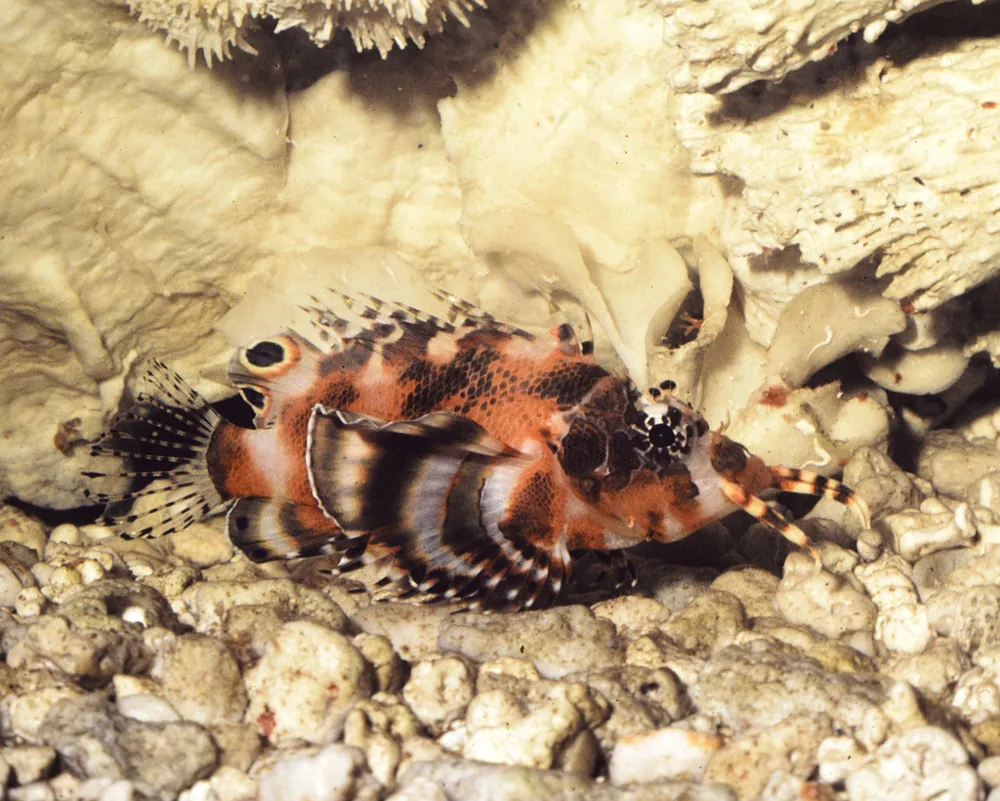
The Fu Manchu lionfish is a small, reddish-brown reef fish with two large dark spots on its back fin that look like eyes. It lives in warm, clear tropical seas across the Indo-West Pacific, mostly among coral. Its spines carry venom, so it is one to admire from a distance.1



 Hogyan ismerd fel
- Overall colour is reddish-brown.1
- Usually has 2, sometimes 3, large black eye-like spots on the soft-rayed part of the back fin.1
- Has 3 pink to yellowish bars across its flanks.1
- Pectoral (side) fins are banded with pale and brown.1
- Long tentacles on the upper jaw, more than twice the width of the eye.1
Méregerő
A méreg az éles tüskékben van. Ha rálépsz vagy megfogod, fáj.
Mit tesz a mérge?
The fin spines are venomous, so a puncture from one injects venom.1
Mennyire veszélyes az emberre?
Veszély az emberre: FájdalmasNagyon tud fájni, de szinte soha nem súlyos. Ha a tüskéi megszúrnak
- Tedd a sebet forró vízbe, olyan forróba, amilyet a sérült égési sérülés nélkül kibír (próbáld ki a saját kezeddel), 30-90 percig. Kérj orvosi segítséget, főleg kőhalnál és tüskésrájánál.
Mindig először a segélyhívó számot hívd (112, 000, 911). Ez általános elsősegély-tájékoztató, nem orvosi tanács. Elsősegély alapjai
 Maradj biztonságban
- Soha ne érints meg, ne fogj meg és ne bosszants vadállatot, még ha kicsi is, és még ha alszik vagy döglöttnek tűnik is.
- Hagyj neki helyet. Ha találkozol eggyel, maradj nyugodt, lassan lépj hátra, és hagyd, hogy menjen a maga útján.
- Ha a tüskéi megszúrnak: maradj nyugodt, ne mozogj, hívd a segélyhívó számot (112, 000, 911), vagy juss el gyorsan kórházba. Jegyezd meg, hogyan nézett ki, egy fotó sokat segít.
Nem akar elkapni téged. A mérgét arra használja, hogy élelmet fogjon vagy megvédje magát, és sokkal szívesebben elbújik. Még több a biztonságról
Hol él a világban?
Mekkora?
Milyen hosszú?
 olyan hosszú, mint 4 játék építőkocka egy sorban
 45 másodperc alatt úszná át egy nagy uszoda hosszát (50 m)
Mekkora Fu Manchu lionfish hozzád képest?
Csak matek a böngésződben. Semmit nem mentünk és nem küldünk el sehova.
Milyen gyors?
Tények
Before feeding, it snaps its back fin spines and shakes its head from side to side as it approaches prey. This may distract the prey or possibly attract it.1
It may also use the fleshy tentacles on its upper jaw to lure prey within striking distance.1
It moves towards prey by 'hopping' on its pelvic fins or by waving its tail fin, until it is about half its body length away.1
It appears occasionally in the aquarium trade, where it is moderately difficult to keep and not suited to beginners.1
Tévhitromboló
Tévhit: It belongs to the genus Dendrochirus.
Az igazság: Before 2023 it was classed in Dendrochirus, but it is now understood not to be particularly closely related to that genus.1
Honnan származnak a tények
- Nemapterois biocellatus (Wikipedia (CC BY-SA 4.0))
- Dendrochirus biocellatus (iNaturalist): nevek és rendszertan.
- Venom Wiki: a veszélyszint, a tipikus méret és a sebességbecslés a saját értékelésünk. Nézd meg, hogyan számoljuk ki: Hogyan értékeljük a veszélyt.
Ezen az oldalon minden tény mellett van egy szám, amely a forrására mutat. Ha valamit elrontottunk, bocsi, mi állatrajongók vagyunk, nem tudományos folyóirat. Írj nekünk ide: [email protected], és kijavítjuk.
 A skorpió éhes! A Venom Wiki egyszemélyes projekt: ingyenes, reklámok és nyomkövetés nélkül. Egy kis borravaló segít, hogy online maradjon.Etesd meg a skorpiót
Még több ugyanebből a csoportból: Mérges halak
 Reef stonefishMérges halakÖlni is tudNe nyúlj hozzá
 Red lionfishMérges halakOrvos kellNe nyúlj hozzá
 Estuarine stonefishMérges halakÖlni is tudNe nyúlj hozzá
 Short-tail stingrayMérges halakÖlni is tud
 Striped eel catfishMérges halakÖlni is tudNe nyúlj hozzá
 Bluespotted ribbontail rayMérges halakOrvos kell
 Ausztrál kockamedúza
 Földrajzi kúpcsiga
 Nagy kékgyűrűs polip
 Japán gömbhal
 Déli kékgyűrűs polip
 Hawksbill sea turtle