
 Afrika
 Asia
Asia Eropa
Eropa Amerika Selatan
 Australia dan Oseania
 Antarktika
 Samudra Pasifik
 Samudra Atlantik
 Samudra Hindia
 Samudra Arktik
 Laut Tengah
 Laut Merah
 Laut Karibia
 Laut Koral
 Laut Cina Selatan
 Laut Filipina
 Laut Andaman
 Laut Utara
 Laut Timor dan Laut Arafura
 Teluk Benggala
 Teluk California
Climbing mantella
 Racun di kulitnya
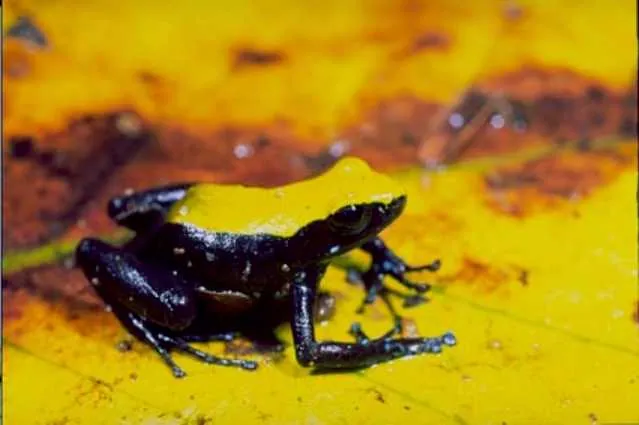
The climbing mantella is a small, brightly coloured frog that lives in the lowland rainforests of northeast Madagascar. It is a poison frog, so its skin holds chemicals that can harm predators. It is special because it is one of the few frogs whose parents care for their tadpoles by feeding them eggs.1



 Cara mengenalinya
- Adults are 24–30 mm long and weigh 1.2–2.0 g1
- Front of the back is bright yellow or pale green1
- Arms, legs, belly and rear are black, with blue spots on the limbs1
- Eyes are completely black1
- Has discs at the tips of its fingers and toes, and the toes are webbed1
Sering tertukar dengan: M. betsileo, M. viridis and M. expectata look similar but are differently coloured. They often have blue spots on the throat rather than the limbs, and they have a faint line along the upper lip, which the climbing mantella lacks.1
Kekuatan racun
Kulitnya beracun. Berbahaya untuk disentuh, dijilat, atau dimakan.
Apa efek racunnya?
This frog is poisonous rather than venomous. Its skin glands contain lipophilic alkaloids, the chemicals that make up its poison, which it gets from the arthropods it eats. Researchers have found 41 different potent alkaloids in its skin. Captive frogs lose their toxicity over time.1
Seberapa berbahaya bagi manusia?
Bahaya bagi manusia: RinganSeperti sengatan lebah atau lebih ringan. Pada dasarnya tidak berbahaya bagi manusia.Apa yang dilakukannya saat takut?
Its bright colours warn predators that its skin is toxic.1
 Jika seseorang menyentuh atau memakannya
- Jika seseorang menyentuhnya: cuci tangan sampai bersih dan jangan menyentuh mata atau mulut. Jika anak atau hewan peliharaan menjilat atau memakannya: hubungi pusat informasi keracunan atau nomor darurat.
Selalu hubungi nomor darurat dulu (112, 000, 911). Ini panduan pertolongan pertama umum, bukan nasihat medis. Dasar-dasar pertolongan pertama
 Tetap aman
- Jangan pernah menyentuh, menangkap, atau mengganggu hewan liar, walaupun kecil, dan walaupun tampak tidur atau mati.
- Beri ia ruang. Jika bertemu, tetap tenang, mundur perlahan, dan biarkan ia pergi.
- Jika kamu menyentuh atau memakannya: jangan mengucek mata atau mulut, cuci tangan, dan cari bantuan medis.
Ia tidak mengincarmu. Racunnya hanya ada supaya tidak ada yang memakannya. Lebih lanjut tentang tetap aman
Di mana di dunia?
Seberapa besar dia?
Seberapa panjang dia?
Seberapa berat dia?
 kira-kira sepanjang penjepit kertas
 sangat ringan sampai tidak terasa di tanganmu
 bisa menempuh 100 meter dalam 100 detik (manusia tercepat butuh 9,6)
Seberapa besar Climbing mantella dibandingkan KAMU?
Hanya hitungan di browsermu. Tidak ada yang disimpan atau dikirim ke mana pun.
Seberapa cepat dia?


Fakta
Its tadpoles eat only the eggs of their own species, and the parents feed them unfertilized eggs.1
Males defend territories of about 2 square metres and fight by wrestling, chasing and leaping, sometimes for over 1.5 hours.1
Female frogs choose a mate based on the quality of the male's well, not on his call.1
The climbing mantella is the only member of the Mantella genus that breeds in water-filled wells in trees, tree holes or broken bamboo stalks.1
Its chemical defence has developed in a similar way to that of the dart frogs of Dendrobatidae, although the two families are only distantly related.1
Untuk ahli bisa
- Nama ilmiah
- Mantella laevigata
- Kelompok
- Katak beracun, kodok, dan kadal air
- Keluarga
- Mantellidae2
- Urutan
- Anura
- Benua
- Afrika
- Anak
- Usually lays only one large egg, 3–3.5 mm across, at the side of a water-filled well or above the water line. The parents feed tadpoles unfertilized eggs.1
- Bagaimana keadaannya di alam liar
- Least Concern (IUCN Red List, 2016), though its population is suspected to be decreasing1
- Bahaya bagi manusia
- 1 / 5: Ringan3
Dari mana faktanya berasal
- Climbing mantella (Wikipedia (CC BY-SA 4.0))
- Mantella laevigata (iNaturalist): nama dan klasifikasi.
- Venom Wiki: tingkat bahaya, ukuran umum, dan perkiraan kecepatan adalah buatan kami. Lihat cara kami menghitungnya: Cara kami menilai bahaya.
Setiap fakta di halaman ini punya nomor yang menunjuk ke sumbernya. Kalau kami salah, maaf ya, kami penggemar hewan, bukan jurnal ilmiah. Beri tahu kami di [email protected] dan kami akan memperbaikinya.
 Kalajengkingnya lapar! Venom Wiki adalah proyek satu orang: gratis, tanpa iklan, dan tanpa pelacak. Tip kecil membantu menjaganya tetap online.Beri makan kalajengking
Lainnya dari kelompok yang sama: Katak beracun, kodok, dan kadal air
 Golden mantellaKatak beracun, kodok, dan kadal airTidak berbahaya
 Iberian ribbed newtKatak beracun, kodok, dan kadal airTidak berbahaya
 Tomato frogKatak beracun, kodok, dan kadal airTidak berbahaya
 African common toadKatak beracun, kodok, dan kadal airHanya sakitJangan sentuh
 Baron's mantellaKatak beracun, kodok, dan kadal airTidak berbahaya
 Blue-legged mantellaKatak beracun, kodok, dan kadal airTidak berbahaya
 Mamba hitam
 Kalajengking deathstalker
 Kobra Mesir
 Ular beludak puff
 Boomslang
 Fat-tailed scorpion