
 Afrika
 Asia
Asia Eropa
Eropa Amerika Selatan
 Australia dan Oseania
 Antarktika
 Samudra Pasifik
 Samudra Atlantik
 Samudra Hindia
 Samudra Arktik
 Laut Tengah
 Laut Merah
 Laut Karibia
 Laut Koral
 Laut Cina Selatan
 Laut Filipina
 Laut Andaman
 Laut Utara
 Laut Timor dan Laut Arafura
 Teluk Benggala
 Teluk California
Clinging jellyfish
 Tentakel penyengat
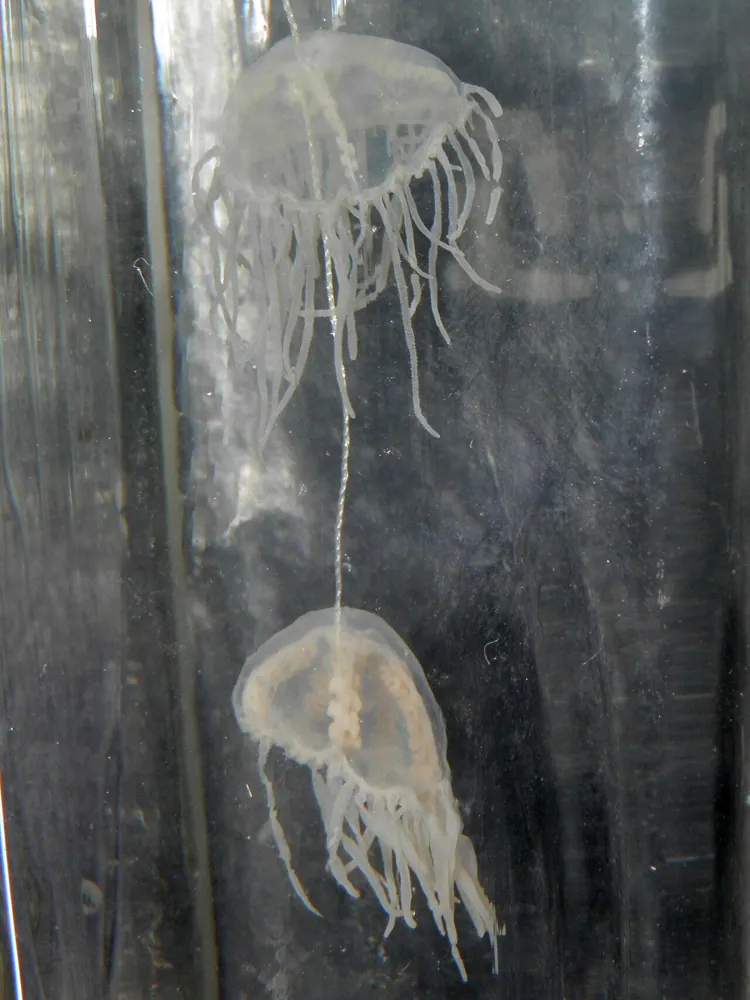
The clinging jellyfish is a small jellyfish, with a bell only 1 to 3 cm across. It lives in shallow coastal waters across much of the Northern Hemisphere. Its sting can be strong in some areas, so it is worth knowing what it looks like.1



 Cara mengenalinya
- Has a transparent bell lined with about 60 to 80 tentacles1
- Gonads are orange, red or violet in females and yellow-brown in males1
- The tan manubrium (mouth structure) hangs down in the middle of the bell1
- Bell is usually 1 to 3 cm across; a tentacle can be twice the bell's diameter when fully extended1
Kekuatan bisa
Ribuan sel penyengat mungil menembak saat sesuatu menyentuhnya.
Apa efek bisanya?
Its sting can cause pain, a swollen throat, chest tightness, muscle cramps, neuropsychiatric changes (effects on mood, thinking or behaviour) and anaphylactic shock, a severe allergic reaction.1
Seberapa berbahaya bagi manusia?
Bahaya bagi manusia: SeriusSengatan perlu ke dokter. Kematian sangat jarang.In much of its range the sting is strong enough to cause serious symptoms. Stinging incidents have been reported from East Asia, Europe and the Atlantic coast of the United States. Off North America's northeast Pacific coast, its sting cannot be felt and it is considered harmless to people.1
 Jika ia menyengat
- Keluar dari air dan ambil sisa tentakel yang menempel (pakai sarung tangan atau kain).
- Untuk ubur-ubur kotak tropis: siram sengatan dengan cuka minimal 30 detik, minta bantuan, dan bersiaplah melakukan CPR. Untuk ubur-ubur botol biru dan kebanyakan lainnya: bilas dengan air laut, lalu air panas untuk meredakan nyeri.
Selalu hubungi nomor darurat dulu (112, 000, 911). Ini panduan pertolongan pertama umum, bukan nasihat medis. Dasar-dasar pertolongan pertama
 Tetap aman
- Jangan pernah menyentuh, menangkap, atau mengganggu hewan liar, walaupun kecil, dan walaupun tampak tidur atau mati.
- Beri ia ruang. Jika bertemu, tetap tenang, mundur perlahan, dan biarkan ia pergi.
- Jika ia menyengatmu: tetap tenang, jangan bergerak, hubungi nomor darurat (112, 000, 911) atau segera ke rumah sakit. Ingat seperti apa rupanya, foto sangat membantu.
Ia tidak mengincarmu. Ia memakai bisanya untuk menangkap makanan atau melindungi diri, dan ia jauh lebih suka bersembunyi. Lebih lanjut tentang tetap aman
Di mana di dunia?
Seberapa besar dia?
Seberapa panjang dia?
 kira-kira sepanjang penjepit kertas
Seberapa besar Clinging jellyfish dibandingkan KAMU?
Hanya hitungan di browsermu. Tidak ada yang disimpan atau dikirim ke mana pun.
Seberapa cepat dia?


Fakta
Some scientists think the clinging jellyfish may be a group of closely related species, because its sting and body shape vary from place to place.1
The jellyfish appear once the water warms to about 17 to 18 °C, so they follow a yearly pattern and sometimes appear in large numbers at once.1
The medusa (jellyfish) stage usually lasts no more than three months, but the polyp stage can last for years.1
Polyps can split into several new polyps by budding.1
In Europe, the species is non-native and has been found in the Mediterranean and along the Atlantic coast from Portugal to Norway and Sweden.1
Pembongkar mitos
Mitos: The clinging jellyfish is harmless everywhere.
Faktanya: Its sting is harmless off the northeast Pacific coast of North America, but it can be strong and dangerous in East Asia, Europe and the Atlantic coast of the United States.1
Untuk ahli bisa
- Nama ilmiah
- Gonionemus vertens
- Kelompok
- Ubur-ubur dan penyengat laut
- Keluarga
- Olindiidae2
- Urutan
- Limnomedusae
- Benua
- Samudra Pasifik, Samudra Atlantik, Samudra
- Anak
- Medusae release tens of thousands of eggs and sperm into the sea. The fertilised young become planula larvae, which settle on the seabed as tiny polyps.1
- Bahaya bagi manusia
- 3 / 5: Serius3
Dari mana faktanya berasal
- Gonionemus vertens (Wikipedia (CC BY-SA 4.0))
- Gonionemus vertens (iNaturalist): nama dan klasifikasi.
- Venom Wiki: tingkat bahaya, ukuran umum, dan perkiraan kecepatan adalah buatan kami. Lihat cara kami menghitungnya: Cara kami menilai bahaya.
Setiap fakta di halaman ini punya nomor yang menunjuk ke sumbernya. Kalau kami salah, maaf ya, kami penggemar hewan, bukan jurnal ilmiah. Beri tahu kami di [email protected] dan kami akan memperbaikinya.
 Kalajengkingnya lapar! Venom Wiki adalah proyek satu orang: gratis, tanpa iklan, dan tanpa pelacak. Tip kecil membantu menjaganya tetap online.Beri makan kalajengking
Lainnya dari kelompok yang sama: Ubur-ubur dan penyengat laut
 Ubur-ubur kotak AustraliaUbur-ubur dan penyengat lautMematikanJangan sentuh
 Irukandji jellyfishUbur-ubur dan penyengat lautBisa membunuhJangan sentuh
 Portuguese man o' warUbur-ubur dan penyengat lautPerlu ke dokterJangan sentuh
 Lion's mane jellyfishUbur-ubur dan penyengat lautHanya sakitJangan sentuh
 Moon jellyfishUbur-ubur dan penyengat lautTidak berbahaya
 Common kingslayerUbur-ubur dan penyengat lautBisa membunuhJangan sentuh
Juga hidup di: Samudra Pasifik
 Siput kerucut geografiSiput kerucut dan guritaMematikan
 Gurita cincin biru besarSiput kerucut dan guritaMematikan
 Ikan buntal harimauHewan beracun lainnyaMematikan
 Gurita cincin biru selatanSiput kerucut dan guritaMematikan
 Hawksbill sea turtleHewan beracun lainnyaBisa membunuh
 Reef stonefishIkan berbisaBisa membunuhJangan sentuh