
 Afrika
 Asia
Asia Eropa
Eropa Amerika Selatan
 Australia dan Oseania
 Antarktika
 Samudra Pasifik
 Samudra Atlantik
 Samudra Hindia
 Samudra Arktik
 Laut Tengah
 Laut Merah
 Laut Karibia
 Laut Koral
 Laut Cina Selatan
 Laut Filipina
 Laut Andaman
 Laut Utara
 Laut Timor dan Laut Arafura
 Teluk Benggala
 Teluk California
Katipo
 Gigitan
The katipō is a cobweb spider found only in New Zealand, where it lives in coastal sand dunes. It is closely related to the Australian redback spider. Its bite is venomous to people, but bites are rare.1

 Cara mengenalinya
- Adult females have a body length of 8–10 mm (about 0.3–0.4 in).1
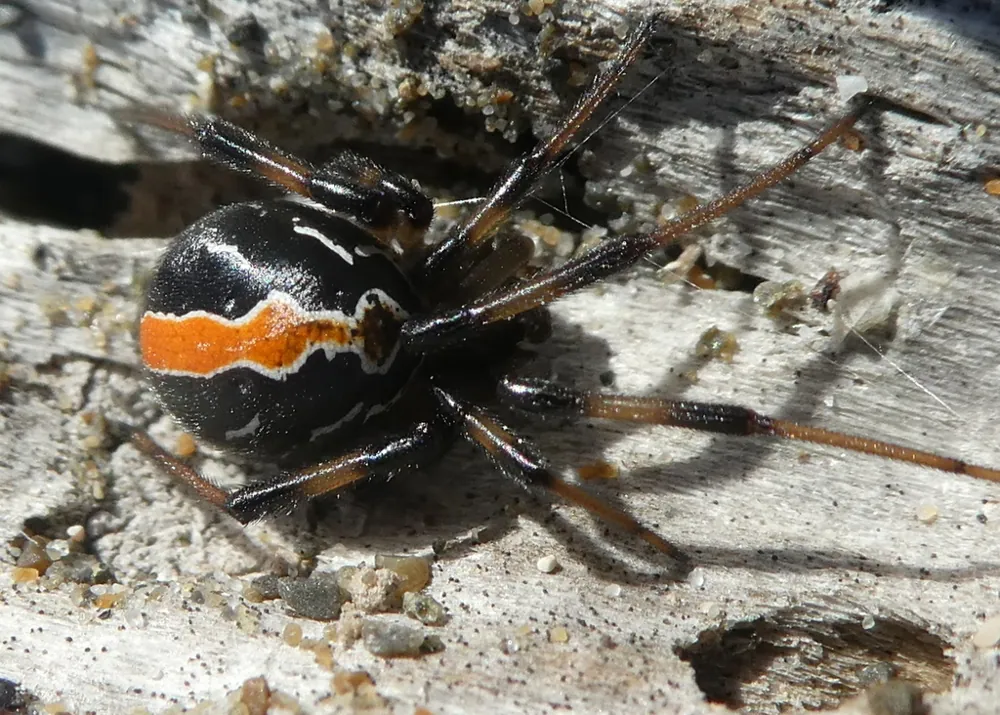
- The red katipō, found in the South Island and lower North Island, has a large black, shiny abdomen with a white-bordered orange or red stripe on top, and a red hourglass-shaped marking underneath.1
- The black katipō, found in the upper North Island, has no upper red or orange stripe and is somewhat lighter in colour.1
- Males are 4–5 mm long, white with black stripes and red hourglass-shaped markings.1
Sering tertukar dengan: Steatoda species, which share the same habitat, are very similar and are called "false katipō" in New Zealand. The katipō has a less shiny, more tapered abdomen, and its side eyes are further apart. It is also similar to the redback, but the katipō has only short hair-like spines on its abdomen, while the redback has a mix of long and short ones.1
Kekuatan bisa
Bisanya keluar lewat taring atau gigi saat menggigit.
Apa efek bisanya?
The bite can cause latrodectism, a toxic syndrome that affects the nerves and body. Symptoms include extreme pain and, potentially, high blood pressure (hypertension) or seizures.1
Seberapa berbahaya bagi manusia?
Bahaya bagi manusia: SeriusGigitan perlu ke dokter. Kematian sangat jarang.Katipō are venomous to humans, but bites are described as rare. Serious symptoms are possible, including extreme pain, high blood pressure and seizures.1
 Kabar baik: dokter punya obat (antibisa) atau pengobatan untuk ini.1
 Jika ia menggigit
- Cuci gigitan dan kompres dengan es untuk meredakan nyeri. Cari bantuan medis jika nyerinya kuat, menyebar, atau orangnya merasa tidak enak badan.
Selalu hubungi nomor darurat dulu (112, 000, 911). Ini panduan pertolongan pertama umum, bukan nasihat medis. Dasar-dasar pertolongan pertama
 Tetap aman
- Jangan pernah menyentuh, menangkap, atau mengganggu hewan liar, walaupun kecil, dan walaupun tampak tidur atau mati.
- Beri ia ruang. Jika bertemu, tetap tenang, mundur perlahan, dan biarkan ia pergi.
- Jika ia menggigitmu: tetap tenang, jangan bergerak, hubungi nomor darurat (112, 000, 911) atau segera ke rumah sakit. Ingat seperti apa rupanya, foto sangat membantu.
Ia tidak mengincarmu. Ia memakai bisanya untuk menangkap makanan atau melindungi diri, dan ia jauh lebih suka bersembunyi. Lebih lanjut tentang tetap aman
Di mana di dunia?
Seberapa besar dia?
Seberapa panjang dia?
 cukup kecil untuk duduk di kukumu
Seberapa besar Katipo dibandingkan KAMU?
Hanya hitungan di browsermu. Tidak ada yang disimpan atau dikirim ke mana pun.
Seberapa cepat dia?


Fakta
In one 24-hour study of young spiders, 28% left the web by ballooning, carried by air currents.1
Katipō is one of the few Māori words that refers to a specific species of spider.1
The female does not usually eat the male after mating, unlike some other widow spiders.1
Females cover their egg sacs with silk and sand, which partly hides them in the web.1
The katipō is found only in New Zealand.1
Pembongkar mitos
Mitos: The katipō is just a form of the redback spider.
Faktanya: The katipō is genetically and physically distinct from the redback, even though the two are closely related. It was once thought to be a subspecies of the redback.1
Untuk ahli bisa
- Nama ilmiah
- Latrodectus katipo
- Kelompok
- Laba-laba
- Keluarga
- Theridiidae2
- Urutan
- Araneae
- Benua
- Australia dan Oseania
- Anak
- The female lays five or six egg sacs in November or December, with about 70 to 90 eggs in each. The young hatch after 20–25 days and leave the egg sac in January and February.1
- Bagaimana keadaannya di alam liar
- In serious decline (New Zealand Threat Classification System)1
- Bahaya bagi manusia
- 3 / 5: Serius3
Dari mana faktanya berasal
- Katipō (Wikipedia (CC BY-SA 4.0))
- Latrodectus katipo (iNaturalist): nama dan klasifikasi.
- Venom Wiki: tingkat bahaya, ukuran umum, dan perkiraan kecepatan adalah buatan kami. Lihat cara kami menghitungnya: Cara kami menilai bahaya.
Setiap fakta di halaman ini punya nomor yang menunjuk ke sumbernya. Kalau kami salah, maaf ya, kami penggemar hewan, bukan jurnal ilmiah. Beri tahu kami di [email protected] dan kami akan memperbaikinya.
 Kalajengkingnya lapar! Venom Wiki adalah proyek satu orang: gratis, tanpa iklan, dan tanpa pelacak. Tip kecil membantu menjaganya tetap online.Beri makan kalajengking
 Redback spider
 White-tailed spider
 Peacock spider
 Badge huntsman spider
 Black house spider
 Eastern white-tailed spider
 Coastal taipan
 Common death adder
 Eastern brown snake
 Taipan pedalaman
 Sydney funnel-web spider
 Ular harimau