
 Africa
 Asia
Asia Europa
 Sud America
 Australia e Oceania
 Antartide
 Oceano Pacifico
 Oceano Atlantico
 Oceano Indiano
 Oceano Artico
 Mar Mediterraneo
 Mar Rosso
 Mar dei Caraibi
 Mar dei Coralli
 Mar Cinese Meridionale
 Mar delle Filippine
 Mare delle Andamane
 Mare del Nord
 Mar di Timor e Mar degli Arafura
 Golfo del Bengala
 Golfo di California
African crested rat
 Tossine nella pelle
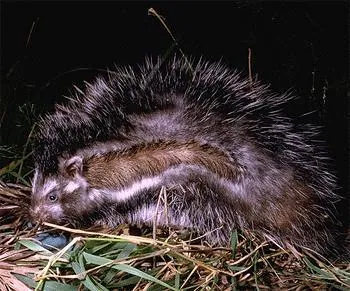
The African crested rat is a large, nocturnal rodent with long hair and a bushy tail. It looks a little like a porcupine. It lives in East Africa, where it is the world's only known poisonous rodent, coating itself in plant toxins to keep predators away.1



 Come riconoscerlo
- Large, nocturnal rodent with long, silver and black-tipped guard hairs over a woolly grey and white undercoat1
- A mane of longer black-and-white banded hairs runs from the top of the head to just beyond the base of the tail1
- A broad, white-bordered strip of glandular skin sits beside the mane, and it becomes visible when the animal is threatened1
- Bushy tail and short black fur on the face and limbs1
- Superficially resembles a porcupine1
Potere tossico
La sua pelle è tossica. È pericoloso toccarlo, leccarlo o mangiarlo.
Cosa fanno le sue tossine?
This animal is poisonous rather than venomous, so it does not bite or sting to inject poison. It smears poison from the bark of the poison arrow tree onto the hairs of its glandular skin patch. A predator that bites it can be sickened or even killed by this poison.1
Quanto è pericoloso per le persone?
Pericolo per le persone: GraveSe qualcuno lo tocca o lo mangia, serve un medico. Le morti sono molto rare.Its poison is a risk to predators that try to bite it. The rat itself is not harmed by the toxins it stores.1
Cosa fa quando ha paura?
When threatened or excited, the mane stands up and the glandular strip parts, exposing the skin that carries the poison.1
 Se qualcuno l'ha toccato o mangiato
- Se qualcuno l'ha mangiato o ha sintomi dopo averlo mangiato: chiama subito il numero di emergenza o il centro antiveleni.
Chiama sempre prima il numero di emergenza (112, 000, 911). Queste sono indicazioni generali di primo soccorso, non consigli medici. Primo soccorso di base
 Stai al sicuro
- Non toccare, catturare o stuzzicare mai un animale selvatico, anche se è piccolo e anche se sembra addormentato o morto.
- Lasciagli spazio. Se ne incontri uno, resta calmo, indietreggia piano e lascialo andare per la sua strada.
- Se l'hai toccato o mangiato: non strofinarti gli occhi o la bocca, lavati le mani e cerca aiuto medico.
Non ce l'ha con te. Le sue tossine servono solo perché nessuno lo mangi. Altro su come stare al sicuro
Dove nel mondo?
Quanto è grande?
Quanto è lungo?
Quanto pesa?

 lungo come 10 mattoncini da costruzione in fila
 potrebbe percorrere 100 metri in 72 secondi (l'uomo più veloce ci mette 9,6)
Quanto è grande African crested rat rispetto a TE?
Solo calcoli nel tuo browser. Niente viene salvato o inviato da nessuna parte.
Quanto è veloce?


Informazioni
It is the world's only known poisonous rodent.1
It is the only rodent known to use and store toxins from a different species in nature to protect itself, and it suffers no known harm from them.1
Its stomach has five anatomically distinct sections, a feature found in very few rodents.1
The skull is covered with small bony projections that give it a pebbled look.1
Its large size may allow microbes in its foregut to break down cellulose from plants by fermentation.1
Sfatiamo i miti
Mito: The maned rat was believed to be solitary.
Verità: It is now known to be somewhat sociable. Several animals are found in the same territory, and they purr and groom one another, so they may form family groups of a male, a female and their young.1
Per gli esperti di veleni
- Nome scientifico
- Lophiomys imhausi
- Gruppo
- Altri animali tossici
- Famiglia
- Muridae2
- Ordine
- Rodentia
- Continenti
- Africa
- Cuccioli
- Litters have 1 to 3 young. The young are slightly haired at birth, their eyes open by day 13, and they are weaned by day 40.1
- Come se la passa in natura
- Least Concern1
- Pericolo per le persone
- 3 / 5: Grave3
Da dove vengono le informazioni
- Maned rat (Wikipedia (CC BY-SA 4.0))
- Lophiomys imhausi (iNaturalist): nomi e classificazione.
- Venom Wiki: il livello di pericolo, la taglia tipica e la stima della velocità sono nostri. Guarda come li calcoliamo: Come valutiamo il pericolo.
Ogni informazione in questa pagina ha un numero che rimanda alla sua fonte. Se abbiamo sbagliato qualcosa, scusa, siamo appassionati di animali, non una rivista scientifica. Scrivici a [email protected] e lo correggeremo.
 Lo scorpione ha fame! Venom Wiki è un progetto di una sola persona: gratis, senza pubblicità e senza tracker. Una piccola mancia aiuta a tenerlo online.Dai da mangiare allo scorpione
Altri dello stesso gruppo: Altri animali tossici
 Common quailAltri animali tossiciFa solo male
 Spur-winged gooseAltri animali tossiciFa solo male
 Fahaka pufferfishAltri animali tossiciPuò uccidere
 Red-striped oil beetleAltri animali tossiciFa solo maleNon toccare
 Pesce palla giapponeseAltri animali tossiciMortale
 Hawksbill sea turtleAltri animali tossiciPuò uccidere
 Mamba nero
 Scorpione giallo palestinese
 Cobra egiziano
 Vipera soffiante
 Boomslang
 Fat-tailed scorpion