
 Africa
 Asia
Asia Europa
 Sud America
 Australia e Oceania
 Antartide
 Oceano Pacifico
 Oceano Atlantico
 Oceano Indiano
 Oceano Artico
 Mar Mediterraneo
 Mar Rosso
 Mar dei Caraibi
 Mar dei Coralli
 Mar Cinese Meridionale
 Mar delle Filippine
 Mare delle Andamane
 Mare del Nord
 Mar di Timor e Mar degli Arafura
 Golfo del Bengala
 Golfo di California
Bat ray
 Punture
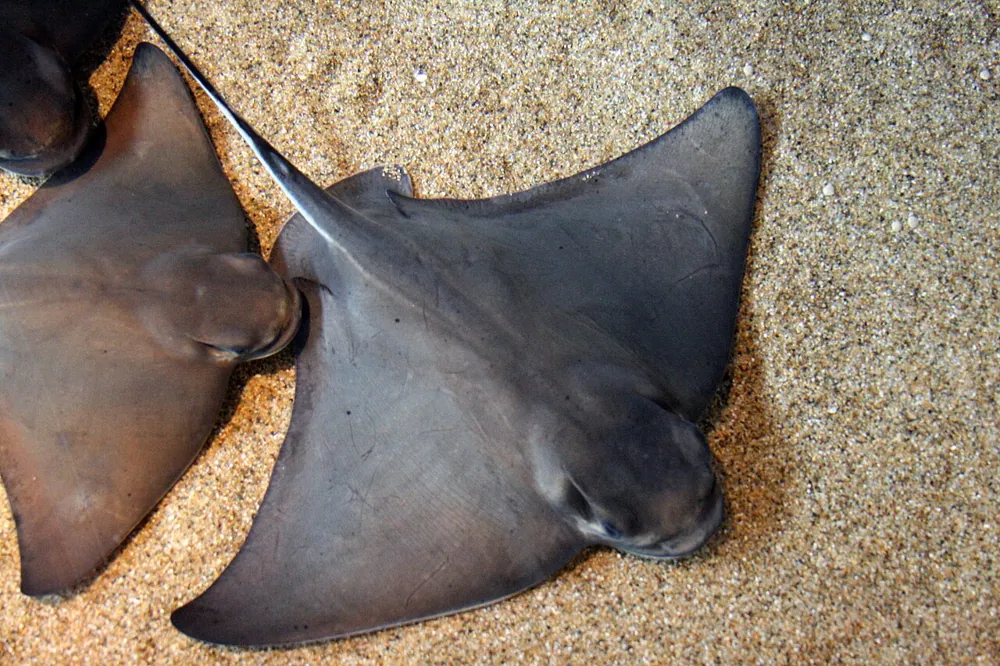
The bat ray is a flat, diamond-shaped fish related to sharks, with wing-like fins that it flaps to swim. It lives in shallow coastal waters from central Oregon in the USA down to the Gulf of California in Mexico, and around the Galápagos Islands. It has a venomous spine near the base of its tail, but it uses it only when it feels threatened.1
 Come riconoscerlo
- Diamond-shaped body, with wing-like pectoral fins that end in blunt points1
- Broad head raised higher than the fins, with eyes set on the sides of the head1
- Dark back, black or dark brown, with a white underside1
- Whip-like tail with at least one venomous spine at its base1
- Usually two small cephalic horns (projections from the front of the head) used for pushing food into the mouth1
Potere del veleno
Il veleno esce da un pungiglione.
Quanto è pericoloso per le persone?
Pericolo per le persone: DolorosoPuò fare davvero male, ma non è quasi mai grave.The bat ray is not considered dangerous to people. It uses its venomous tail spine only when it is attacked or frightened.1
Cosa fa quando ha paura?
The bat ray camouflages itself in the sand and uses its tail spine only when attacked or frightened.1
 Se punge
- Metti la ferita in acqua calda, calda quanto la persona riesce a sopportare senza scottarsi (provala con la tua mano), da 30 a 90 minuti. Cerca aiuto medico, soprattutto per pesci pietra e pastinache.
Chiama sempre prima il numero di emergenza (112, 000, 911). Queste sono indicazioni generali di primo soccorso, non consigli medici. Primo soccorso di base
 Stai al sicuro
- Non toccare, catturare o stuzzicare mai un animale selvatico, anche se è piccolo e anche se sembra addormentato o morto.
- Lasciagli spazio. Se ne incontri uno, resta calmo, indietreggia piano e lascialo andare per la sua strada.
- Se uno ti punge: resta calmo, stai fermo, chiama il numero di emergenza (112, 000, 911) o vai subito in ospedale. Ricorda com'era, una foto aiuta.
Non ce l'ha con te. Usa il veleno per procurarsi il cibo o per difendersi, e preferisce di gran lunga nascondersi. Altro su come stare al sicuro
Dove nel mondo?
Quanto è grande?
Quanto è lungo?
Quanto pesa?

 lungo come 4 gatti di casa dal naso alla coda
 lungo come 10 banane in fila
 potrebbe nuotare per tutta la lunghezza di una grande piscina (50 m) in 8,2 secondi
Quanto è grande Bat ray rispetto a TE?
Solo calcoli nel tuo browser. Niente viene salvato o inviato da nessuna parte.
Quanto è veloce?


Informazioni
Bat rays dig pits in the seabed that can be up to 4 m long, and small fish gather to eat the creatures the rays expose.1
The bat ray's young are born with the spine's sheath, which falls off within hours of birth.1
Bat rays can grow to a wingspan of 1.8 m, and the largest individuals weigh about 91 kg.1
Some bat rays live alone, while others form schools of thousands.1
Bat rays have teeth that are replaced continuously, as is the case with all elasmobranchs (sharks, rays and their relatives).1
Sfatiamo i miti
Mito: Bat rays are dangerous to people because of their venomous spine.
Verità: Bat rays are not considered dangerous. They use the spine only when attacked or frightened, and people can avoid it by shuffling their feet when walking through shallow sand.1
Per gli esperti di veleni
- Nome scientifico
- Myliobatis californica
- Gruppo
- Pesci velenosi
- Famiglia
- Myliobatidae2
- Ordine
- Myliobatiformes
- Continenti
- Oceano Pacifico, Golfo di California, Gli oceani
- Cuccioli
- Bat rays are ovoviviparous, so the eggs hatch inside the mother and the young are born live. A litter has two to ten pups, which are born tail first with their fins wrapped around their bodies.1
- Durata della vita
- circa 23 anni1
- Come se la passa in natura
- Least Concern1
- Pericolo per le persone
- 2 / 5: Doloroso3
Da dove vengono le informazioni
- Bat ray (Wikipedia (CC BY-SA 4.0))
- Myliobatis californica (iNaturalist): nomi e classificazione.
- Venom Wiki: il livello di pericolo, la taglia tipica e la stima della velocità sono nostri. Guarda come li calcoliamo: Come valutiamo il pericolo.
Ogni informazione in questa pagina ha un numero che rimanda alla sua fonte. Se abbiamo sbagliato qualcosa, scusa, siamo appassionati di animali, non una rivista scientifica. Scrivici a [email protected] e lo correggeremo.
 Lo scorpione ha fame! Venom Wiki è un progetto di una sola persona: gratis, senza pubblicità e senza tracker. Una piccola mancia aiuta a tenerlo online.Dai da mangiare allo scorpione
Altri dello stesso gruppo: Pesci velenosi
 Reef stonefishPesci velenosiPuò uccidereNon toccare
 Red lionfishPesci velenosiServe un medicoNon toccare
 Estuarine stonefishPesci velenosiPuò uccidereNon toccare
 Short-tail stingrayPesci velenosiPuò uccidere
 Striped eel catfishPesci velenosiPuò uccidereNon toccare
 Bluespotted ribbontail rayPesci velenosiServe un medico
Vive anche in: Oceano Pacifico
 Australian box jellyfishMeduse e altri urticanti mariniMortaleNon toccare
 Geography coneMolluschi cono e polpiMortale
 Greater blue-ringed octopusMolluschi cono e polpiMortale
 Japanese pufferfishAltri animali tossiciMortale
 Southern blue-ringed octopusMolluschi cono e polpiMortale
 Hawksbill sea turtleAltri animali tossiciPuò uccidere