
 Africa
 Asia
Asia Europa
 Sud America
 Australia e Oceania
 Antartide
 Oceano Pacifico
 Oceano Atlantico
 Oceano Indiano
 Oceano Artico
 Mar Mediterraneo
 Mar Rosso
 Mar dei Caraibi
 Mar dei Coralli
 Mar Cinese Meridionale
 Mar delle Filippine
 Mare delle Andamane
 Mare del Nord
 Mar di Timor e Mar degli Arafura
 Golfo del Bengala
 Golfo di California
Climbing mantella
 Tossine nella pelle
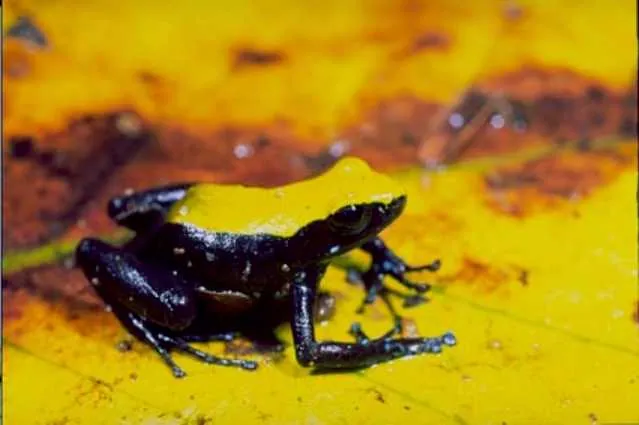
The climbing mantella is a small, brightly coloured frog that lives in the lowland rainforests of northeast Madagascar. It is a poison frog, so its skin holds chemicals that can harm predators. It is special because it is one of the few frogs whose parents care for their tadpoles by feeding them eggs.1



 Come riconoscerlo
- Adults are 24–30 mm long and weigh 1.2–2.0 g1
- Front of the back is bright yellow or pale green1
- Arms, legs, belly and rear are black, with blue spots on the limbs1
- Eyes are completely black1
- Has discs at the tips of its fingers and toes, and the toes are webbed1
Spesso confuso con: M. betsileo, M. viridis and M. expectata look similar but are differently coloured. They often have blue spots on the throat rather than the limbs, and they have a faint line along the upper lip, which the climbing mantella lacks.1
Potere tossico
La sua pelle è tossica. È pericoloso toccarlo, leccarlo o mangiarlo.
Cosa fanno le sue tossine?
This frog is poisonous rather than venomous. Its skin glands contain lipophilic alkaloids, the chemicals that make up its poison, which it gets from the arthropods it eats. Researchers have found 41 different potent alkaloids in its skin. Captive frogs lose their toxicity over time.1
Quanto è pericoloso per le persone?
Pericolo per le persone: LieveCome una puntura d'ape o meno. In pratica innocuo per le persone.Cosa fa quando ha paura?
Its bright colours warn predators that its skin is toxic.1
 Se qualcuno l'ha toccato o mangiato
- Se qualcuno ne ha toccato uno: lava bene le mani e non toccare occhi o bocca. Se un bambino o un animale domestico ne ha leccato o mangiato uno: chiama il centro antiveleni o il numero di emergenza.
Chiama sempre prima il numero di emergenza (112, 000, 911). Queste sono indicazioni generali di primo soccorso, non consigli medici. Primo soccorso di base
 Stai al sicuro
- Non toccare, catturare o stuzzicare mai un animale selvatico, anche se è piccolo e anche se sembra addormentato o morto.
- Lasciagli spazio. Se ne incontri uno, resta calmo, indietreggia piano e lascialo andare per la sua strada.
- Se l'hai toccato o mangiato: non strofinarti gli occhi o la bocca, lavati le mani e cerca aiuto medico.
Non ce l'ha con te. Le sue tossine servono solo perché nessuno lo mangi. Altro su come stare al sicuro
Dove nel mondo?
Quanto è grande?
Quanto è lungo?
Quanto pesa?
 lungo più o meno come una graffetta
 così leggero che non lo sentiresti sulla mano
 potrebbe percorrere 100 metri in 100 secondi (l'uomo più veloce ci mette 9,6)
Quanto è grande Climbing mantella rispetto a TE?
Solo calcoli nel tuo browser. Niente viene salvato o inviato da nessuna parte.
Quanto è veloce?


Informazioni
Its tadpoles eat only the eggs of their own species, and the parents feed them unfertilized eggs.1
Males defend territories of about 2 square metres and fight by wrestling, chasing and leaping, sometimes for over 1.5 hours.1
Female frogs choose a mate based on the quality of the male's well, not on his call.1
The climbing mantella is the only member of the Mantella genus that breeds in water-filled wells in trees, tree holes or broken bamboo stalks.1
Its chemical defence has developed in a similar way to that of the dart frogs of Dendrobatidae, although the two families are only distantly related.1
Per gli esperti di veleni
- Nome scientifico
- Mantella laevigata
- Gruppo
- Rane dardo, rospi e tritoni
- Famiglia
- Mantellidae2
- Ordine
- Anura
- Continenti
- Africa
- Cuccioli
- Usually lays only one large egg, 3–3.5 mm across, at the side of a water-filled well or above the water line. The parents feed tadpoles unfertilized eggs.1
- Come se la passa in natura
- Least Concern (IUCN Red List, 2016), though its population is suspected to be decreasing1
- Pericolo per le persone
- 1 / 5: Lieve3
Da dove vengono le informazioni
- Climbing mantella (Wikipedia (CC BY-SA 4.0))
- Mantella laevigata (iNaturalist): nomi e classificazione.
- Venom Wiki: il livello di pericolo, la taglia tipica e la stima della velocità sono nostri. Guarda come li calcoliamo: Come valutiamo il pericolo.
Ogni informazione in questa pagina ha un numero che rimanda alla sua fonte. Se abbiamo sbagliato qualcosa, scusa, siamo appassionati di animali, non una rivista scientifica. Scrivici a [email protected] e lo correggeremo.
 Lo scorpione ha fame! Venom Wiki è un progetto di una sola persona: gratis, senza pubblicità e senza tracker. Una piccola mancia aiuta a tenerlo online.Dai da mangiare allo scorpione
Altri dello stesso gruppo: Rane dardo, rospi e tritoni
 Golden mantellaRane dardo, rospi e tritoniInnocuo
 Iberian ribbed newtRane dardo, rospi e tritoniInnocuo
 Tomato frogRane dardo, rospi e tritoniInnocuo
 African common toadRane dardo, rospi e tritoniFa solo maleNon toccare
 Baron's mantellaRane dardo, rospi e tritoniInnocuo
 Blue-legged mantellaRane dardo, rospi e tritoniInnocuo
 Mamba nero
 Scorpione giallo palestinese
 Cobra egiziano
 Vipera soffiante
 Boomslang
 Fat-tailed scorpion