
 Africa
 Asia
Asia Europa
 Sud America
 Australia e Oceania
 Antartide
 Oceano Pacifico
 Oceano Atlantico
 Oceano Indiano
 Oceano Artico
 Mar Mediterraneo
 Mar Rosso
 Mar dei Caraibi
 Mar dei Coralli
 Mar Cinese Meridionale
 Mar delle Filippine
 Mare delle Andamane
 Mare del Nord
 Mar di Timor e Mar degli Arafura
 Golfo del Bengala
 Golfo di California
Daddy long-legs spider
 Morsi
MorsiThe daddy long-legs spider is a small spider with very long, thin legs. It lives indoors in quiet, dim corners of homes, cellars and garages, and it is found in most temperate countries on every continent. It is valued because it hunts other spiders, including the dangerous redback spider.1


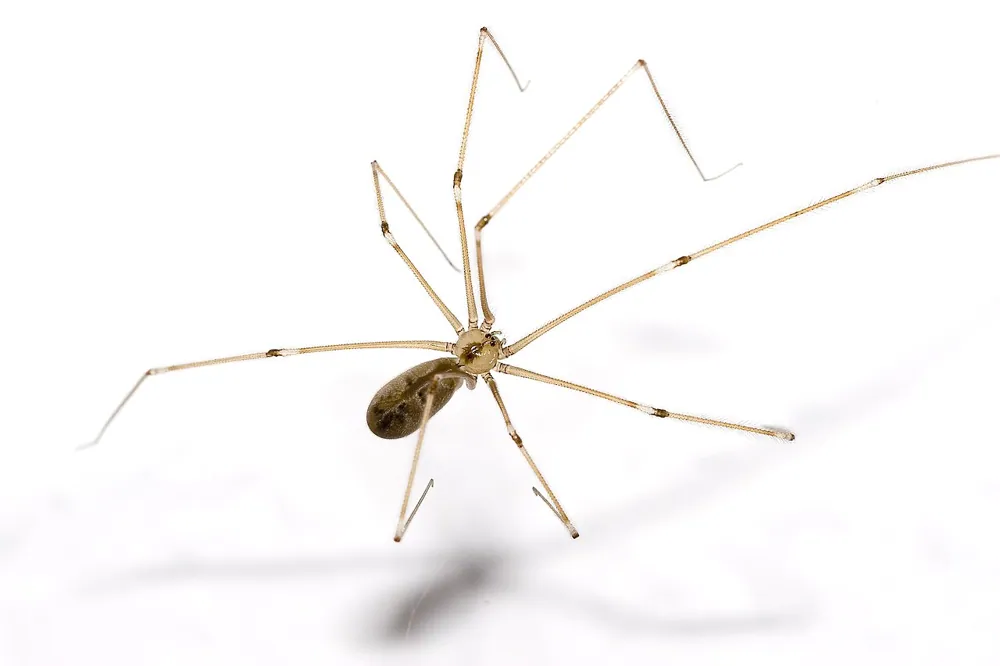
 Come riconoscerlo
- Small body, about 6 to 10 mm long in males and 7 to 8 mm on average in females, not counting the legs.1
- Eight very long, thin legs covered in fine grey bristles. The legs are about 5 to 6 times the length of the body.1
- Translucent grey or pale brown body, with a dark spot on the back of the front body part and dark, blurred spots on the top of the rear body part.1
- Eight eyes: a pair of small dark eyes at the front, followed by three rows of pairs of larger eyes.1
- Loose, horizontal webs with many irregularities, often tangled with the webs of other spiders.1
Spesso confuso con: It is often called 'daddy long-legs', a name also used for crane flies and harvestmen. Crane flies are insects, and harvestmen belong to a different group of arachnids (the order Opiliones), so they are not spiders.1
Potere del veleno
Il veleno esce dalle zanne o dai denti quando morde.
Cosa fa il suo veleno?
Its venom is used to subdue prey, and it can bite. According to researchers, its venom has negligible effects on humans and other mammals. A bite causes a mild stinging sensation with no long-term health effects.1
Quanto è pericoloso per le persone?
Pericolo per le persone: LieveCome una puntura d'ape o meno. In pratica innocuo per le persone.It is considered harmless to humans. Bites are hardly ever reported, and a bite causes only mild stinging.1
Cosa fa quando ha paura?
When it senses danger, it swings its body round in a circle repeatedly while its legs stay fixed on the web, a movement called whirling.1
 Se morde
- Lava il morso e mettici una borsa del ghiaccio per il dolore. Cerca aiuto medico se il dolore è forte, si diffonde o la persona si sente male.
Chiama sempre prima il numero di emergenza (112, 000, 911). Queste sono indicazioni generali di primo soccorso, non consigli medici. Primo soccorso di base
 Stai al sicuro
- Non toccare, catturare o stuzzicare mai un animale selvatico, anche se è piccolo e anche se sembra addormentato o morto.
- Lasciagli spazio. Se ne incontri uno, resta calmo, indietreggia piano e lascialo andare per la sua strada.
- Se uno ti morde: resta calmo, stai fermo, chiama il numero di emergenza (112, 000, 911) o vai subito in ospedale. Ricorda com'era, una foto aiuta.
Non ce l'ha con te. Usa il veleno per procurarsi il cibo o per difendersi, e preferisce di gran lunga nascondersi. Altro su come stare al sicuro
Dove nel mondo?
Quanto è grande?
Quanto è lungo?
 lungo come 2 mattoncini da costruzione in fila
 potrebbe percorrere 100 metri in 280 secondi (l'uomo più veloce ci mette 9,6)
Quanto è grande Daddy long-legs spider rispetto a TE?
Solo calcoli nel tuo browser. Niente viene salvato o inviato da nessuna parte.
Quanto è veloce?


Informazioni
It hunts redback spiders, which are among the most venomous spiders in the world.1
It fakes the vibrations of a trapped insect in its web, then waits on its long legs until the prey touches one of them before attacking.1
Its whirling defence can last several hours or even days when it is threatened by jumping spiders.1
Its silk has been reported to have potential medicinal uses.1
Sfatiamo i miti
Mito: Daddy long-legs spiders cannot bite humans because their fangs cannot get through human skin.
Verità: Their fangs are about 0.25 mm long, and human skin is about 0.1 mm thick, so they can bite. Bites are very rarely reported, and they cause only mild stinging.1
Da dove vengono le informazioni
- Pholcus phalangioides (Wikipedia (CC BY-SA 4.0))
- Pholcus phalangioides (iNaturalist): nomi e classificazione.
- Venom Wiki: il livello di pericolo, la taglia tipica e la stima della velocità sono nostri. Guarda come li calcoliamo: Come valutiamo il pericolo.
Ogni informazione in questa pagina ha un numero che rimanda alla sua fonte. Se abbiamo sbagliato qualcosa, scusa, siamo appassionati di animali, non una rivista scientifica. Scrivici a [email protected] e lo correggeremo.
 Lo scorpione ha fame! Venom Wiki è un progetto di una sola persona: gratis, senza pubblicità e senza tracker. Una piccola mancia aiuta a tenerlo online.Dai da mangiare allo scorpione
Altri dello stesso gruppo: Ragni
 Mediterranean black widow
 Diving bell spider
 European yellow sac spider
 Noble false widow
 Tarantula wolf spider
 European garden spider
Vive anche in: Europa
 Common European adderVipere e marassiServe un medico
 Spanish flyAltri animali tossiciServe un medicoNon toccare
 Common waspApi, vespe e calabroniFa solo male
 European hornetApi, vespe e calabroniFa solo male
 Fire salamanderRane dardo, rospi e tritoniFa solo maleNon toccare
 Western honey beeApi, vespe e calabroniFa solo male