
 Africa
 Asia
Asia Europa
 Sud America
 Australia e Oceania
 Antartide
 Oceano Pacifico
 Oceano Atlantico
 Oceano Indiano
 Oceano Artico
 Mar Mediterraneo
 Mar Rosso
 Mar dei Caraibi
 Mar dei Coralli
 Mar Cinese Meridionale
 Mar delle Filippine
 Mare delle Andamane
 Mare del Nord
 Mar di Timor e Mar degli Arafura
 Golfo del Bengala
 Golfo di California
Eastern copperhead
 Morsi
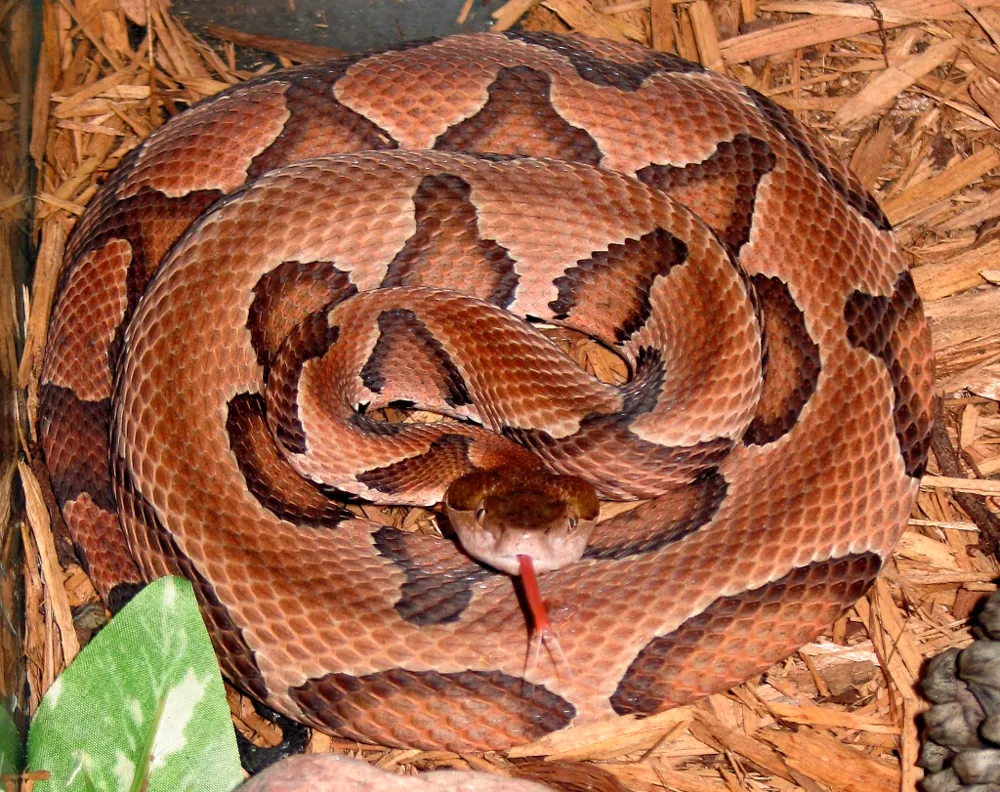
MorsiThe eastern copperhead is a venomous pit viper that lives across much of the eastern United States. It has hourglass-shaped bands on a tan or reddish-brown body, which help it hide in leaves and clay. It is common, so people sometimes meet it without realising, and it makes up half of the treated snake bites in the United States.1
 Come riconoscerlo
- Dark brown, hourglass-shaped crossbands on a light reddish-brown or brown background1
- A heavy, stout body rather than a slender one1
- A broad head that is distinct from the neck1
- Young have green or yellow tail tips, which darken to brown or black within a year1
- Adults are typically 50 to 95 cm long, including the tail1
Spesso confuso con: The snout slopes down and back, so it looks less blunt than the snout of the cottonmouth. The head also extends further forward than the mouth.1
Potere del veleno
Il veleno esce dalle zanne o dai denti quando morde.
Quanto è pericoloso per le persone?
Pericolo per le persone: GraveUn morso richiede un medico. Le morti sono molto rare.Copperhead bites account for half of the treated snake bites in the United States. Bites usually happen when people unknowingly step on or near the snake. It is generally nonaggressive and will strike only if threatened as a last resort.1
Cosa fa quando ha paura?
It often freezes instead of fleeing, relying on its camouflage, and may vibrate its tail when closely approached.1
 Se morde
- Tieni la persona ferma e calma, tieni l'arto morso all'altezza del cuore, togli anelli e cose strette e portala subito in ospedale.
Chiama sempre prima il numero di emergenza (112, 000, 911). Queste sono indicazioni generali di primo soccorso, non consigli medici. Primo soccorso di base
 Stai al sicuro
- Non toccare, catturare o stuzzicare mai un animale selvatico, anche se è piccolo e anche se sembra addormentato o morto.
- Lasciagli spazio. Se ne incontri uno, resta calmo, indietreggia piano e lascialo andare per la sua strada.
- Se uno ti morde: resta calmo, stai fermo, chiama il numero di emergenza (112, 000, 911) o vai subito in ospedale. Ricorda com'era, una foto aiuta.
Non ce l'ha con te. Usa il veleno per procurarsi il cibo o per difendersi, e preferisce di gran lunga nascondersi. Altro su come stare al sicuro
Dove nel mondo?
Quanto è grande?
Quanto è lungo?
Quanto pesa?
 lungo come 2 gatti di casa dal naso alla coda
 lungo come 5 banane in fila
 potrebbe percorrere 100 metri in 100 secondi (l'uomo più veloce ci mette 9,6)
Quanto è grande Eastern copperhead rispetto a TE?
Solo calcoli nel tuo browser. Niente viene salvato o inviato da nessuna parte.
Quanto è veloce?


Informazioni
Its tail can vibrate more than 40 times per second, faster than almost any non-rattlesnake snake.1
Juveniles wave a brightly coloured tail to attract frogs and perhaps lizards, a behaviour called caudal luring.1
Its camouflage is so good that it can be almost impossible to see on dead leaves or red clay.1
In Texas, copperheads have been found in bushes, vines and trees up to 12 metres above the ground, seeking newly emerged cicadas.1
Its venom has potential medicinal value to humans.1
Historically, kingsnakes were major predators of copperheads, and recent copperhead numbers have risen where kingsnake populations have declined.1
Sfatiamo i miti
Mito: Copperheads are aggressive snakes that chase people and go looking for trouble.
Verità: They are generally nonaggressive. They usually freeze or flee, and they strike only if threatened as a last resort. Most bites happen when people step on or near them without noticing.1
Per gli esperti di veleni
- Nome scientifico
- Agkistrodon contortrix
- Gruppo
- Vipere a fossetta
- Famiglia
- Viperidae2
- Ordine
- Squamata
- Continenti
- Nord America
- Cuccioli
- Newborn copperheads are born with green or yellow tail tips, which darken to brown or black within one year.1
- Come se la passa in natura
- Least Concern (IUCN Red List, v3.1, 2001); population trend stable when assessed in 20071
- Pericolo per le persone
- 3 / 5: Grave3
Da dove vengono le informazioni
- Eastern copperhead (Wikipedia (CC BY-SA 4.0))
- Agkistrodon contortrix (iNaturalist): nomi e classificazione.
- Venom Wiki: il livello di pericolo, la taglia tipica e la stima della velocità sono nostri. Guarda come li calcoliamo: Come valutiamo il pericolo.
Ogni informazione in questa pagina ha un numero che rimanda alla sua fonte. Se abbiamo sbagliato qualcosa, scusa, siamo appassionati di animali, non una rivista scientifica. Scrivici a [email protected] e lo correggeremo.
 Lo scorpione ha fame! Venom Wiki è un progetto di una sola persona: gratis, senza pubblicità e senza tracker. Una piccola mancia aiuta a tenerlo online.Dai da mangiare allo scorpione
 Terciopelo
 Eyelash viper
 Cottonmouth
 Cantil
 Central American bushmaster
 Martinique lancehead
 Eastern coral snake
 Eastern diamondback rattlesnake
 Timber rattlesnake
 Western diamondback rattlesnake
 Arizona bark scorpion
 Brown recluse