
 Africa
 Asia
Asia Europa
 Sud America
 Australia e Oceania
 Antartide
 Oceano Pacifico
 Oceano Atlantico
 Oceano Indiano
 Oceano Artico
 Mar Mediterraneo
 Mar Rosso
 Mar dei Caraibi
 Mar dei Coralli
 Mar Cinese Meridionale
 Mar delle Filippine
 Mare delle Andamane
 Mare del Nord
 Mar di Timor e Mar degli Arafura
 Golfo del Bengala
 Golfo di California
Flamboyant cuttlefish
 Tossico da mangiare
The flamboyant cuttlefish is a small sea creature that can change its colours and patterns in a flash. It lives in shallow tropical waters around northern Australia, New Guinea, the Philippines, Indonesia and Malaysia. It is special because its flesh is poisonous to eat, and it walks along the sea floor instead of swimming.1


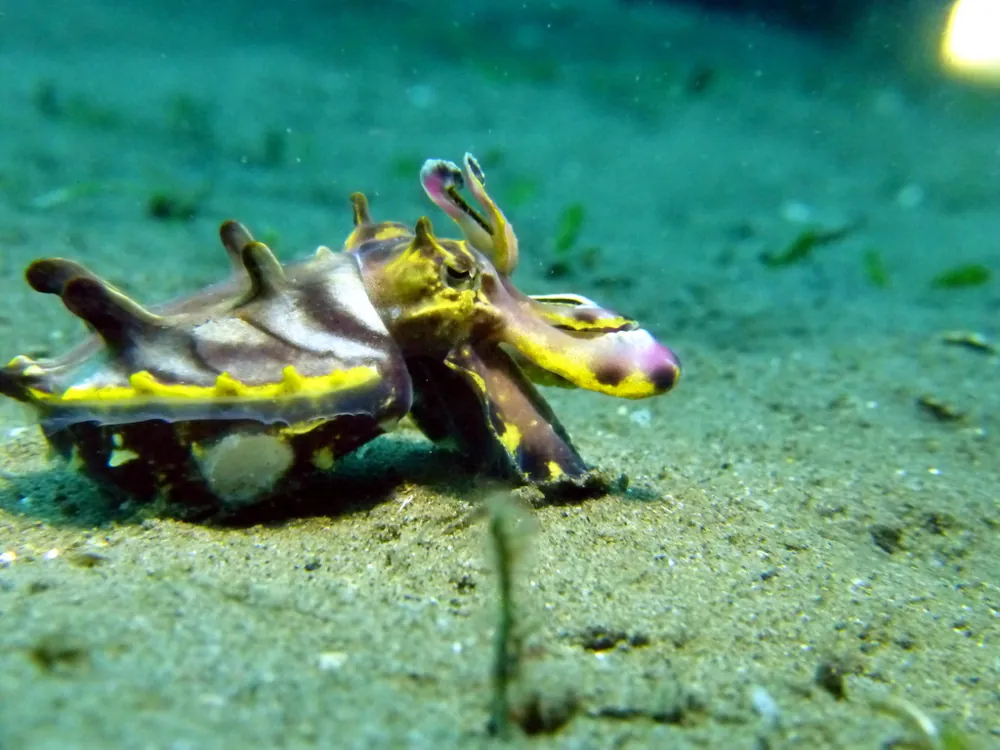
 Come riconoscerlo
- Has a very broad, oval body (mantle) and small, flat, fin-like flaps on the back1
- Broad, blade-like arms with four rows of suckers1
- Normal base colour is dark brown1
- When disturbed, it quickly turns black, dark brown and white, with yellow patches around the body, arms and eyes1
- Arm tips often flash bright red as a warning1
Potere tossico
È dannoso solo se qualcosa lo mangia.
Quanto è pericoloso per le persone?
Pericolo per le persone: DolorosoPuò fare davvero male, ma non è quasi mai grave.Its muscle tissue is highly toxic, so eating it can be dangerous.1
Cosa fa quando ha paura?
When disturbed or attacked, it changes colour to a dark, high-contrast pattern and shows bright red arm tips to warn off predators. It also walks along the sea floor while waving the wide membranes on its arms.1
 Se qualcuno l'ha toccato o mangiato
- Bendaggio compressivo e immobilizzazione: avvolgi una benda elastica ben salda sopra il morso e poi su tutto l'arto, immobilizzalo con una stecca e tieni la persona completamente ferma finché non arrivano i soccorsi.
- Un polpo dagli anelli blu o un mollusco cono possono fermare il respiro di una persona mentre è ancora sveglia: chiama aiuto e preparati a fare le ventilazioni di soccorso finché non subentrano i soccorritori dell'ambulanza.
Chiama sempre prima il numero di emergenza (112, 000, 911). Queste sono indicazioni generali di primo soccorso, non consigli medici. Primo soccorso di base
 Stai al sicuro
- Non toccare, catturare o stuzzicare mai un animale selvatico, anche se è piccolo e anche se sembra addormentato o morto.
- Lasciagli spazio. Se ne incontri uno, resta calmo, indietreggia piano e lascialo andare per la sua strada.
- Se l'hai toccato o mangiato: non strofinarti gli occhi o la bocca, lavati le mani e cerca aiuto medico.
Non ce l'ha con te. Le sue tossine servono solo perché nessuno lo mangi. Altro su come stare al sicuro
Dove nel mondo?
Quanto è grande?
Quanto è lungo?
 lungo come 2,5 mattoncini da costruzione in fila
 potrebbe nuotare per tutta la lunghezza di una grande piscina (50 m) in 12 secondi
Quanto è grande Flamboyant cuttlefish rispetto a TE?
Solo calcoli nel tuo browser. Niente viene salvato o inviato da nessuna parte.
Quanto è veloce?

Informazioni
A toxicology report found its muscle tissue highly toxic, making it only the third cephalopod known to be poisonous.1
It is one of the only cuttlefish known to walk on the sea floor. This is because its cuttlebone lacks an outer cone, the part most other cuttlefish use to float.1
A female once laid about a dozen eggs inside an overturned half coconut husk, which kept them safe from fish.1
Its toxin has been compared with that of the blue-ringed octopus, but the strength of that link is disputed.1
Sfatiamo i miti
Mito: Its bright arm display means it is a dangerous, deadly poisonous animal.
Verità: The display is thought to warn predators that its flesh is poisonous. However, significant amounts of toxin have not yet been isolated from this species, and preliminary tests found only trace amounts of tetrodotoxin.1
Per gli esperti di veleni
- Nome scientifico
- Metasepia pfefferi
- Gruppo
- Molluschi cono e polpi
- Famiglia
- Sepiidae2
- Ordine
- Sepiida
- Continenti
- Oceano Indiano, Oceano Pacifico, Mar dei Coralli, Mar delle Filippine, Mar di Timor e Mar degli Arafura, Gli oceani
- Cuccioli
- Eggs are laid one at a time in crevices or on ledges in coral, rock or wood. Hatchlings look like adults and can copy the same camouflage patterns. They receive no care from their parents.1
- Pericolo per le persone
- 2 / 5: Doloroso3
Da dove vengono le informazioni
- Ascarosepion pfefferi (Wikipedia (CC BY-SA 4.0))
- Metasepia pfefferi (iNaturalist): nomi e classificazione.
- Venom Wiki: il livello di pericolo, la taglia tipica e la stima della velocità sono nostri. Guarda come li calcoliamo: Come valutiamo il pericolo.
Ogni informazione in questa pagina ha un numero che rimanda alla sua fonte. Se abbiamo sbagliato qualcosa, scusa, siamo appassionati di animali, non una rivista scientifica. Scrivici a [email protected] e lo correggeremo.
 Lo scorpione ha fame! Venom Wiki è un progetto di una sola persona: gratis, senza pubblicità e senza tracker. Una piccola mancia aiuta a tenerlo online.Dai da mangiare allo scorpione
Altri dello stesso gruppo: Molluschi cono e polpi
 Geography cone
 Greater blue-ringed octopus
 Southern blue-ringed octopus
 Blue sea dragon
 Common octopus
 Giant Pacific octopus
Vive anche in: Oceano Indiano
 Australian box jellyfishMeduse e altri urticanti mariniMortaleNon toccare
 Hawksbill sea turtleAltri animali tossiciPuò uccidere
 Irukandji jellyfishMeduse e altri urticanti mariniPuò uccidereNon toccare
 Reef stonefishPesci velenosiPuò uccidereNon toccare
 Crown-of-thorns starfishRicci, stelle e vermiServe un medicoNon toccare
 Portuguese man o' warMeduse e altri urticanti mariniServe un medicoNon toccare