
 Africa
 Asia
Asia Europa
 Sud America
 Australia e Oceania
 Antartide
 Oceano Pacifico
 Oceano Atlantico
 Oceano Indiano
 Oceano Artico
 Mar Mediterraneo
 Mar Rosso
 Mar dei Caraibi
 Mar dei Coralli
 Mar Cinese Meridionale
 Mar delle Filippine
 Mare delle Andamane
 Mare del Nord
 Mar di Timor e Mar degli Arafura
 Golfo del Bengala
 Golfo di California
Mexican redknee tarantula
 Morsi
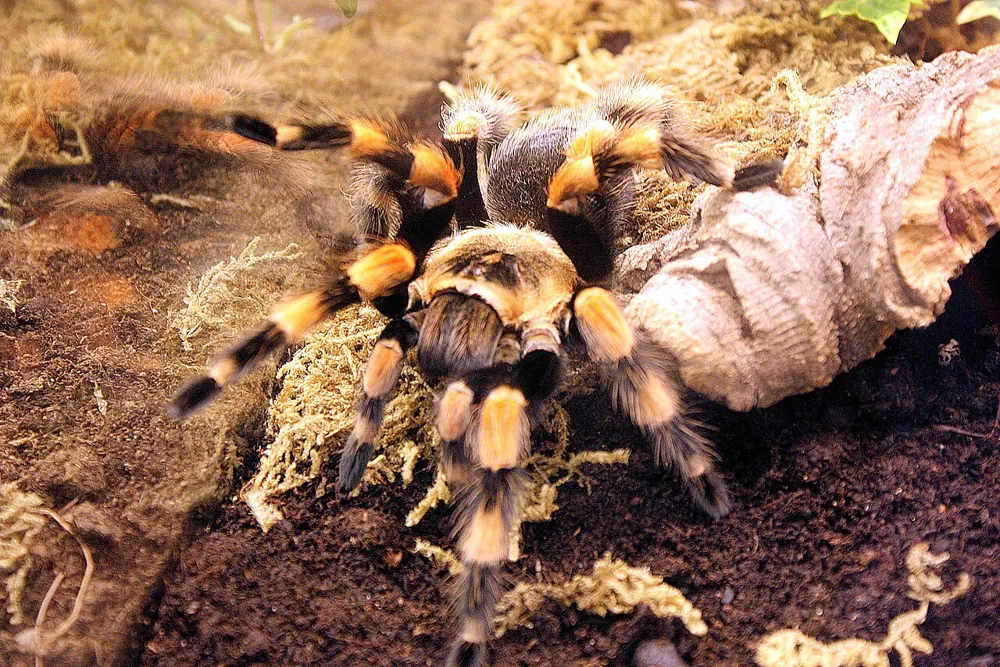
MorsiThe Mexican redknee tarantula is a large, hairy spider from the Pacific coast of Mexico. It lives in burrows under rocks and tree roots, and it is a popular pet among tarantula keepers. Its name has caused confusion, because for many years it was mixed up with a very similar species.1



 Come riconoscerlo
- Males and females are large, with bodies about 4 to 6 cm long, not counting the fangs and spinnerets.1
- Legs and palps (the short leg-like parts near the mouth) are bluish black with reddish orange and pale pink rings.1
- Adult males have a yellowish brown carapace (the hard top of the front body) and a black upper abdomen.1
- Adult females vary more. The carapace may be mostly bluish black with a light brown border, or have a dark starburst pattern.1
Spesso confuso con: It is often confused with Brachypelma hamorii, which has very similar colours. The two can be told apart by two brownish pink bands on the chelicerae (the fang-bearing parts), which are present in B. hamorii but absent in B. smithi. Mature males can also be told apart by the shape of the palpal bulb, which is straighter and spoon-shaped in B. smithi.1
Potere del veleno
Il veleno esce dalle zanne o dai denti quando morde.
Quanto è pericoloso per le persone?
Pericolo per le persone: LieveCome una puntura d'ape o meno. In pratica innocuo per le persone. Se morde
- Lava il morso e raffreddalo. Cerca aiuto medico se il dolore è forte o la persona si sente male.
Chiama sempre prima il numero di emergenza (112, 000, 911). Queste sono indicazioni generali di primo soccorso, non consigli medici. Primo soccorso di base
 Stai al sicuro
- Non toccare, catturare o stuzzicare mai un animale selvatico, anche se è piccolo e anche se sembra addormentato o morto.
- Lasciagli spazio. Se ne incontri uno, resta calmo, indietreggia piano e lascialo andare per la sua strada.
- Se uno ti morde: resta calmo, stai fermo, chiama il numero di emergenza (112, 000, 911) o vai subito in ospedale. Ricorda com'era, una foto aiuta.
Non ce l'ha con te. Usa il veleno per procurarsi il cibo o per difendersi, e preferisce di gran lunga nascondersi. Altro su come stare al sicuro
Dove nel mondo?
Quanto è grande?
Quanto è lungo?
 più corto del tuo dito mignolo
 potrebbe percorrere 100 metri in 200 secondi (l'uomo più veloce ci mette 9,6)
Quanto è grande Mexican redknee tarantula rispetto a TE?
Solo calcoli nel tuo browser. Niente viene salvato o inviato da nessuna parte.
Quanto è veloce?


Informazioni
Large numbers of wild-caught Mexican redknee tarantulas are still smuggled out of Mexico. At least 3,000 Mexican tarantulas were sent to the United States or Europe a few years before 2017, most of them this species.1
Its burrow has a single entrance, a tunnel about three times the spider's leg span long, and one or two chambers, one for moulting and one for resting and eating.1
Males have shorter bodies than females but longer legs.1
Sfatiamo i miti
Mito: The name Mexican redknee tarantula always refers to one single species.
Verità: The name has been used for two very similar species, B. smithi and B. hamorii. Many older sources mixed them up, so earlier records may be about either species.1
Da dove vengono le informazioni
- Brachypelma smithi (Wikipedia (CC BY-SA 4.0))
- Brachypelma smithi (iNaturalist): nomi e classificazione.
- Venom Wiki: il livello di pericolo, la taglia tipica e la stima della velocità sono nostri. Guarda come li calcoliamo: Come valutiamo il pericolo.
Ogni informazione in questa pagina ha un numero che rimanda alla sua fonte. Se abbiamo sbagliato qualcosa, scusa, siamo appassionati di animali, non una rivista scientifica. Scrivici a [email protected] e lo correggeremo.
 Lo scorpione ha fame! Venom Wiki è un progetto di una sola persona: gratis, senza pubblicità e senza tracker. Una piccola mancia aiuta a tenerlo online.Dai da mangiare allo scorpione
Altri dello stesso gruppo: Tarantole e ragni dei cunicoli
 Arizona blond tarantulaTarantole e ragni dei cunicoliInnocuo
 Ravine trapdoor spiderTarantole e ragni dei cunicoliInnocuo
 Trinidad chevron tarantulaTarantole e ragni dei cunicoliFa solo male
 Antilles pinktoe tarantulaTarantole e ragni dei cunicoliInnocuo
 California trapdoor spiderTarantole e ragni dei cunicoliInnocuo
 Costa Rican zebra tarantulaTarantole e ragni dei cunicoliInnocuo
 Terciopelo
 Eastern coral snake
 Eastern diamondback rattlesnake
 Eyelash viper
 Timber rattlesnake
 Western diamondback rattlesnake