
 Africa
 Asia
Asia Europa
 Sud America
 Australia e Oceania
 Antartide
 Oceano Pacifico
 Oceano Atlantico
 Oceano Indiano
 Oceano Artico
 Mar Mediterraneo
 Mar Rosso
 Mar dei Caraibi
 Mar dei Coralli
 Mar Cinese Meridionale
 Mar delle Filippine
 Mare delle Andamane
 Mare del Nord
 Mar di Timor e Mar degli Arafura
 Golfo del Bengala
 Golfo di California
Philippine slow loris
 Morsi
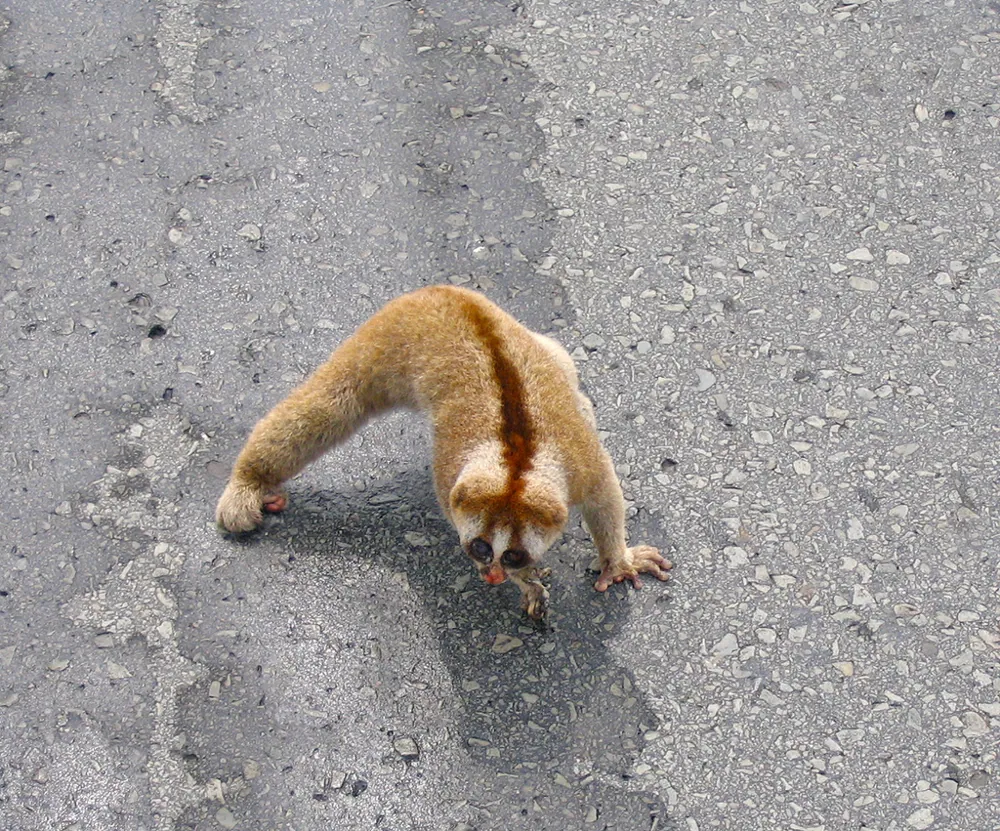
MorsiThe Philippine slow loris is a small primate with pale golden to red fur and large eyes. It lives in lowland forests, gardens and plantations on the north and east coasts of Borneo and in the Sulu Archipelago of the Philippines. It is special because it is one of the smallest slow lorises and one of the hardest to find in the wild.1

 Come riconoscerlo
- Pale golden to red fur1
- Low-contrast markings on the face and head, with no strong dark face mask1
- Short, unfluffed body hair1
- Consistently lacks a second upper incisor (front tooth)1
- Small body, with a vestigial tail, round head and short ears; it is nocturnal and moves through the trees1
Spesso confuso con: It is often confused with other slow lorises. The Bornean kayan slow loris (N. kayan) also has pale body colour, but it has a dark, high-contrast face mask and longer, fluffier fur. Its face markings are much fainter than those of N. kayan.1
Potere del veleno
Il veleno esce dalle zanne o dai denti quando morde.
Cosa fa il suo veleno?
This animal has a gland on the inside of its elbow that makes a pungent, clear, oily toxin. It spreads the toxin on its toothcomb (a set of lower front teeth) and uses it for defence.1
Quanto è pericoloso per le persone?
Pericolo per le persone: DolorosoPuò fare davvero male, ma non è quasi mai grave.Cosa fa quando ha paura?
When threatened, it wipes toxin from its elbow gland onto its toothcomb.1
 Se morde
- Lava bene la ferita e cerca aiuto medico.
Chiama sempre prima il numero di emergenza (112, 000, 911). Queste sono indicazioni generali di primo soccorso, non consigli medici. Primo soccorso di base
 Stai al sicuro
- Non toccare, catturare o stuzzicare mai un animale selvatico, anche se è piccolo e anche se sembra addormentato o morto.
- Lasciagli spazio. Se ne incontri uno, resta calmo, indietreggia piano e lascialo andare per la sua strada.
- Se uno ti morde: resta calmo, stai fermo, chiama il numero di emergenza (112, 000, 911) o vai subito in ospedale. Ricorda com'era, una foto aiuta.
Non ce l'ha con te. Usa il veleno per procurarsi il cibo o per difendersi, e preferisce di gran lunga nascondersi. Altro su come stare al sicuro
Dove nel mondo?
Quanto è grande?
Quanto è lungo?
Quanto pesa?

 lungo come 9 mattoncini da costruzione in fila
 potrebbe percorrere 100 metri in 180 secondi (l'uomo più veloce ci mette 9,6)
Quanto è grande Philippine slow loris rispetto a TE?
Solo calcoli nel tuo browser. Niente viene salvato o inviato da nessuna parte.
Quanto è veloce?


Informazioni
It is so rare and hard to find that in one 75-day field study at Sabangau National Park, researchers recorded only 12 sightings.1
It has a curved grooming claw on its second hind toe, which it uses for scratching and grooming.1
Fossils of this species have been found in the Late Pleistocene site of Niah in Sarawak.1
It is one of the smallest slow lorises, and it is the least studied of Indonesia's slow lorises.1
Da dove vengono le informazioni
- Philippine slow loris (Wikipedia (CC BY-SA 4.0))
- Nycticebus menagensis (iNaturalist): nomi e classificazione.
- Venom Wiki: il livello di pericolo, la taglia tipica e la stima della velocità sono nostri. Guarda come li calcoliamo: Come valutiamo il pericolo.
Ogni informazione in questa pagina ha un numero che rimanda alla sua fonte. Se abbiamo sbagliato qualcosa, scusa, siamo appassionati di animali, non una rivista scientifica. Scrivici a [email protected] e lo correggeremo.
 Lo scorpione ha fame! Venom Wiki è un progetto di una sola persona: gratis, senza pubblicità e senza tracker. Una piccola mancia aiuta a tenerlo online.Dai da mangiare allo scorpione
 Bengal slow loris
 Javan slow loris
 Pygmy slow loris
 Sunda slow loris
 Kayan River slow loris
 Eurasian water shrew
 Scorpione giallo palestinese
 Cobra indiano
 Echide carenata
 Cobra reale
 Vipera soffiante
 Vipera di Russell