
 Africa
 Asia
Asia Europa
 Sud America
 Australia e Oceania
 Antartide
 Oceano Pacifico
 Oceano Atlantico
 Oceano Indiano
 Oceano Artico
 Mar Mediterraneo
 Mar Rosso
 Mar dei Caraibi
 Mar dei Coralli
 Mar Cinese Meridionale
 Mar delle Filippine
 Mare delle Andamane
 Mare del Nord
 Mar di Timor e Mar degli Arafura
 Golfo del Bengala
 Golfo di California
Port Jackson shark
 Spine velenose
The Port Jackson shark is a bottom-dwelling shark that lives in the cool coastal waters of southern Australia. It is active mostly at night, when it hunts shellfish, sea urchins and fish. It is harmless to people, though its spines have a reputation that is not confirmed.1



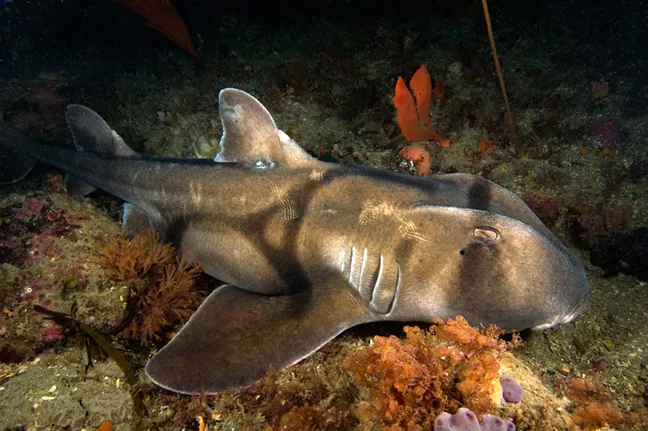
 Come riconoscerlo
- Grey-brown body with dark brown, harness-like bands, including one that runs across the eyes.1
- Large, blunt, flat head with raised ridges above the eyes.1
- A spine at the front edge of each of its two dorsal fins, which are nearly equal in size.1
- Front teeth are small and pointed, while back teeth are flat and blunt.1
- Adults can grow up to 1.65 metres long.1
Potere del veleno
Spine aguzze portano il veleno. Calpestarlo o afferrarlo fa male.
Quanto è pericoloso per le persone?
Pericolo per le persone: LieveCome una puntura d'ape o meno. In pratica innocuo per le persone.The shark poses no danger to humans. In October 2011, a man was bitten at Elwood Beach near Melbourne, but the bite did not pierce the skin and he was able to swim away while the shark was still attached to his calf.1
 Se le sue spine ti trafiggono
- Metti la ferita in acqua calda, calda quanto la persona riesce a sopportare senza scottarsi (provala con la tua mano), da 30 a 90 minuti. Cerca aiuto medico, soprattutto per pesci pietra e pastinache.
Chiama sempre prima il numero di emergenza (112, 000, 911). Queste sono indicazioni generali di primo soccorso, non consigli medici. Primo soccorso di base
 Stai al sicuro
- Non toccare, catturare o stuzzicare mai un animale selvatico, anche se è piccolo e anche se sembra addormentato o morto.
- Lasciagli spazio. Se ne incontri uno, resta calmo, indietreggia piano e lascialo andare per la sua strada.
- Se le sue spine ti trafiggono: resta calmo, stai fermo, chiama il numero di emergenza (112, 000, 911) o vai subito in ospedale. Ricorda com'era, una foto aiuta.
Non ce l'ha con te. Usa il veleno per procurarsi il cibo o per difendersi, e preferisce di gran lunga nascondersi. Altro su come stare al sicuro
Dove nel mondo?
Quanto è grande?
Quanto è lungo?
 lungo come 3 gatti di casa dal naso alla coda
 lungo come 9 banane in fila
 potrebbe nuotare per tutta la lunghezza di una grande piscina (50 m) in 8,2 secondi
Quanto è grande Port Jackson shark rispetto a TE?
Solo calcoli nel tuo browser. Niente viene salvato o inviato da nessuna parte.
Quanto è veloce?


Informazioni
It can turn its stomach inside out and spit out unwanted contents.1
It can breathe while lying still on the bottom. It pumps water in through its first gill slit and out through the others, so it does not need to swim with its mouth open.1
Juveniles have individual personalities. Some are bolder than others when exploring new places, and they respond differently to stress.1
Juveniles can learn to link bubbles, lights or sounds with food, and they can learn by watching other sharks.1
Adults are often seen resting together in caves, but juveniles do not seem to be social.1
Each year it migrates south in summer and returns north to breed in winter.1
Sfatiamo i miti
Mito: Port Jackson sharks are dangerous to people.
Verità: The shark poses no danger to humans. Its spines are rumoured to be venomous, but this has not been confirmed.1
Per gli esperti di veleni
- Nome scientifico
- Heterodontus portusjacksoni
- Gruppo
- Pesci velenosi
- Famiglia
- Heterodontidae2
- Ordine
- Heterodontiformes
- Continenti
- Oceano Indiano, Oceano Meridionale, Antartide, Gli oceani
- Cuccioli
- It lays eggs rather than giving birth to live young. From late August to mid-November, the female lays pairs of eggs every 8 to 17 days, up to eight pairs in total, and the eggs take 10 to 11 months to hatch.1
- Come se la passa in natura
- Least Concern (IUCN Red List)1
- Pericolo per le persone
- 1 / 5: Lieve3
Da dove vengono le informazioni
- Port Jackson shark (Wikipedia (CC BY-SA 4.0))
- Heterodontus portusjacksoni (iNaturalist): nomi e classificazione.
- Venom Wiki: il livello di pericolo, la taglia tipica e la stima della velocità sono nostri. Guarda come li calcoliamo: Come valutiamo il pericolo.
Ogni informazione in questa pagina ha un numero che rimanda alla sua fonte. Se abbiamo sbagliato qualcosa, scusa, siamo appassionati di animali, non una rivista scientifica. Scrivici a [email protected] e lo correggeremo.
 Lo scorpione ha fame! Venom Wiki è un progetto di una sola persona: gratis, senza pubblicità e senza tracker. Una piccola mancia aiuta a tenerlo online.Dai da mangiare allo scorpione
Altri dello stesso gruppo: Pesci velenosi
 Reef stonefishPesci velenosiPuò uccidereNon toccare
 Red lionfishPesci velenosiServe un medicoNon toccare
 Estuarine stonefishPesci velenosiPuò uccidereNon toccare
 Short-tail stingrayPesci velenosiPuò uccidere
 Striped eel catfishPesci velenosiPuò uccidereNon toccare
 Bluespotted ribbontail rayPesci velenosiServe un medico
Vive anche in: Oceano Indiano
 Vespa di mareMeduse e altri urticanti mariniMortaleNon toccare
 Cono geografoMolluschi cono e polpiMortale
 Polpo dagli anelli blu maggioreMolluschi cono e polpiMortale
 Polpo dagli anelli blu meridionaleMolluschi cono e polpiMortale
 Hawksbill sea turtleAltri animali tossiciPuò uccidere
 Irukandji jellyfishMeduse e altri urticanti mariniPuò uccidereNon toccare