
 Africa
 Asia
Asia Europa
 Sud America
 Australia e Oceania
 Antartide
 Oceano Pacifico
 Oceano Atlantico
 Oceano Indiano
 Oceano Artico
 Mar Mediterraneo
 Mar Rosso
 Mar dei Caraibi
 Mar dei Coralli
 Mar Cinese Meridionale
 Mar delle Filippine
 Mare delle Andamane
 Mare del Nord
 Mar di Timor e Mar degli Arafura
 Golfo del Bengala
 Golfo di California
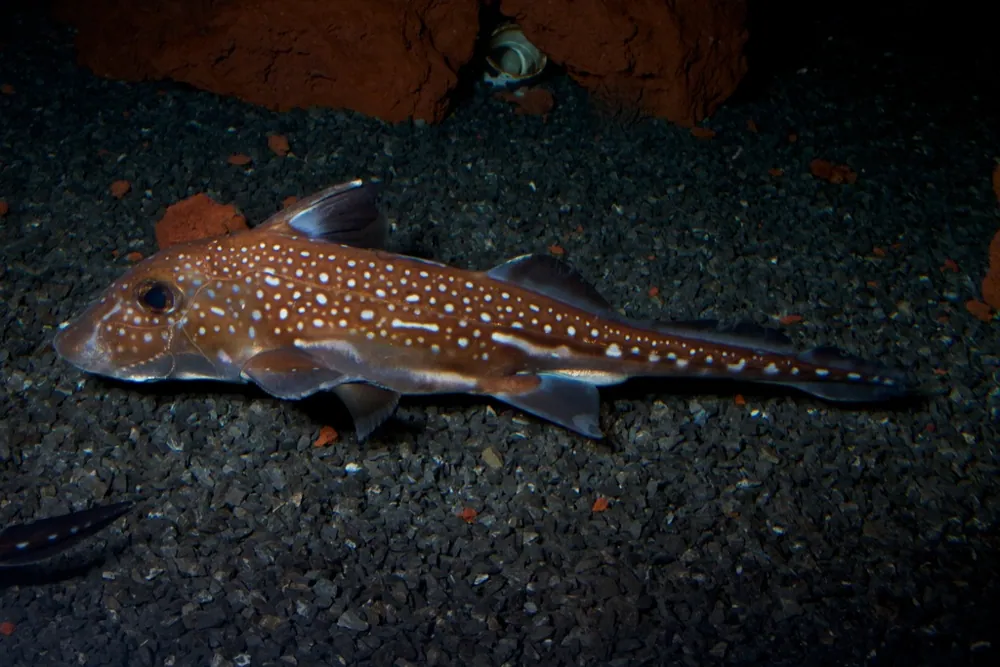
Spotted ratfish
 Spine velenose
The spotted ratfish is a chimaera, a cartilage fish related to sharks and rays. It lives in the northeastern Pacific Ocean, and divers often see it at night in the Pacific Northwest. It gets its name from its pointed, rat-like tail.1



 Come riconoscerlo
- Smooth, scaleless skin that is silvery-bronze, often with gold, blue and green shine1
- Speckled white spots along the back1
- Large, triangular pectoral fins that stick straight out from the sides, like airplane wings1
- A pointed, rat-like tail that makes up almost half of its total length1
- Large emerald green eyes and a duckbill-shaped snout1
Potere del veleno
Spine aguzze portano il veleno. Calpestarlo o afferrarlo fa male.
Cosa fa il suo veleno?
The spine on the leading edge of its dorsal fin is grooved and connected to a venom gland at its base. The venom is mildly toxic. A sting from the spine causes a painful wound.1
Quanto è pericoloso per le persone?
Pericolo per le persone: DolorosoPuò fare davvero male, ma non è quasi mai grave.It does not present a serious danger to humans, but its spines can cause painful wounds. Harbor seals have been known to die after swallowing spotted ratfish, when a spine pierced the stomach or esophagus.1
Cosa fa quando ha paura?
It usually keeps a safe distance from divers and is not aggressive, but it will defend its territory with the spine on its dorsal fin if it feels invaded.1
 Se le sue spine ti trafiggono
- Metti la ferita in acqua calda, calda quanto la persona riesce a sopportare senza scottarsi (provala con la tua mano), da 30 a 90 minuti. Cerca aiuto medico, soprattutto per pesci pietra e pastinache.
Chiama sempre prima il numero di emergenza (112, 000, 911). Queste sono indicazioni generali di primo soccorso, non consigli medici. Primo soccorso di base
 Stai al sicuro
- Non toccare, catturare o stuzzicare mai un animale selvatico, anche se è piccolo e anche se sembra addormentato o morto.
- Lasciagli spazio. Se ne incontri uno, resta calmo, indietreggia piano e lascialo andare per la sua strada.
- Se le sue spine ti trafiggono: resta calmo, stai fermo, chiama il numero di emergenza (112, 000, 911) o vai subito in ospedale. Ricorda com'era, una foto aiuta.
Non ce l'ha con te. Usa il veleno per procurarsi il cibo o per difendersi, e preferisce di gran lunga nascondersi. Altro su come stare al sicuro
Dove nel mondo?
Quanto è grande?
Quanto è lungo?
 lungo come 2 gatti di casa dal naso alla coda
 lungo come 5 banane in fila
 potrebbe nuotare per tutta la lunghezza di una grande piscina (50 m) in 12 secondi
Quanto è grande Spotted ratfish rispetto a TE?
Solo calcoli nel tuo browser. Niente viene salvato o inviato da nessuna parte.
Quanto è veloce?

Informazioni
Adult males have a club-like cephalic clasper on the head, an organ not found in any other vertebrate, which they use to hold on to females during courtship.1
Its large eyes reflect light, much like the eyes of a cat.1
It swims with its large pectoral fins, and its barrel rolls and corkscrew turns have been described as aquatic flight.1
Its teeth are plate-shaped, mineralised and permanent, unlike the easily replaced teeth of sharks, and they help it grind prey.1
Its ampullary organs on the head detect electric fields, and they are homologous to the ampullae of Lorenzini found in sharks and rays.1
Its meat is not typically eaten by humans and it is not commercially caught.1
Per gli esperti di veleni
- Nome scientifico
- Hydrolagus colliei
- Gruppo
- Pesci velenosi
- Famiglia
- Chimaeridae2
- Ordine
- Chimaeriformes
- Continenti
- Oceano Pacifico, Golfo di California, Gli oceani
- Cuccioli
- Like some sharks, it lays eggs; the female releases up to two fertilised eggs every 10–14 days in spring to autumn, and development can take up to a year.1
- Pericolo per le persone
- 2 / 5: Doloroso3
Da dove vengono le informazioni
- Spotted ratfish (Wikipedia (CC BY-SA 4.0))
- Hydrolagus colliei (iNaturalist): nomi e classificazione.
- Venom Wiki: il livello di pericolo, la taglia tipica e la stima della velocità sono nostri. Guarda come li calcoliamo: Come valutiamo il pericolo.
Ogni informazione in questa pagina ha un numero che rimanda alla sua fonte. Se abbiamo sbagliato qualcosa, scusa, siamo appassionati di animali, non una rivista scientifica. Scrivici a [email protected] e lo correggeremo.
 Lo scorpione ha fame! Venom Wiki è un progetto di una sola persona: gratis, senza pubblicità e senza tracker. Una piccola mancia aiuta a tenerlo online.Dai da mangiare allo scorpione
Altri dello stesso gruppo: Pesci velenosi
 Reef stonefishPesci velenosiPuò uccidereNon toccare
 Red lionfishPesci velenosiServe un medicoNon toccare
 Estuarine stonefishPesci velenosiPuò uccidereNon toccare
 Short-tail stingrayPesci velenosiPuò uccidere
 Striped eel catfishPesci velenosiPuò uccidereNon toccare
 Bluespotted ribbontail rayPesci velenosiServe un medico
Vive anche in: Oceano Pacifico
 Australian box jellyfishMeduse e altri urticanti mariniMortaleNon toccare
 Geography coneMolluschi cono e polpiMortale
 Greater blue-ringed octopusMolluschi cono e polpiMortale
 Japanese pufferfishAltri animali tossiciMortale
 Southern blue-ringed octopusMolluschi cono e polpiMortale
 Hawksbill sea turtleAltri animali tossiciPuò uccidere