
 Africa
 Asia
Asia Europa
 Sud America
 Australia e Oceania
 Antartide
 Oceano Pacifico
 Oceano Atlantico
 Oceano Indiano
 Oceano Artico
 Mar Mediterraneo
 Mar Rosso
 Mar dei Caraibi
 Mar dei Coralli
 Mar Cinese Meridionale
 Mar delle Filippine
 Mare delle Andamane
 Mare del Nord
 Mar di Timor e Mar degli Arafura
 Golfo del Bengala
 Golfo di California
Yellow-bellied toad
 Tossine nella pelle
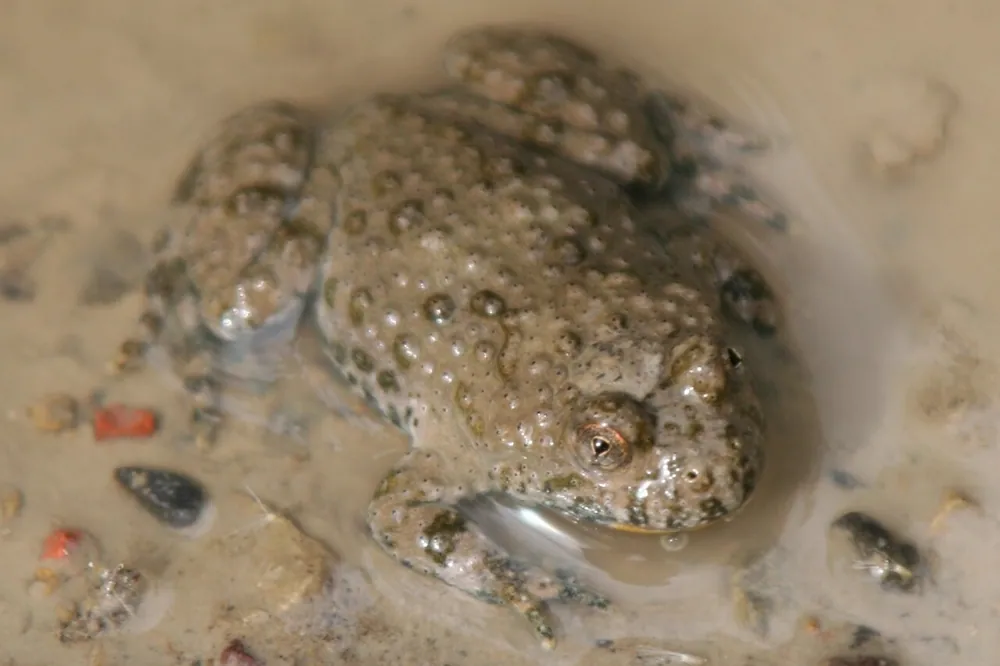
The yellow-bellied toad is a small toad with a bright yellow and black belly that it shows only when it feels threatened. It lives mainly in mountain areas of western Europe. Its skin toxins are not fatal to people, but they can harm smaller animals.1
 Come riconoscerlo
- Grey-brown or dark brown and green upper body, often with faded, bright spots1
- Bright yellow to orange patches on the underside, usually covering more than half of the belly1
- Underside is grey-blue to black-blue between the yellow patches1
- Compact body and a rounded snout1
- Heart-shaped pupils, with the eardrums not visible1
- Warty skin with raised swirls on the back1
Spesso confuso con: The European fire-bellied toad (Bombina bombina) is a close relative and lives in the same region. The yellow-bellied toad has a more compact body that is not as flat.1
Potere tossico
La sua pelle è tossica. È pericoloso toccarlo, leccarlo o mangiarlo.
Cosa fanno le sue tossine?
The toad has toxins in its skin, released through the warts on its back when it is threatened. The toxin is not fatal to humans, but it can cause significant discomfort to most animals and is fatal to smaller ones.1
Quanto è pericoloso per le persone?
Pericolo per le persone: LieveCome una puntura d'ape o meno. In pratica innocuo per le persone.The toxin is not fatal to humans, although it can still cause discomfort to most animals.1
Cosa fa quando ha paura?
It stays still and camouflaged most of the time, and when threatened it shows its yellow belly, puffs up its chest and releases toxins from its warts.1
 Se qualcuno l'ha toccato o mangiato
- Se qualcuno ne ha toccato uno: lava bene le mani e non toccare occhi o bocca. Se un bambino o un animale domestico ne ha leccato o mangiato uno: chiama il centro antiveleni o il numero di emergenza.
Chiama sempre prima il numero di emergenza (112, 000, 911). Queste sono indicazioni generali di primo soccorso, non consigli medici. Primo soccorso di base
 Stai al sicuro
- Non toccare, catturare o stuzzicare mai un animale selvatico, anche se è piccolo e anche se sembra addormentato o morto.
- Lasciagli spazio. Se ne incontri uno, resta calmo, indietreggia piano e lascialo andare per la sua strada.
- Se l'hai toccato o mangiato: non strofinarti gli occhi o la bocca, lavati le mani e cerca aiuto medico.
Non ce l'ha con te. Le sue tossine servono solo perché nessuno lo mangi. Altro su come stare al sicuro
Dove nel mondo?
Quanto è grande?
Quanto è lungo?
Quanto pesa?
 più corto del tuo dito mignolo
 così leggero che non lo sentiresti sulla mano
 potrebbe percorrere 100 metri in 180 secondi (l'uomo più veloce ci mette 9,6)
Quanto è grande Yellow-bellied toad rispetto a TE?
Solo calcoli nel tuo browser. Niente viene salvato o inviato da nessuna parte.
Quanto è veloce?


Informazioni
When a male is threatened or wants to attract a female, he kicks his hind legs into a small pond to make a wave-like pattern. This marks his territory and only works in ponds of a certain depth.1
They can change the shade of their colour to suit lighter or darker surroundings by moving pigment within their cells.1
Yellow-bellied toads breed in unpredictable places, such as shallow pools that can disappear overnight. Within their family, they are the only species that chooses such sites.1
Their life span ranges from 5 to 23 years, and climate plays a large role in how long an individual lives.1
Males have longer forelimbs than females, which is thought to help them during mating and fights with other males.1
Per gli esperti di veleni
- Nome scientifico
- Bombina variegata
- Gruppo
- Rane dardo, rospi e tritoni
- Famiglia
- Bombinatoridae2
- Ordine
- Anura
- Continenti
- Europa
- Cuccioli
- Females can lay over 200 eggs at one time, but typically lay about 40. Eggs are laid in ponds, and tadpoles develop rapidly.1
- Come se la passa in natura
- Endangered in Germany1
- Pericolo per le persone
- 1 / 5: Lieve3
Da dove vengono le informazioni
- Yellow-bellied toad (Wikipedia (CC BY-SA 4.0))
- Bombina variegata (iNaturalist): nomi e classificazione.
- Venom Wiki: il livello di pericolo, la taglia tipica e la stima della velocità sono nostri. Guarda come li calcoliamo: Come valutiamo il pericolo.
Ogni informazione in questa pagina ha un numero che rimanda alla sua fonte. Se abbiamo sbagliato qualcosa, scusa, siamo appassionati di animali, non una rivista scientifica. Scrivici a [email protected] e lo correggeremo.
 Lo scorpione ha fame! Venom Wiki è un progetto di una sola persona: gratis, senza pubblicità e senza tracker. Una piccola mancia aiuta a tenerlo online.Dai da mangiare allo scorpione
Altri dello stesso gruppo: Rane dardo, rospi e tritoni
 Fire salamanderRane dardo, rospi e tritoniFa solo maleNon toccare
 Common toadRane dardo, rospi e tritoniFa solo maleNon toccare
 European fire-bellied toadRane dardo, rospi e tritoniInnocuo
 Iberian ribbed newtRane dardo, rospi e tritoniInnocuo
 Natterjack toadRane dardo, rospi e tritoniInnocuo
 Alpine salamanderRane dardo, rospi e tritoniInnocuo
Vive anche in: Europa
 Common European adderVipere e marassiServe un medico
 Spanish flyAltri animali tossiciServe un medicoNon toccare
 Common waspApi, vespe e calabroniFa solo male
 European hornetApi, vespe e calabroniFa solo male
 Western honey beeApi, vespe e calabroniFa solo male
 Blunt-nosed viperVipere e marassiPuò uccidere