
 Africa
 Asia
Asia Europa
 Sud America
 Australia e Oceania
 Antartide
 Oceano Pacifico
 Oceano Atlantico
 Oceano Indiano
 Oceano Artico
 Mar Mediterraneo
 Mar Rosso
 Mar dei Caraibi
 Mar dei Coralli
 Mar Cinese Meridionale
 Mar delle Filippine
 Mare delle Andamane
 Mare del Nord
 Mar di Timor e Mar degli Arafura
 Golfo del Bengala
 Golfo di California
Yellow stingray
 Punture
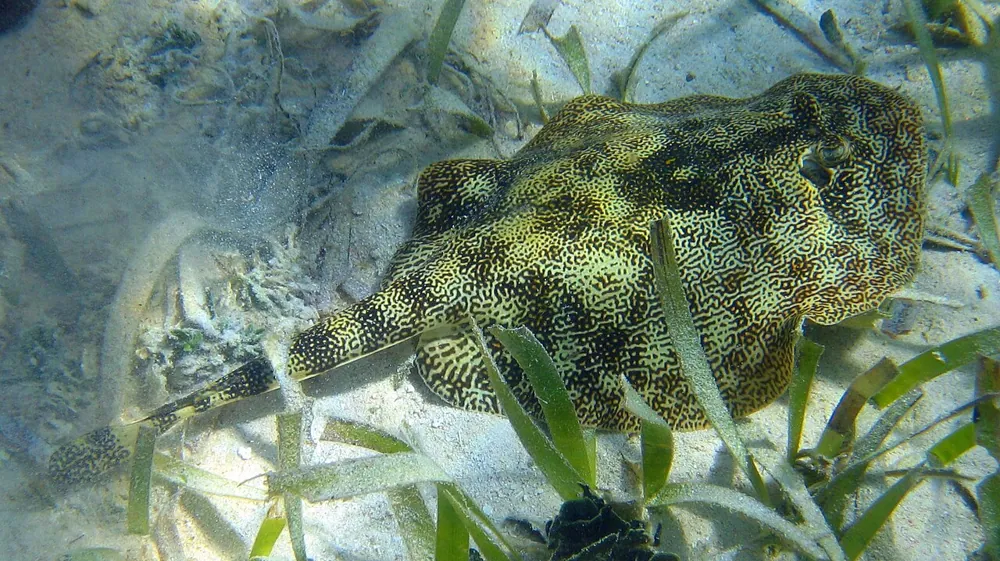
The yellow stingray is a small ray that lives on the sandy, muddy or seagrass bottoms of shallow coastal waters in the western Atlantic, the Gulf of Mexico and the Caribbean. It spends much of the day buried under sand or lying still. It can sting with a venomous spine on its tail, but it usually ignores divers unless it is stepped on or provoked.1



 Come riconoscerlo
- Nearly round pectoral fin disc with a short tail and a small, leaf-shaped tail fin.1
- Pattern of spots and blotches, either light on dark or dark on light, which varies a lot between individuals.1
- Can quickly change the tone and contrast of its colour to match its surroundings.1
- Underside is yellowish, greenish or brownish white, with small darker spots near the edge of the disc and the tail.1
- A serrated spine sits about halfway along the tail.1
Potere del veleno
Il veleno esce da un pungiglione.
Cosa fa il suo veleno?
The tail spine is coated in potent venom. The wound it causes is extremely painful, but it is seldom life-threatening.1
Quanto è pericoloso per le persone?
Pericolo per le persone: DolorosoPuò fare davvero male, ma non è quasi mai grave.It is not aggressive towards people. It injures people only when it is stepped on or otherwise provoked, and the resulting wound is very painful but seldom life-threatening.1
Cosa fa quando ha paura?
When threatened it mostly stays still, buried under sediment or lying in vegetation, and if stepped on or provoked it defends itself with its tail spine.1
 Se punge
- Metti la ferita in acqua calda, calda quanto la persona riesce a sopportare senza scottarsi (provala con la tua mano), da 30 a 90 minuti. Cerca aiuto medico, soprattutto per pesci pietra e pastinache.
Chiama sempre prima il numero di emergenza (112, 000, 911). Queste sono indicazioni generali di primo soccorso, non consigli medici. Primo soccorso di base
 Stai al sicuro
- Non toccare, catturare o stuzzicare mai un animale selvatico, anche se è piccolo e anche se sembra addormentato o morto.
- Lasciagli spazio. Se ne incontri uno, resta calmo, indietreggia piano e lascialo andare per la sua strada.
- Se uno ti punge: resta calmo, stai fermo, chiama il numero di emergenza (112, 000, 911) o vai subito in ospedale. Ricorda com'era, una foto aiuta.
Non ce l'ha con te. Usa il veleno per procurarsi il cibo o per difendersi, e preferisce di gran lunga nascondersi. Altro su come stare al sicuro
Dove nel mondo?
Quanto è grande?
Quanto è lungo?
 lungo come 4 banane in fila
 potrebbe nuotare per tutta la lunghezza di una grande piscina (50 m) in 13 secondi
Quanto è grande Yellow stingray rispetto a TE?
Solo calcoli nel tuo browser. Niente viene salvato o inviato da nessuna parte.
Quanto è veloce?


Informazioni
It glows green when lit by blue or ultraviolet light, a effect called biofluorescence that may help it communicate and camouflage itself.1
It can raise the front of its disc to form a shaded 'cave' that draws in small creatures looking for shelter.1
Off Jamaica, up to one yellow stingray per square metre gathers under mangrove roosts used by cattle egrets, possibly because bird droppings feed the small animals that attract the rays.1
Its eyes give it a 360° view of its surroundings, and each eye has a covering that controls how much light enters.1
It can live for 15 to 25 years.1
Sfatiamo i miti
Mito: Stingrays attack people in the water.
Verità: Yellow stingrays generally pay little attention to divers and can be approached closely. They only sting when they are stepped on or otherwise provoked.1
Per gli esperti di veleni
- Nome scientifico
- Urobatis jamaicensis
- Gruppo
- Pesci velenosi
- Famiglia
- Urotrygonidae2
- Ordine
- Myliobatiformes
- Continenti
- Oceano Atlantico, Mar dei Caraibi, Golfo del Messico, Gli oceani
- Cuccioli
- It gives birth to live young, with litters of up to seven. Females have two litters a year in seagrass beds after a gestation period of 5–6 months.1
- Durata della vita
- circa 25 anni1
- Come se la passa in natura
- Least Concern1
- Pericolo per le persone
- 2 / 5: Doloroso3
Da dove vengono le informazioni
- Yellow stingray (Wikipedia (CC BY-SA 4.0))
- Urobatis jamaicensis (iNaturalist): nomi e classificazione.
- Venom Wiki: il livello di pericolo, la taglia tipica e la stima della velocità sono nostri. Guarda come li calcoliamo: Come valutiamo il pericolo.
Ogni informazione in questa pagina ha un numero che rimanda alla sua fonte. Se abbiamo sbagliato qualcosa, scusa, siamo appassionati di animali, non una rivista scientifica. Scrivici a [email protected] e lo correggeremo.
 Lo scorpione ha fame! Venom Wiki è un progetto di una sola persona: gratis, senza pubblicità e senza tracker. Una piccola mancia aiuta a tenerlo online.Dai da mangiare allo scorpione
Altri dello stesso gruppo: Pesci velenosi
 Reef stonefishPesci velenosiPuò uccidereNon toccare
 Red lionfishPesci velenosiServe un medicoNon toccare
 Estuarine stonefishPesci velenosiPuò uccidereNon toccare
 Short-tail stingrayPesci velenosiPuò uccidere
 Striped eel catfishPesci velenosiPuò uccidereNon toccare
 Bluespotted ribbontail rayPesci velenosiServe un medico
Vive anche in: Oceano Atlantico
 Hawksbill sea turtleAltri animali tossiciPuò uccidere
 Portuguese man o' warMeduse e altri urticanti mariniServe un medicoNon toccare
 Blue sea dragonMolluschi cono e polpiFa solo male
 Greenland sharkAltri animali tossiciFa solo male
 Lion's mane jellyfishMeduse e altri urticanti mariniFa solo maleNon toccare
 Common octopusMolluschi cono e polpiInnocuo