
 アフリカ
アフリカ アジア
アジア ヨーロッパ
ヨーロッパ 南アメリカ
南アメリカ オーストラリアとオセアニア
 南極大陸
南極大陸 太平洋
太平洋 大西洋
大西洋 インド洋
インド洋 北極海
北極海 地中海
地中海 紅海
紅海 カリブ海
カリブ海 サンゴ海
サンゴ海 南シナ海
南シナ海 フィリピン海
 アンダマン海
 北海
北海 ティモール海とアラフラ海
 ベンガル湾
ベンガル湾 カリフォルニア湾
Filament-finned stinger
 毒のとげ
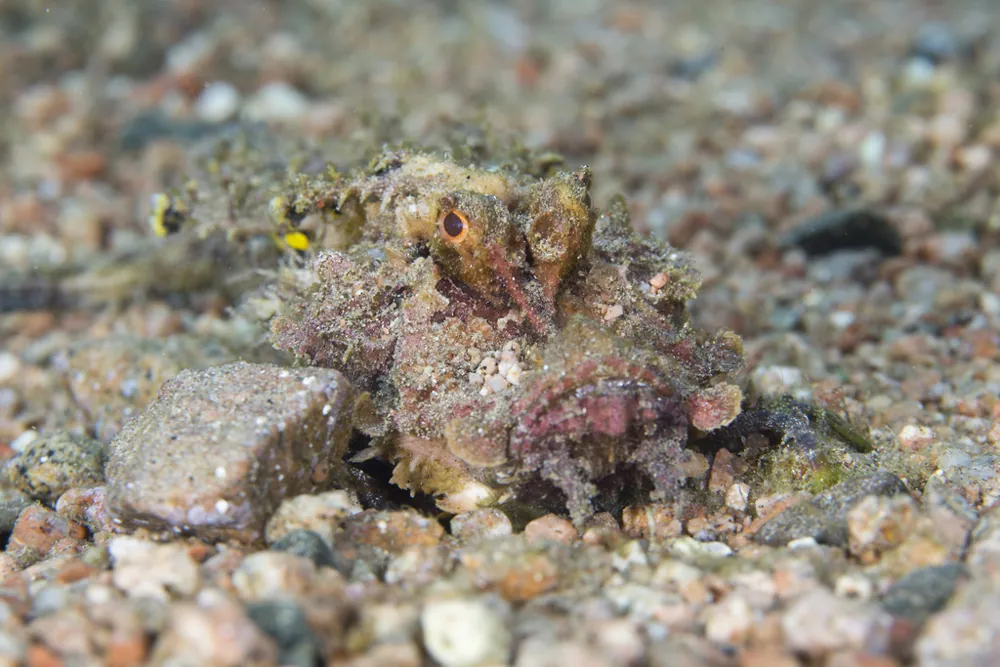
毒のとげThe filament-finned stinger is a well-camouflaged fish with venomous spines on its skin. It lives on sandy and silty seabeds in warm coastal waters, from the Red Sea and East Africa to the Maldives. It is easy to step on or touch by accident, so it is worth knowing what it looks like.1

 見分け方
見分け方
- Body colour is dull yellow, grey, brown or rust, with light blotches that match the seabed1
- Skin has no scales along most of the body, but is covered in venomous spines and wart-like glands, giving a knobby look1
- Flattened, concave head, with the eyes, mouth and nostrils projecting upwards and outwards1
- Caudal (tail) fin has dark bands at its base and near its tip1
- Two pectoral fin rays are detached and angled downwards, and are used like legs1
よくまちがえられるのは: It is often confused with Inimicus sinensis, which is nearly identical. The key difference is on the underside of the pectoral fins: the black bands of this species are faint, while those of I. sinensis have yellow spots.1
毒パワー
するどいとげに毒があるよ。ふんだりつかんだりすると痛い。
人にとってどれくらい危険?
人への危険: 深刻とげが刺さったらお医者さんへ。死ぬことはとてもまれだよ。こわいとき、どうするの?
When disturbed by a diver or a possible predator, it fans out its brightly coloured pectoral and tail fins as a warning, and it is very reluctant to leave its hiding place once dug in.1
 とげが刺さったら
- 傷口をお湯につけよう。やけどしない範囲で、その人ががまんできるいちばん熱いお湯で(自分の手で温度を確かめて)、30分から90分。医療の助けを受けよう。とくにオニダルマオコゼやアカエイのときは必ず。
まず必ず救急番号(112、000、911)に電話しよう。これは一般的な応急手当の案内で、医療のアドバイスではないよ。 応急手当の基本
 安全に過ごそう
- 野生の動物には、小さくても、ねているように見えても、死んでいるように見えても、ぜったいにさわったり、つかまえたり、からかったりしないこと。
- 近づかないで。出会ったら落ちついて、ゆっくりあとずさりして、そのまま行かせてあげよう。
- とげが刺さったら:落ちついて、じっとして、救急番号(112、000、911)に電話するか、急いで病院へ行こう。見た目をおぼえておいてね。写真があると役に立つよ。
きみをねらっているわけじゃないよ。毒はエサをとったり身を守ったりするために使うだけで、本当はかくれていたいんだ。 安全に過ごすためにもっと知ろう
どれくらい大きい?
どれくらい長い?
どれくらい重い?

 おもちゃのブロック8こを1列にならべた長さ
 大きなプール(50 m)を36秒で泳げる
Filament-finned stingerは、きみとくらべてどれくらい大きい?
ブラウザで計算しているだけ。何も保存されないし、どこにも送られないよ。
どれくらい速い?
データ
It walks slowly along the seabed, using the two lower pectoral fin rays on each side as legs.1
Its pectoral fins can be brightly coloured, which it shows as a warning when threatened.1
It has no known natural predators.1
During the day it covers itself with sand and debris, which hides it further.1
It is nocturnal, so it hunts mainly at night.1
事実の出典
- Inimicus filamentosus (Wikipedia (CC BY-SA 4.0))
- Inimicus filamentosus (iNaturalist): 名前と分類。
- Venom Wiki: 危険レベル、ふつうの大きさ、スピードの予想は、わたしたち独自のものだよ。どうやって決めているかはこちら: 危険度のつけ方.
このページのどの事実にも、出典をしめす番号がついているよ。まちがいがあったらごめんね、わたしたちは動物好きで、科学雑誌じゃないんだ。[email protected]に教えてくれたら直すよ。
 サソリはおなかがペコペコ! Venom Wikiはひとりでつくっているプロジェクト:無料で、広告もトラッカーもなし。少しのチップがサイトを続ける助けになるよ。サソリにエサをあげる
 Reef stonefish
 Red lionfish
 Estuarine stonefish
 Short-tail stingray
 Striped eel catfish
 Bluespotted ribbontail ray
 オーストラリアウンバチクラゲ
 アンボイナガイ
 オオマルモンダコ
 ミナミヒョウモンダコ
 Hawksbill sea turtle
 Irukandji jellyfish