
 アフリカ
アフリカ アジア
アジア ヨーロッパ
ヨーロッパ 南アメリカ
南アメリカ オーストラリアとオセアニア
 南極大陸
南極大陸 太平洋
太平洋 大西洋
大西洋 インド洋
インド洋 北極海
北極海 地中海
地中海 紅海
紅海 カリブ海
カリブ海 サンゴ海
サンゴ海 南シナ海
南シナ海 フィリピン海
 アンダマン海
 北海
北海 ティモール海とアラフラ海
 ベンガル湾
ベンガル湾 カリフォルニア湾
Savigny's long-spined urchin
 毒のとげ
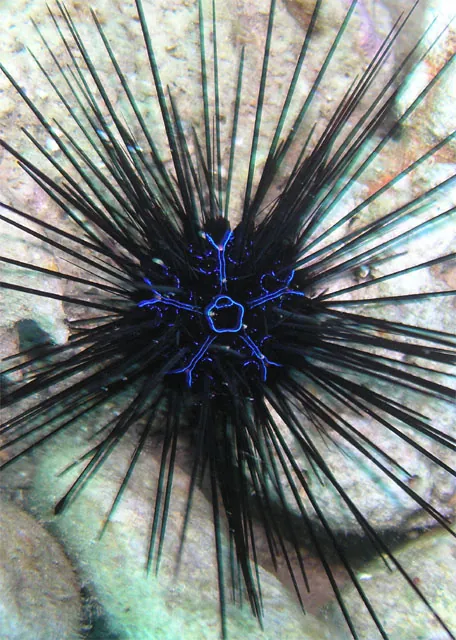
毒のとげSavigny's long-spined urchin is a spiny sea animal that lives on reefs and in shallow lagoons. It has very long, thin spines that can grow up to 25 cm, and it comes out at night to graze on algae. Its spines are the part that can hurt people, so it is worth giving it plenty of room.1


 見分け方
見分け方
- Usually black, with a rounded body (called a test) up to about 9 cm across1
- Long, thin, hollow spines that grow in tufts and can reach 25 cm; they are usually black but can be grey, dark brown or purple1
- Juveniles may have bands of lighter and darker shades, and the occasional individual is completely white1
- Iridescent green or blue lines around the interambulacral areas and around the periproct (the cone-shaped region surrounding the anus)1
よくまちがえられるのは: It is very similar to Diadema setosum, which shares much of its range and often lives in the same groups. Savigny's long-spined urchin lacks the thin orange ring around the periproct that Diadema setosum has.1
毒パワー
するどいとげに毒があるよ。ふんだりつかんだりすると痛い。
人にとってどれくらい危険?
人への危険: 痛いすごく痛いこともあるけど、深刻になることはほとんどないよ。こわいとき、どうするの?
When a shadow falls on it, it angles its spines towards the possible attacker.1
 とげが刺さったら
- 傷口をお湯につけよう。やけどしない範囲で、その人ががまんできるいちばん熱いお湯で。とげを取ってもらうために医療の助けを受けよう。自分でほじくり出さないで。
まず必ず救急番号(112、000、911)に電話しよう。これは一般的な応急手当の案内で、医療のアドバイスではないよ。 応急手当の基本
 安全に過ごそう
- 野生の動物には、小さくても、ねているように見えても、死んでいるように見えても、ぜったいにさわったり、つかまえたり、からかったりしないこと。
- 近づかないで。出会ったら落ちついて、ゆっくりあとずさりして、そのまま行かせてあげよう。
- とげが刺さったら:落ちついて、じっとして、救急番号(112、000、911)に電話するか、急いで病院へ行こう。見た目をおぼえておいてね。写真があると役に立つよ。
きみをねらっているわけじゃないよ。毒はエサをとったり身を守ったりするために使うだけで、本当はかくれていたいんだ。 安全に過ごすためにもっと知ろう
どれくらい大きい?
どれくらい長い?
 おもちゃのブロック3こを1列にならべた長さ
 カタツムリより遅い
Savigny's long-spined urchinは、きみとくらべてどれくらい大きい?
ブラウザで計算しているだけ。何も保存されないし、どこにも送られないよ。
どれくらい速い?

データ
Its spines are brittle, thin and hollow, and grow in tufts that can be as long as 25 cm.1
Small fish such as cardinal fish, flatworms and shrimps sometimes shelter among its long spines.1
It spawns just after the full moon, while its close relative Diadema setosum mostly spawns around days eight to ten of the lunar cycle, which keeps the two species from interbreeding.1
Its grazing helps control algae, which might otherwise smother corals.1
It is nocturnal, hiding in crevices or under boulders by day, though several individuals sometimes huddle together in the open.1
Its predators include pufferfish, porcupinefish, lobsters and snails.1
毒のエキスパート向け
- 学名
- Diadema savignyi
- グループ
- ウニ、ヒトデ、ゴカイのなかま
- 家族
- Diadematidae2
- ならびかえ
- Diadematoida
- 大陸
- インド洋, 太平洋, 紅海, アラビア海とペルシャ湾, ティモール海とアラフラ海, ベンガル湾, 海
- 赤ちゃん
- It does not have live young. Instead it releases eggs and sperm into the water (spawning), mainly during the north-east monsoon period, peaking in May, and timed to the lunar cycle.1
- 人への危険
- 2 / 5: 痛い3
事実の出典
- Diadema savignyi (Wikipedia (CC BY-SA 4.0))
- Diadema savignyi (iNaturalist): 名前と分類。
- Venom Wiki: 危険レベル、ふつうの大きさ、スピードの予想は、わたしたち独自のものだよ。どうやって決めているかはこちら: 危険度のつけ方.
このページのどの事実にも、出典をしめす番号がついているよ。まちがいがあったらごめんね、わたしたちは動物好きで、科学雑誌じゃないんだ。[email protected]に教えてくれたら直すよ。
 サソリはおなかがペコペコ! Venom Wikiはひとりでつくっているプロジェクト:無料で、広告もトラッカーもなし。少しのチップがサイトを続ける助けになるよ。サソリにエサをあげる
 Crown-of-thorns starfish
 Flower urchin
 Fire urchin
 Bearded fireworm
 Black long-spined urchin
 Bloodworm
 オーストラリアウンバチクラゲ
 アンボイナガイ
 オオマルモンダコ
 ミナミヒョウモンダコ
 Hawksbill sea turtle
 Irukandji jellyfish