
 Afirika
 Asiya
Asiya Bulaaya
 Amerika ey'Obukiikaddyo
 Awusitureeliya ne Oseyaniya
 Antakitika
 Oseyani ya Pasifiki
 Oseyani ya Atlantiki
 Oseyani y'e Buyindi
 Oseyani ya Arakitiki
 Ennyanja ya Mediterenia
 Ennyanja Emmyufu
 Ennyanja ya Karibiyani
 Ennyanja ya Korali
 Ennyanja ya China ey'Obukiikaddyo
 Ennyanja ya Bufilipino
 Ennyanja ya Andaman
 Ennyanja ey'Obukiikakkono (North Sea)
 Ennyanja ya Timor ne Arafura
 Ekikono kya Bengal
 Ekikono kya Kalifoniya
Black-footed yellow sac spider
 Kiruma
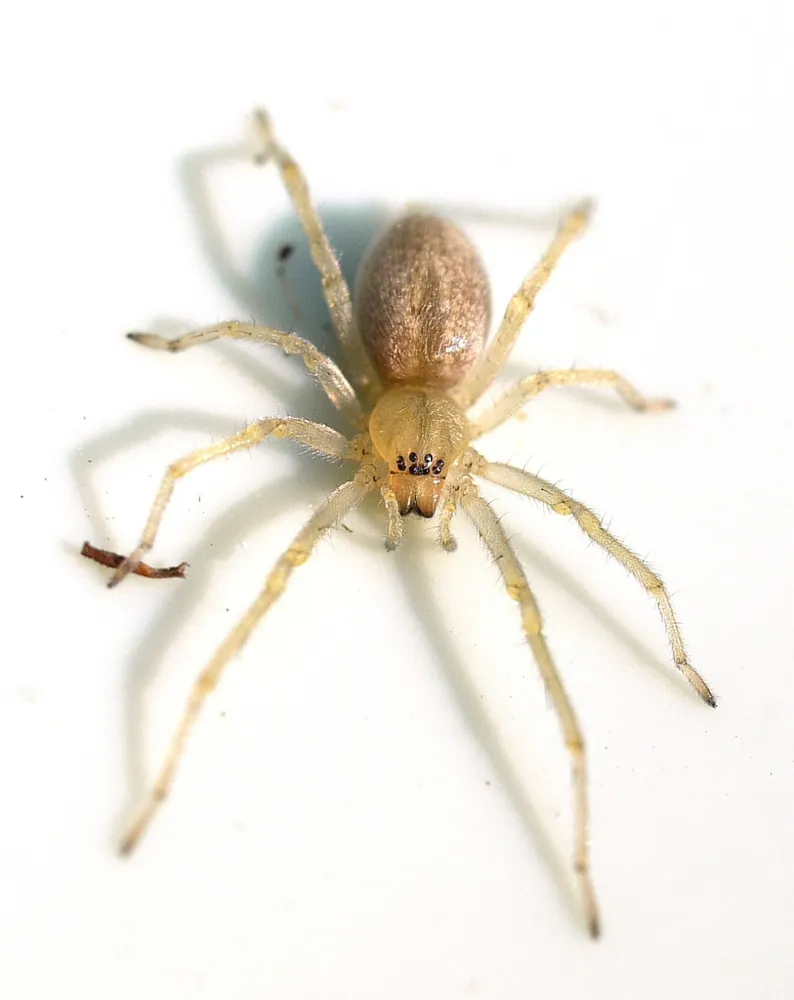
The black-footed yellow sac spider is a small, pale yellow spider native to the Americas. It hunts at night and does not spin webs to catch food. It sometimes lives in homes, but its bites rarely cause more than local symptoms.1

 Engeri y'okukitegeera
- Pale yellow-beige body colour.1
- Dark brown markings on the palps, jaws (chelicerae) and the ends of the feet (tarsi).1
- Often an orange-brown stripe running down the top-centre of the abdomen.1
- Eight similar-sized eyes in two parallel horizontal rows.1
- Females measure 5 to 9 mm in body length and males 4 to 8 mm. The leg span can reach 2.5 cm, and the front pair of legs is longer than the other three pairs.1
Kitera okutabulwa ne: Cheiracanthium mildei, an introduced species from Europe, is similar in appearance and natural history. It can also be found in North American homes.1
Amaanyi g'obusagwa
Obusagwa buyita mu mannyo gaakyo amawanvu (fangs) oba mu mannyo amalala nga kiruma.
Obusagwa bwakyo bukola ki?
A bite begins with moderate pain, followed by itching. Symptoms usually clear within 7 to 10 days. The venom rarely causes more than local symptoms.1
Kirina akabi kenkana wa eri abantu?
Akabi eri abantu: Kya bulumiKisobola okuluma ddala, naye kumpi tekiba kya kabi kinene.Bites are rare. Females bite more often than wandering males. The venom rarely causes more than local symptoms.1
 Bwe kiruma
- Naaza ekifo ekirumiddwa era okiteekeko ayisi olw'obulumi. Funa obuyambi bw'abasawo singa obulumi bungi, busaasaana oba omuntu awulira bubi.
Bulijjo sooka kuba ennamba y'ebigwa bitalaze (112, 000, 911). Buno bulagirizi bwa bujjanjabi obusooka obwa bulijjo, si kuwabula kwa musawo. Obujjanjabi obusooka obw'omusingi
 Weekuume
- Tokwatako, tokwata wadde okusoomooza ensolo ey'omu nsiko, ne bw'eba ntono, era ne bw'eba erabika nga yeebase oba nga efudde.
- Gireke n'ebbanga. Bw'osisinkana emu, beera mukkakkamu, dda emabega mpola era gireke egende mu kkubo lyayo.
- Bw'emu ekuluma: beera mukkakkamu, totambula, kuba ennamba y'ebigwa bitalaze (112, 000, 911) oba tuuka mu ddwaliro mangu. Jjukira bwe yali efaanana, ekifaananyi kiyamba.
Tekikunoonya. Kikozesa obusagwa bwakyo okukwata emmere oba okwekuuma, era kyandisinze kwekweka. Ebirala ku kwekuuma
Wa mu nsi?
Kinene kyenkana wa?
Kiwanvu kyenkana wa?
 kiwanvu nga pepa kiripu
Black-footed yellow sac spider kinene kyenkana wa bw'ogeraageranya ne GGWE?
Kubala bwokka mu browser yo. Tewali kitterekebwa wadde okusindikibwa wonna.
Kidduka kyenkana wa?


Ebituufu
It hunts at night and builds a new small silk nest every day, in under 10 minutes.1
It can spread to new trees and shrubs by releasing a long silk thread that the wind carries, or by ballooning through the air on a silk line.1
It does not spin a web to catch prey. It hunts actively instead.1
Females mate only once and produce their first egg mass about 14 days after mating.1
Omumenyi w'enfumo
Enfumo: Cheiracanthium bites cause necrosis, the death of skin and tissue.
Amazima: Bites cause only localised swelling.1
Ku bakugu mu busagwa
- Erinnya erya ssaayansi
- Cheiracanthium inclusum
- Ekibinja
- Nnabbubi
- Amaka
- Cheiracanthiidae2
- Ensengeka
- Araneae
- Ssemazinga
- Amerika ey'Obukiikakkono, Amerika ey'Obukiikaddyo
- Abaana abawere
- Females usually lay two egg masses, though they may lay from one to five. Each mass holds 17 to 85 eggs, and up to 112 have been reported. The female guards the eggs and then the young for about 17 days.1
- Akabi eri abantu
- 2 / 5: Kya bulumi3
Ebituufu we biva
- Cheiracanthium inclusum (Wikipedia (CC BY-SA 4.0))
- Cheiracanthium inclusum (iNaturalist): amannya n'ensengeka y'ebika.
- Venom Wiki: omutendera gw'akabi, obunene obwa bulijjo n'okuteebereza kw'embiro bibyaffe. Laba engeri gye tubibalamu: Engeri gye tupimamu akabi.
Buli kituufu ku lupapula luno kirina ennamba eraga we kyava. Bwe tuba tukoze ensobi, tusonyiwe, tuli bayagazi ba nsolo, so si magazini ya ssaayansi. Tubuulire ku [email protected] tujja kugitereeza.
 Enjaba erumwa enjala! Venom Wiki pulojekiti ya muntu omu: ya bwereere, tewali birango era tewali bikulondoola. Akasiimo akatono kayamba okugikuuma ku yintaneti.Liisa enjaba
Ebirala okuva mu kibinja kye kimu: Nnabbubi
 Brazilian wandering spider
 Brown recluse
 Southern black widow
 Amazon wandering spider
 Chilean recluse
 Northern black widow
Era kibeera mu: Amerika ey'Obukiikakkono
 TerciopeloPit vipers (emisota egiwulira ebbugumu)Kitta
 Eastern coral snakeEmisota gya korali (coral snakes)Kisobola okutta
 Eastern diamondback rattlesnakeRattlesnakeKisobola okutta
 Eyelash viperPit vipers (emisota egiwulira ebbugumu)Kisobola okutta
 Timber rattlesnakeRattlesnakeKisobola okutta
 Western diamondback rattlesnakeRattlesnakeKisobola okutta