
 Afirika
 Asiya
Asiya Bulaaya
 Amerika ey'Obukiikaddyo
 Awusitureeliya ne Oseyaniya
 Antakitika
 Oseyani ya Pasifiki
 Oseyani ya Atlantiki
 Oseyani y'e Buyindi
 Oseyani ya Arakitiki
 Ennyanja ya Mediterenia
 Ennyanja Emmyufu
 Ennyanja ya Karibiyani
 Ennyanja ya Korali
 Ennyanja ya China ey'Obukiikaddyo
 Ennyanja ya Bufilipino
 Ennyanja ya Andaman
 Ennyanja ey'Obukiikakkono (North Sea)
 Ennyanja ya Timor ne Arafura
 Ekikono kya Bengal
 Ekikono kya Kalifoniya
Brazilian yellow scorpion
 Kibojja
The Brazilian yellow scorpion is a small scorpion that lives in Brazil, often in towns and cities. Its venom is extremely toxic, and it is the most dangerous scorpion in South America.1

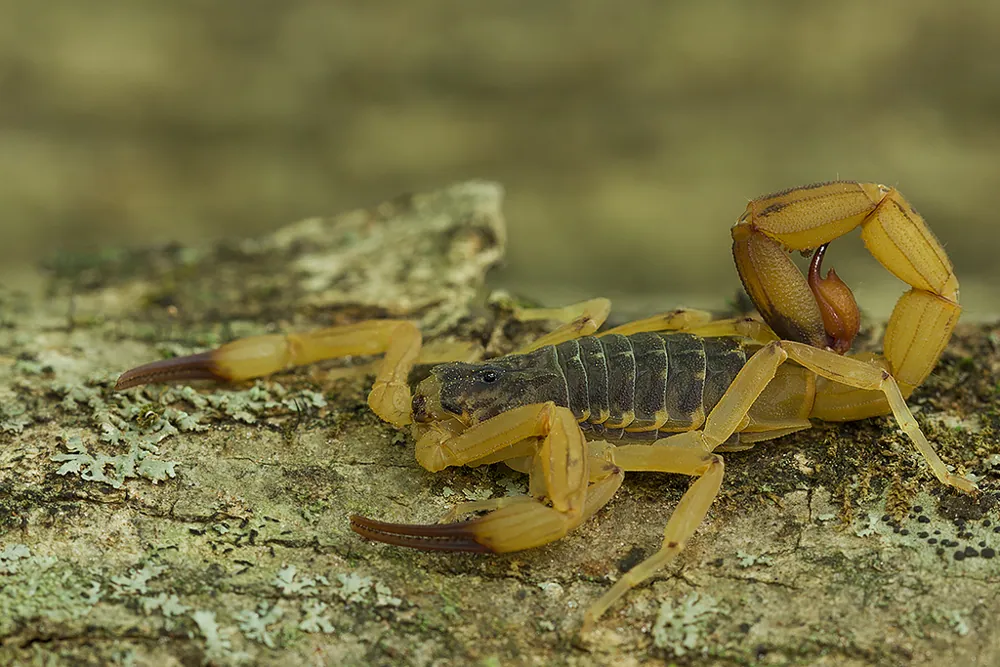
 Engeri y'okukitegeera
- Adults are usually 5 to 7 cm long.1
- Legs and pedipalps are pale yellow, while the body and the tip of the tail are a darker yellowish brown.1
- The tail is bulbous and segmented, with prominent ridges and serrations, and is often carried curved forward over the back.1
- The tail ends in a venom-injecting barb.1
Amaanyi g'obusagwa
Obusagwa buyita mu ggwa lyakyo eribojja.
Obusagwa bwakyo bukola ki?
Its venom contains an excitatory neurotoxin, which attacks the nerves that control involuntary body functions and releases adrenaline and related chemicals. Mild cases cause mainly localised pain, while more serious cases can bring fever, sweating, tremors, vomiting, agitation, a fast heartbeat and inflammation of the pancreas. Deaths can occur within 1 to 6 hours, or 12 to 14 hours, depending on age, health and the amount of venom injected.1
Kirina akabi kenkana wa eri abantu?
Akabi eri abantu: Kya kabi nnyoKisobola okutta omuntu atafunye bujjanjabi.It is responsible for more medically significant accidents than any other scorpion in Brazil, and most of the country's fatal scorpion cases. Mortality rates are 1.0 to 2.0% among children and elderly people. In a nationwide study from 2000 to 2012, Brazil recorded 482,616 scorpion accidents and 728 deaths, and this species was believed to cause most of those deaths.1
Kikola ki nga kitidde?
It uses its tail barb to deliver defensive strikes.1
 Bwe kibojja
- Nyogoza ekifo ekibojjeddwa ne ayisi era omuntu muleke ateetambula. Funa obuyambi bw'abasawo mangu, naddala ku baana: enjaba ezimu zitta abaana.
Bulijjo sooka kuba ennamba y'ebigwa bitalaze (112, 000, 911). Buno bulagirizi bwa bujjanjabi obusooka obwa bulijjo, si kuwabula kwa musawo. Obujjanjabi obusooka obw'omusingi
 Weekuume
- Tokwatako, tokwata wadde okusoomooza ensolo ey'omu nsiko, ne bw'eba ntono, era ne bw'eba erabika nga yeebase oba nga efudde.
- Gireke n'ebbanga. Bw'osisinkana emu, beera mukkakkamu, dda emabega mpola era gireke egende mu kkubo lyayo.
- Bw'emu ekubojja: beera mukkakkamu, totambula, kuba ennamba y'ebigwa bitalaze (112, 000, 911) oba tuuka mu ddwaliro mangu. Jjukira bwe yali efaanana, ekifaananyi kiyamba.
Tekikunoonya. Kikozesa obusagwa bwakyo okukwata emmere oba okwekuuma, era kyandisinze kwekweka. Ebirala ku kwekuuma
Wa mu nsi?
Kinene kyenkana wa?
Kiwanvu kyenkana wa?
 kiwanvu nga bbulooka 2 ez'okuzannyisa mu lunyiriri
 kyandisobodde okudduka mita 100 mu sikonda 260 (omuntu asinga embiro yeetaaga 9,6)
Brazilian yellow scorpion kinene kyenkana wa bw'ogeraageranya ne GGWE?
Kubala bwokka mu browser yo. Tewali kitterekebwa wadde okusindikibwa wonna.
Kidduka kyenkana wa?


Ebituufu
Reported scorpion stings in Brazil rose from 12,000 in 2000 to 140,000 by 2018.1
It has a low metabolic rate, so it can survive for months without eating.1
Scorpion numbers have grown in Brazilian cities, helped by plenty of cockroaches to eat and few predators.1
Its venom varies by region. Scorpions from Distrito Federal have an LD50 of 51.6 μg/kg, compared with 26 μg/kg for those from Minas Gerais. LD50 is the dose that kills half of the animals tested.1
Its tail is bulbous and segmented, with ridges and serrations, and it often curls forward over its back.1
Ebituufu we biva
- Tityus serrulatus (Wikipedia (CC BY-SA 4.0))
- Tityus serrulatus (iNaturalist): amannya n'ensengeka y'ebika.
- Venom Wiki: omutendera gw'akabi, obunene obwa bulijjo n'okuteebereza kw'embiro bibyaffe. Laba engeri gye tubibalamu: Engeri gye tupimamu akabi.
Buli kituufu ku lupapula luno kirina ennamba eraga we kyava. Bwe tuba tukoze ensobi, tusonyiwe, tuli bayagazi ba nsolo, so si magazini ya ssaayansi. Tubuulire ku [email protected] tujja kugitereeza.
 Enjaba erumwa enjala! Venom Wiki pulojekiti ya muntu omu: ya bwereere, tewali birango era tewali bikulondoola. Akasiimo akatono kayamba okugikuuma ku yintaneti.Liisa enjaba
Ebirala okuva mu kibinja kye kimu: Enjaba
 Amazonian black scorpion
 Caracas scorpion
 Panamanian black scorpion
 Zulia scorpion
 Amazon forest scorpion
 Argentine striped scorpion
Era kibeera mu: Amerika ey'Obukiikaddyo
 Golden poison frogEbikere eby'obutwa, ebikere ebinene (toads) ne newtsKittaTokwatako
 TerciopeloPit vipers (emisota egiwulira ebbugumu)Kitta
 Brazilian wandering spiderNnabbubiKisobola okutta
 Eyelash viperPit vipers (emisota egiwulira ebbugumu)Kisobola okutta
 Golden lanceheadPit vipers (emisota egiwulira ebbugumu)Kisobola okutta
 South American bushmasterPit vipers (emisota egiwulira ebbugumu)Kisobola okutta