
 Afirika
 Asiya
Asiya Bulaaya
 Amerika ey'Obukiikaddyo
 Awusitureeliya ne Oseyaniya
 Antakitika
 Oseyani ya Pasifiki
 Oseyani ya Atlantiki
 Oseyani y'e Buyindi
 Oseyani ya Arakitiki
 Ennyanja ya Mediterenia
 Ennyanja Emmyufu
 Ennyanja ya Karibiyani
 Ennyanja ya Korali
 Ennyanja ya China ey'Obukiikaddyo
 Ennyanja ya Bufilipino
 Ennyanja ya Andaman
 Ennyanja ey'Obukiikakkono (North Sea)
 Ennyanja ya Timor ne Arafura
 Ekikono kya Bengal
 Ekikono kya Kalifoniya
Cane toad
 Obutwa mu lususu lwakyoKirya: Katono ku buli kimuKya butwa, si kya busagwa
The cane toad is a large toad that is very poisonous to many animals. It is native to South and mainland Central America, but people have moved it to islands in Oceania and the Caribbean and to northern Australia. It matters because it spreads quickly and harms native wildlife and pets.1


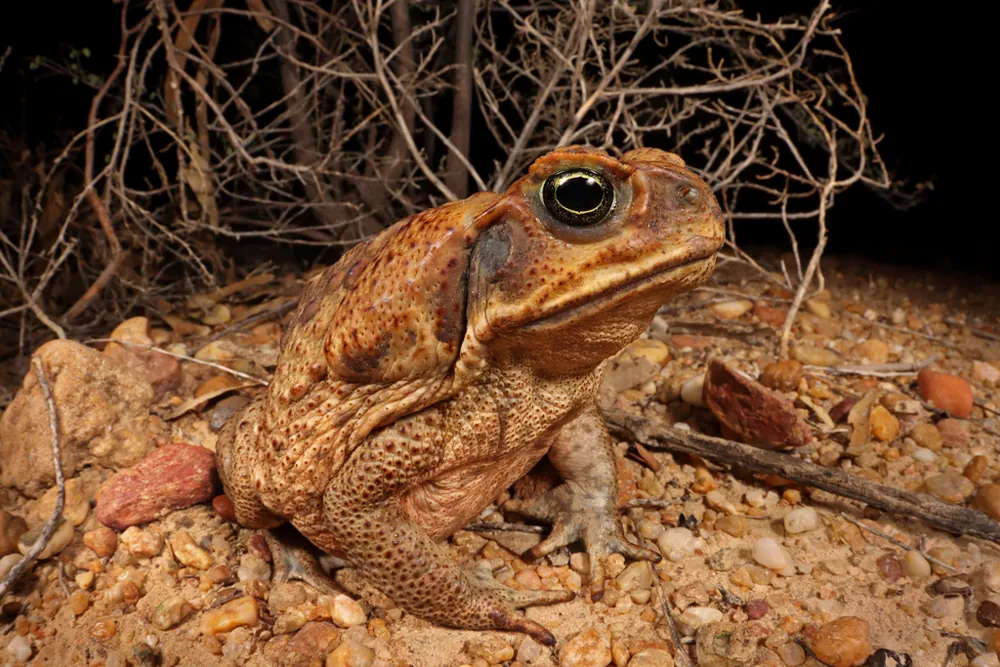
 Engeri y'okukitegeera
- Very large, with adults usually 10 to 15 cm long1
- Dry, warty skin with distinct ridges above the eyes that run down the snout1
- A large parotoid gland (a swollen gland) behind each eye1
- Grey, yellowish, red-brown or olive-brown skin, often with patterns1
- Horizontal pupils and golden irises1
Kitera okutabulwa ne: In Australia, adults can be confused with large native frogs, but these lack the large parotoid glands and the ridge between the nostril and eye. The giant burrowing frog has vertical pupils and silver-grey irises, while the cane toad has horizontal pupils and golden irises. In the United States, the southern toad has two bulbs in front of the parotoid glands.1
Amaanyi g'obutwa
Olususu lwakyo lwa butwa. Kya kabi okukwatako, okukomba oba okulya.
Obutwa bwakyo bukola ki?
The toad's glands secrete a milky-white fluid called bufotoxin when it is threatened. Components of bufotoxin are toxic to many animals. In dogs, signs of poisoning include excessive drooling, extremely red gums, head-shaking, crying and loss of coordination.1
Kirina akabi kenkana wa eri abantu?
Akabi eri abantu: Kya maanyiOmuntu bw'akikwatako oba bw'akirya, genda eri omusawo. Okufa kubaawo kitono nnyo.The toxic skin can kill many wild and domestic animals. Dogs are especially at risk from licking or biting the toad. Human deaths have also been recorded after people ate cane toads.1
Kikola ki nga kitidde?
When threatened, it releases bufotoxin from its glands.1
 Omuntu bw'aba nga akikutteko oba akiridde
- Omuntu bw'aba nga akutteko emu: naaza bulungi engalo era tokwata ku maaso wadde akamwa. Omwana oba ensolo y'awaka bw'aba ng'agikombye oba agiridde: kuba ekifo ekikola ku butwa (poison centre) oba ennamba y'ebigwa bitalaze.
Bulijjo sooka kuba ennamba y'ebigwa bitalaze (112, 000, 911). Buno bulagirizi bwa bujjanjabi obusooka obwa bulijjo, si kuwabula kwa musawo. Obujjanjabi obusooka obw'omusingi
 Weekuume
- Tokwatako, tokwata wadde okusoomooza ensolo ey'omu nsiko, ne bw'eba ntono, era ne bw'eba erabika nga yeebase oba nga efudde.
- Gireke n'ebbanga. Bw'osisinkana emu, beera mukkakkamu, dda emabega mpola era gireke egende mu kkubo lyayo.
- Bw'oba okikutteko oba okiridde: tokolokota maaso go wadde akamwa, naaza engalo zo era funa obuyambi bw'abasawo.
Tekikunoonya. Obutwa bwakyo buliwo bwokka tewabaawo kikirya. Ebirala ku kwekuuma
Wa mu nsi?
Kinene kyenkana wa?
Kiwanvu kyenkana wa?
 kiwanvu nga bbulooka 8 ez'okuzannyisa mu lunyiriri
 kyandisobodde okudduka mita 100 mu sikonda 180 (omuntu asinga embiro yeetaaga 9,6)
Cane toad kinene kyenkana wa bw'ogeraageranya ne GGWE?
Kubala bwokka mu browser yo. Tewali kitterekebwa wadde okusindikibwa wonna.
Kidduka kyenkana wa?


Ebituufu
Young toads lose the toxicity they had as eggs and tadpoles, and they only develop their poison glands later. Only an estimated 0.5% of cane toads reach adulthood.1
In Australia, tadpoles have evolved to be more likely to eat their siblings than tadpoles in South America.1
A female can lay thousands of eggs in one spawn, in strings up to 20 metres long.1
In the wild, cane toads can live 10 to 15 years, and one captive toad was reported to have lived 35 years.1
The cane toad is considered the largest species in the Bufonidae, the toad family.1
Cane toads eat both living and dead matter, which is unusual among frogs and toads.1
Omumenyi w'enfumo
Enfumo: The name 'marine toad' suggests that cane toads live in the sea.
Amazima: Cane toads do not live in the sea. The name came from a mistaken belief by an early naturalist.1
Ku bakugu mu busagwa
- Erinnya erya ssaayansi
- Rhinella marina
- Ekibinja
- Ebikere eby'obutwa, ebikere ebinene (toads) ne newts
- Amaka
- Bufonidae2
- Ensengeka
- Anura
- Ssemazinga
- Amerika ey'Obukiikakkono, Amerika ey'Obukiikaddyo
- Abaana abawere
- A female lays 8,000 to 25,000 eggs at once, in long jelly strings that can stretch up to 20 metres.1
- Obuwangaazi
- nga emyaka 151
- Akabi eri abantu
- 3 / 5: Kya maanyi3
Ebituufu we biva
- Cane toad (Wikipedia (CC BY-SA 4.0))
- Rhinella marina (iNaturalist): amannya n'ensengeka y'ebika.
- Venom Wiki: omutendera gw'akabi, obunene obwa bulijjo n'okuteebereza kw'embiro bibyaffe. Laba engeri gye tubibalamu: Engeri gye tupimamu akabi.
Buli kituufu ku lupapula luno kirina ennamba eraga we kyava. Bwe tuba tukoze ensobi, tusonyiwe, tuli bayagazi ba nsolo, so si magazini ya ssaayansi. Tubuulire ku [email protected] tujja kugitereeza.
 Enjaba erumwa enjala! Venom Wiki pulojekiti ya muntu omu: ya bwereere, tewali birango era tewali bikulondoola. Akasiimo akatono kayamba okugikuuma ku yintaneti.Liisa enjaba
Ebirala okuva mu kibinja kye kimu: Ebikere eby'obutwa, ebikere ebinene (toads) ne newts
 Golden poison frogEbikere eby'obutwa, ebikere ebinene (toads) ne newtsKittaTokwatako
 Dyeing poison dart frogEbikere eby'obutwa, ebikere ebinene (toads) ne newtsKiruma bwokkaTokwatako
 Strawberry poison-dart frogEbikere eby'obutwa, ebikere ebinene (toads) ne newtsKiruma bwokkaTokwatako
 Black-legged poison frogEbikere eby'obutwa, ebikere ebinene (toads) ne newtsKisobola okuttaTokwatako
 California newtEbikere eby'obutwa, ebikere ebinene (toads) ne newtsKisobola okuttaTokwatako
 Rough-skinned newtEbikere eby'obutwa, ebikere ebinene (toads) ne newtsKisobola okuttaTokwatako
Era kibeera mu: Amerika ey'Obukiikakkono
 TerciopeloPit vipers (emisota egiwulira ebbugumu)Kitta
 Eastern coral snakeEmisota gya korali (coral snakes)Kisobola okutta
 Eastern diamondback rattlesnakeRattlesnakeKisobola okutta
 Eyelash viperPit vipers (emisota egiwulira ebbugumu)Kisobola okutta
 Timber rattlesnakeRattlesnakeKisobola okutta
 Western diamondback rattlesnakeRattlesnakeKisobola okutta