
 Afirika
 Asiya
Asiya Bulaaya
 Amerika ey'Obukiikaddyo
 Awusitureeliya ne Oseyaniya
 Antakitika
 Oseyani ya Pasifiki
 Oseyani ya Atlantiki
 Oseyani y'e Buyindi
 Oseyani ya Arakitiki
 Ennyanja ya Mediterenia
 Ennyanja Emmyufu
 Ennyanja ya Karibiyani
 Ennyanja ya Korali
 Ennyanja ya China ey'Obukiikaddyo
 Ennyanja ya Bufilipino
 Ennyanja ya Andaman
 Ennyanja ey'Obukiikakkono (North Sea)
 Ennyanja ya Timor ne Arafura
 Ekikono kya Bengal
 Ekikono kya Kalifoniya
Common house spider
 Kiruma
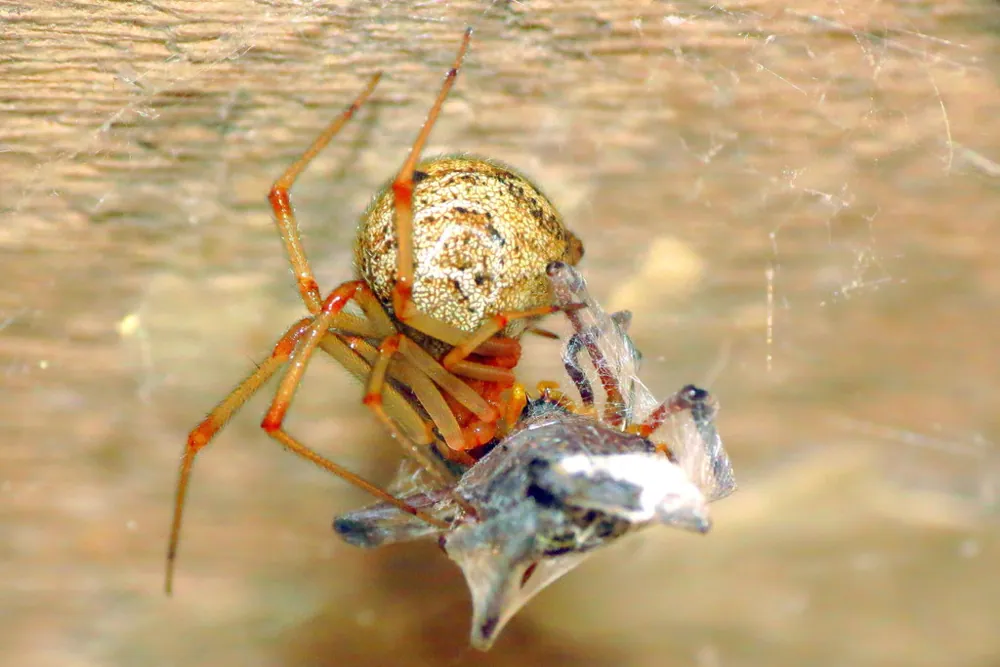
The common house spider is a small spider that lives in and around human homes. It spins messy three-dimensional webs in dark corners and catches household insects. It is found in many parts of the world, and its bite is not known to be dangerous to people.1



 Engeri y'okukitegeera
- Its colour varies from tan to nearly black, often with patterns of different shades on the body.1
- Females are usually 5 to 6 mm long, and males are usually 3.8 to 4.7 mm long.1
- With legs outspread, it can measure 2.5 cm or more across.1
- Its webs are three-dimensional and built in dark corners.1
Kitera okutabulwa ne: Its body shape is similar to that of widow spiders. Males have a less bulbous (rounded) abdomen than females.1
Amaanyi g'obusagwa
Obusagwa buyita mu mannyo gaakyo amawanvu (fangs) oba mu mannyo amalala nga kiruma.
Obusagwa bwakyo bukola ki?
It has neurotoxic venom, which attacks the nerves. Its bites are less severe than those of other theridiids (a family of cobweb spiders).1
Kirina akabi kenkana wa eri abantu?
Akabi eri abantu: KitonoNga okubojja kw'enjuki oba okutono okusingawo. Kumpi tekirina kabi eri abantu.Its bites are not known to be dangerous to humans. It bites people only in self-defence, when it is grabbed and squeezed.1
Kikola ki nga kitidde?
It runs to a secure hiding place when it senses movement, and if cornered it plays dead as a last resort.1
 Bwe kiruma
- Naaza ekifo ekirumiddwa era okiteekeko ayisi olw'obulumi. Funa obuyambi bw'abasawo singa obulumi bungi, busaasaana oba omuntu awulira bubi.
Bulijjo sooka kuba ennamba y'ebigwa bitalaze (112, 000, 911). Buno bulagirizi bwa bujjanjabi obusooka obwa bulijjo, si kuwabula kwa musawo. Obujjanjabi obusooka obw'omusingi
 Weekuume
- Tokwatako, tokwata wadde okusoomooza ensolo ey'omu nsiko, ne bw'eba ntono, era ne bw'eba erabika nga yeebase oba nga efudde.
- Gireke n'ebbanga. Bw'osisinkana emu, beera mukkakkamu, dda emabega mpola era gireke egende mu kkubo lyayo.
- Bw'emu ekuluma: beera mukkakkamu, totambula, kuba ennamba y'ebigwa bitalaze (112, 000, 911) oba tuuka mu ddwaliro mangu. Jjukira bwe yali efaanana, ekifaananyi kiyamba.
Tekikunoonya. Kikozesa obusagwa bwakyo okukwata emmere oba okwekuuma, era kyandisinze kwekweka. Ebirala ku kwekuuma
Wa mu nsi?
Kinene kyenkana wa?
Kiwanvu kyenkana wa?
 kitono nnyo nti kisobola okutuula ku lwala lwo
Common house spider kinene kyenkana wa bw'ogeraageranya ne GGWE?
Kubala bwokka mu browser yo. Tewali kitterekebwa wadde okusindikibwa wonna.
Kidduka kyenkana wa?


Ebituufu
The assassin bug Stenolemus lanipes apparently feeds only on its young, though it can also eat adults.1
When food dries out, it usually drops it to the floor to free up space in its web, rather than rebuilding the web.1
It has poor eyesight and cannot detect movement more than three to four inches away.1
Males and females often share the same web for long periods, though females sometimes fight when they meet.1
Omumenyi w'enfumo
Enfumo: Common house spiders are dangerous to people.
Amazima: Their venom is neurotoxic, but their bites are not known to be dangerous to humans. They bite only when grabbed and squeezed.1
Ku bakugu mu busagwa
- Erinnya erya ssaayansi
- Parasteatoda tepidariorum
- Ekibinja
- Nnabbubi
- Amaka
- Theridiidae2
- Ensengeka
- Araneae
- Ssemazinga
- Amerika ey'Obukiikakkono, Amerika ey'Obukiikaddyo
- Abaana abawere
- Females hang their spherical egg sacs in their webs, with clutches averaging 149 eggs. The young stay in the mother's web for several days after hatching.1
- Akabi eri abantu
- 1 / 5: Kitono3
Ebituufu we biva
- Parasteatoda tepidariorum (Wikipedia (CC BY-SA 4.0))
- Parasteatoda tepidariorum (iNaturalist): amannya n'ensengeka y'ebika.
- Venom Wiki: omutendera gw'akabi, obunene obwa bulijjo n'okuteebereza kw'embiro bibyaffe. Laba engeri gye tubibalamu: Engeri gye tupimamu akabi.
Buli kituufu ku lupapula luno kirina ennamba eraga we kyava. Bwe tuba tukoze ensobi, tusonyiwe, tuli bayagazi ba nsolo, so si magazini ya ssaayansi. Tubuulire ku [email protected] tujja kugitereeza.
 Enjaba erumwa enjala! Venom Wiki pulojekiti ya muntu omu: ya bwereere, tewali birango era tewali bikulondoola. Akasiimo akatono kayamba okugikuuma ku yintaneti.Liisa enjaba
Ebirala okuva mu kibinja kye kimu: Nnabbubi
 Brazilian wandering spider
 Brown recluse
 Southern black widow
 Amazon wandering spider
 Chilean recluse
 Northern black widow
Era kibeera mu: Amerika ey'Obukiikakkono
 TerciopeloPit vipers (emisota egiwulira ebbugumu)Kitta
 Eastern coral snakeEmisota gya korali (coral snakes)Kisobola okutta
 Eastern diamondback rattlesnakeRattlesnakeKisobola okutta
 Eyelash viperPit vipers (emisota egiwulira ebbugumu)Kisobola okutta
 Timber rattlesnakeRattlesnakeKisobola okutta
 Western diamondback rattlesnakeRattlesnakeKisobola okutta