
 Afirika
 Asiya
Asiya Bulaaya
 Amerika ey'Obukiikaddyo
 Awusitureeliya ne Oseyaniya
 Antakitika
 Oseyani ya Pasifiki
 Oseyani ya Atlantiki
 Oseyani y'e Buyindi
 Oseyani ya Arakitiki
 Ennyanja ya Mediterenia
 Ennyanja Emmyufu
 Ennyanja ya Karibiyani
 Ennyanja ya Korali
 Ennyanja ya China ey'Obukiikaddyo
 Ennyanja ya Bufilipino
 Ennyanja ya Andaman
 Ennyanja ey'Obukiikakkono (North Sea)
 Ennyanja ya Timor ne Arafura
 Ekikono kya Bengal
 Ekikono kya Kalifoniya
Lion's mane jellyfish
 Ebiwuuzi ebibojja
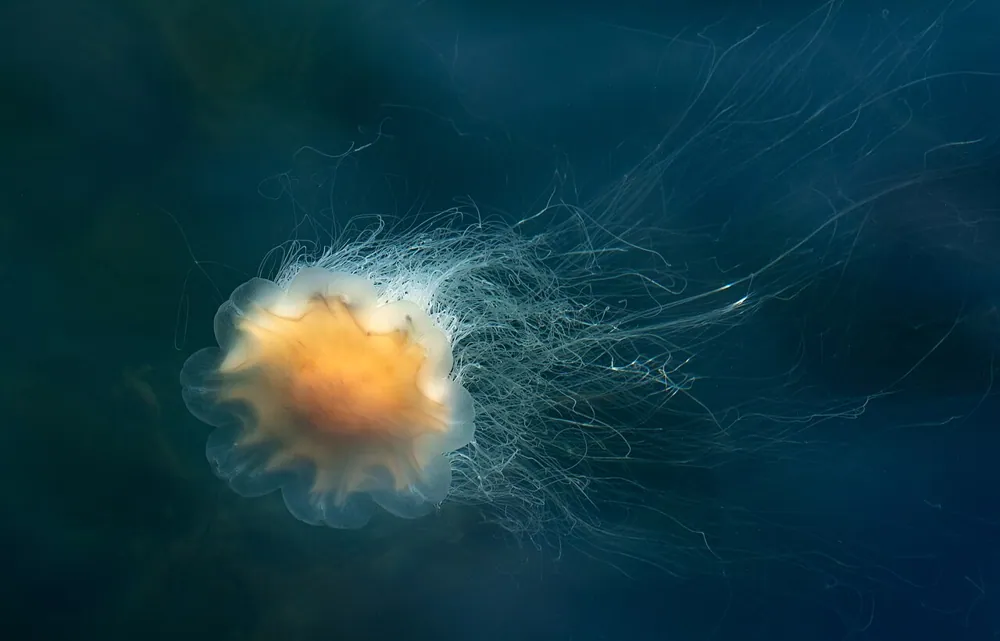
The lion's mane jellyfish is one of the largest jellyfish known, and its bell can be over 2 m across in the far north. It lives in cold northern seas, including the English Channel, the North Sea and the Irish Sea. Its long, trailing stinging tentacles can wash up on beaches in late summer and autumn.1



 Engeri y'okukitegeera
- Bell is divided into eight lobes, giving it the look of an eight-point star1
- Young ones are light orange or tan, darkening to red and purple as they grow1
- Long, thin, trailing tentacles, with many more tentacles around the mouth1
- Bell is often about 50 cm across in lower latitudes, and much larger in the far north1
- Usually found alone, rarely in groups1
Kitera okutabulwa ne: The blue jellyfish (Cyanea lamarckii) is sometimes found in the same waters. It is blue rather than red, and smaller, with a bell of about 10 to 20 cm across.1
Amaanyi g'obusagwa
Enkumi n'enkumi z'obutoffaali obutono obubojja zikuba ekintu bwe kizikwatako.
Obusagwa bwakyo bukola ki?
Its tentacles carry stinging cells, called nematocysts, which inject a sting when touched. The sting is very painful and feels like intense itching or burning, and it can cause temporary pain and redness where the skin was touched. Stings across large parts of the body can cause whole-body (systemic) effects, and medical attention is recommended in that case.1
Kirina akabi kenkana wa eri abantu?
Akabi eri abantu: Kya bulumiKisobola okuluma ddala, naye kumpi tekiba kya kabi kinene.Stings are not known to be fatal in healthy people, and there is normally no real danger, though people with special allergies may be at risk. Rare severe stings in deep water can cause panic, which may lead to drowning. In July 2010, about 150 beachgoers were stung by the remains of one broken-up jellyfish on a beach in New Hampshire, US.1
 Bwe kibojja
- Vinegar can be used to deactivate the stinging cells. If you have touched a large number of tentacles, get medical attention after exposure.1
- Va mu mazzi era ggyako ebiwuuzi (tentacles) byonna (ng'okozesa ggalavu oba olugoye).
- Ku box jellyfish ez'omu bitundu ebibuguma: yiwa viniga ku bifo ebibojjeddwa okumala waakiri sikonda 30, kuba essimu okufuna obuyambi era beera mwetegefu okukola CPR. Ku bluebottles n'endala ezisinga: yozaayo n'amazzi g'ennyanja, oluvannyuma amazzi agookya olw'obulumi.
Bulijjo sooka kuba ennamba y'ebigwa bitalaze (112, 000, 911). Buno bulagirizi bwa bujjanjabi obusooka obwa bulijjo, si kuwabula kwa musawo. Obujjanjabi obusooka obw'omusingi
 Weekuume
- Tokwatako, tokwata wadde okusoomooza ensolo ey'omu nsiko, ne bw'eba ntono, era ne bw'eba erabika nga yeebase oba nga efudde.
- Gireke n'ebbanga. Bw'osisinkana emu, beera mukkakkamu, dda emabega mpola era gireke egende mu kkubo lyayo.
- Bw'emu ekubojja: beera mukkakkamu, totambula, kuba ennamba y'ebigwa bitalaze (112, 000, 911) oba tuuka mu ddwaliro mangu. Jjukira bwe yali efaanana, ekifaananyi kiyamba.
Tekikunoonya. Kikozesa obusagwa bwakyo okukwata emmere oba okwekuuma, era kyandisinze kwekweka. Ebirala ku kwekuuma
Wa mu nsi?
Kinene kyenkana wa?
Kiwanvu kyenkana wa?
 kiwanvu nga kkapa ez'awaka 4 okuva ku nnyindo okutuuka ku mukira
 kiwanvu nga ndiizi 12 eziteekeddwa mu lunyiriri
 kyandisobodde okuwuga obuwanvu bw'ekidiba ekinene (m 50) mu sikonda 140
Lion's mane jellyfish kinene kyenkana wa bw'ogeraageranya ne GGWE?
Kubala bwokka mu browser yo. Tewali kitterekebwa wadde okusindikibwa wonna.
Kidduka kyenkana wa?

Ebituufu
The longest recorded tentacles were 36.6 m long, longer than a blue whale.1
Its tentacles can still sting for up to 25 days after they have detached from the jellyfish.1
Each of the eight lobes of its bell has about 70 to 150 tentacles, and it has around 1,200 tentacles near its mouth.1
The leatherback sea turtle feeds almost exclusively on lion's mane jellyfish in large numbers during summer around Eastern Canada.1
Unlike most jellyfish that drift in groups, the lion's mane is completely solitary.1
Omumenyi w'enfumo
Enfumo: The lion's mane jellyfish is the longest animal in the world.
Amazima: This claim was made on a TV show, but it was corrected. A bootlace worm reported in 1864 was said to be over 55 m long, and that report is doubted because bootlace worms can stretch well beyond their natural length. If that report is wrong, the lion's mane would be the longest animal.1
Ku bakugu mu busagwa
- Erinnya erya ssaayansi
- Cyanea capillata
- Ekibinja
- Jellyfish n'ebibojja eby'ennyanja
- Amaka
- Cyaneidae2
- Ensengeka
- Semaeostomeae
- Ssemazinga
- Oseyani ya Arakitiki, Oseyani ya Atlantiki, Oseyani ya Pasifiki, Ennyanja ey'Obukiikakkono (North Sea), Oseyani
- Abaana abawere
- The female carries fertilised eggs in a tentacle, and they grow into larvae that settle on a hard surface and become polyps, which then produce young jellyfish called ephyrae.1
- Obuwangaazi
- nga emyaka 11
- Akabi eri abantu
- 2 / 5: Kya bulumi3
Ebituufu we biva
- Lion's mane jellyfish (Wikipedia (CC BY-SA 4.0))
- Cyanea capillata (iNaturalist): amannya n'ensengeka y'ebika.
- Venom Wiki: omutendera gw'akabi, obunene obwa bulijjo n'okuteebereza kw'embiro bibyaffe. Laba engeri gye tubibalamu: Engeri gye tupimamu akabi.
Buli kituufu ku lupapula luno kirina ennamba eraga we kyava. Bwe tuba tukoze ensobi, tusonyiwe, tuli bayagazi ba nsolo, so si magazini ya ssaayansi. Tubuulire ku [email protected] tujja kugitereeza.
 Enjaba erumwa enjala! Venom Wiki pulojekiti ya muntu omu: ya bwereere, tewali birango era tewali bikulondoola. Akasiimo akatono kayamba okugikuuma ku yintaneti.Liisa enjaba
Ebirala okuva mu kibinja kye kimu: Jellyfish n'ebibojja eby'ennyanja
 Australian box jellyfishJellyfish n'ebibojja eby'ennyanjaKittaTokwatako
 Irukandji jellyfishJellyfish n'ebibojja eby'ennyanjaKisobola okuttaTokwatako
 Portuguese man o' warJellyfish n'ebibojja eby'ennyanjaKyetaaga omusawoTokwatako
 Moon jellyfishJellyfish n'ebibojja eby'ennyanjaTekirina kabi
 Common kingslayerJellyfish n'ebibojja eby'ennyanjaKisobola okuttaTokwatako
 Hell's fire anemoneJellyfish n'ebibojja eby'ennyanjaKyetaaga omusawoTokwatako
 Greenland shark
 Spiny dogfish
 Bootlace worm