
 Afirika
 Asiya
Asiya Bulaaya
 Amerika ey'Obukiikaddyo
 Awusitureeliya ne Oseyaniya
 Antakitika
 Oseyani ya Pasifiki
 Oseyani ya Atlantiki
 Oseyani y'e Buyindi
 Oseyani ya Arakitiki
 Ennyanja ya Mediterenia
 Ennyanja Emmyufu
 Ennyanja ya Karibiyani
 Ennyanja ya Korali
 Ennyanja ya China ey'Obukiikaddyo
 Ennyanja ya Bufilipino
 Ennyanja ya Andaman
 Ennyanja ey'Obukiikakkono (North Sea)
 Ennyanja ya Timor ne Arafura
 Ekikono kya Bengal
 Ekikono kya Kalifoniya
Southern yellowjacket
 Kibojja
The southern yellowjacket is a social wasp with black and yellow stripes and an orange queen. It lives in eastern North America and further south into Central America. Its nests are often in yards, parks and by roads, so people meet it often, and its stings are painful.1



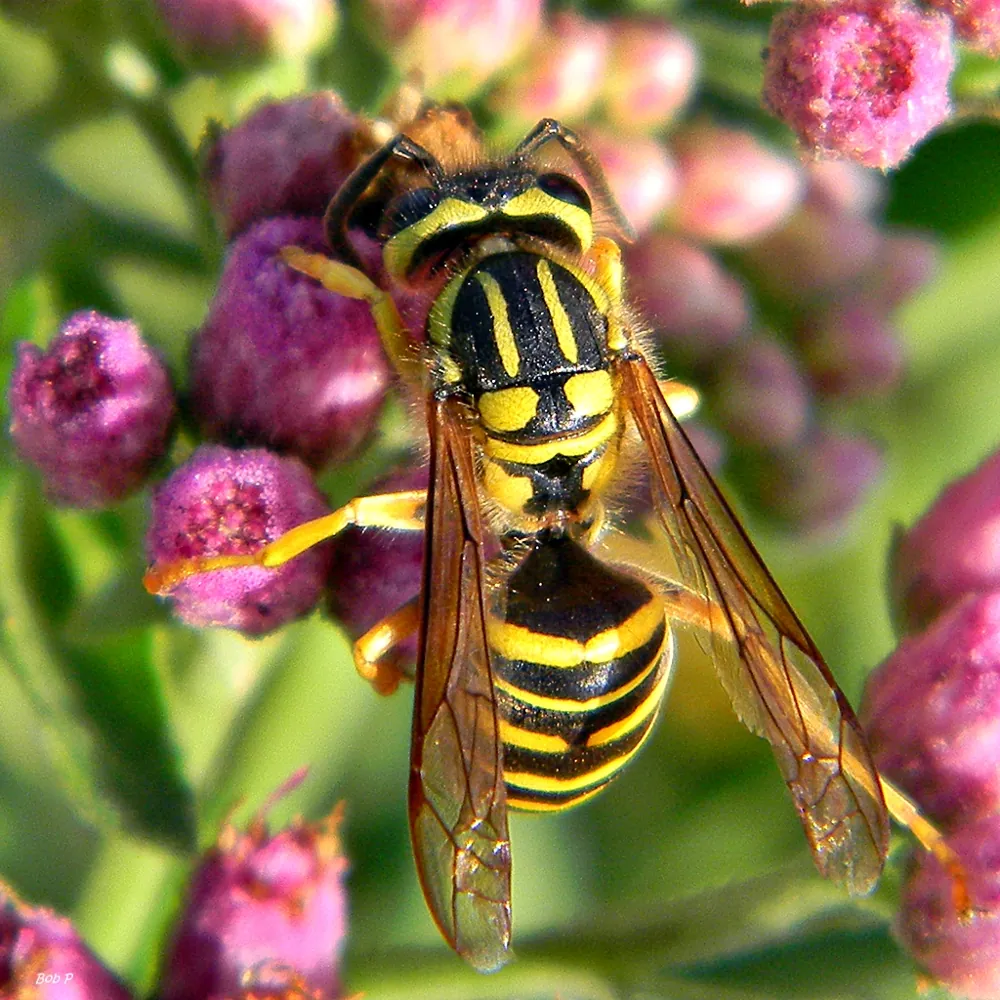
 Engeri y'okukitegeera
- Black body with yellow striping over the whole body1
- Clear wings and a hairless body1
- About 1.3 cm long1
- The queen is larger than the males and workers and is more orange in colour1
- Has two stripes on its scuta1
Kitera okutabulwa ne: Its two stripes on the scuta are shared with V. sulphurea. The queen looks different from the workers and males, so check the colour and size of the wasp you see.1
Amaanyi g'obusagwa
Obusagwa buyita mu ggwa lyakyo eribojja.
Obusagwa bwakyo bukola ki?
Its stings are venomous, and the venom causes pain. Workers can sting several times in one attack.1
Kirina akabi kenkana wa eri abantu?
Akabi eri abantu: Kya bulumiKisobola okuluma ddala, naye kumpi tekiba kya kabi kinene.The species is considered a pest because its nests are close to people and can be large. Close contact with people commonly leads to multiple, painful stings. Disturbing a nest can result in several stings.1
Kikola ki nga kitidde?
Workers release alarm pheromones that signal the rest of the colony to attack whatever threatens the nest. Their stings are typically used in defence of the colony.1
 Bwe kibojja
- Kalakata oggyemu eriggwa ly'enjuki era onyogoze ekifo.
- Omuntu bw'aba nga tassa bulungi, ng'azimbye mu maaso oba mu mumiro, oba ng'awulira ng'agenda kuzirika, buno bubenje bwa alergy obw'amangu: kuba ennamba y'ebigwa bitalaze era kozesa empiso ye eya adrenaline (adrenaline pen) bw'aba nga agirina.
Bulijjo sooka kuba ennamba y'ebigwa bitalaze (112, 000, 911). Buno bulagirizi bwa bujjanjabi obusooka obwa bulijjo, si kuwabula kwa musawo. Obujjanjabi obusooka obw'omusingi
 Weekuume
- Tokwatako, tokwata wadde okusoomooza ensolo ey'omu nsiko, ne bw'eba ntono, era ne bw'eba erabika nga yeebase oba nga efudde.
- Gireke n'ebbanga. Bw'osisinkana emu, beera mukkakkamu, dda emabega mpola era gireke egende mu kkubo lyayo.
- Bw'emu ekubojja: beera mukkakkamu, totambula, kuba ennamba y'ebigwa bitalaze (112, 000, 911) oba tuuka mu ddwaliro mangu. Jjukira bwe yali efaanana, ekifaananyi kiyamba.
Tekikunoonya. Kikozesa obusagwa bwakyo okukwata emmere oba okwekuuma, era kyandisinze kwekweka. Ebirala ku kwekuuma
Wa mu nsi?
Kinene kyenkana wa?
Kiwanvu kyenkana wa?
 kitono nnyo nti kisobola okutuula ku lwala lwo
 kyandisobodde okubuuka okusala ekisaawe ky'omupiira kyonna mu sikonda 16
Southern yellowjacket kinene kyenkana wa bw'ogeraageranya ne GGWE?
Kubala bwokka mu browser yo. Tewali kitterekebwa wadde okusindikibwa wonna.
Kidduka kyenkana wa?


_(7225863346).jpg)
Ebituufu
Most southern yellowjackets are social parasites: they build their nests around the nests of another species.1
About 85% of colonies start when a queen takes over a small nest of the eastern yellowjacket, V. maculifrons, and only about 15% are founded independently.1
Some nests are very large. One of the biggest reported was in a pine tree and the dirt beneath it, and it had over 50 combs in the trunk alone.1
In Florida and other southern coastal areas, some nests survive the winter and last for several years.1
Workers and queens use pheromones to communicate, with alarm signals for attacks and a different pheromone that attracts males to the queen.1
Ku bakugu mu busagwa
Ebituufu we biva
- Vespula squamosa (Wikipedia (CC BY-SA 4.0))
- Vespula squamosa (iNaturalist): amannya n'ensengeka y'ebika.
- Venom Wiki: omutendera gw'akabi, obunene obwa bulijjo n'okuteebereza kw'embiro bibyaffe. Laba engeri gye tubibalamu: Engeri gye tupimamu akabi.
Buli kituufu ku lupapula luno kirina ennamba eraga we kyava. Bwe tuba tukoze ensobi, tusonyiwe, tuli bayagazi ba nsolo, so si magazini ya ssaayansi. Tubuulire ku [email protected] tujja kugitereeza.
 Enjaba erumwa enjala! Venom Wiki pulojekiti ya muntu omu: ya bwereere, tewali birango era tewali bikulondoola. Akasiimo akatono kayamba okugikuuma ku yintaneti.Liisa enjaba
Ebirala okuva mu kibinja kye kimu: Enjuki, ennumba n'ennumba ennene
 Tarantula hawkEnjuki, ennumba n'ennumba enneneKiruma bwokka
 Executioner waspEnjuki, ennumba n'ennumba enneneKyetaaga omusawo
 Warrior waspEnjuki, ennumba n'ennumba enneneKyetaaga omusawo
 Bald-faced hornetEnjuki, ennumba n'ennumba enneneKiruma bwokka
 Cow killer velvet antEnjuki, ennumba n'ennumba enneneKiruma bwokka
 Eastern cicada killerEnjuki, ennumba n'ennumba enneneTekirina kabi
Era kibeera mu: Amerika ey'Obukiikakkono
 TerciopeloPit vipers (emisota egiwulira ebbugumu)Kitta
 Eastern coral snakeEmisota gya korali (coral snakes)Kisobola okutta
 Eastern diamondback rattlesnakeRattlesnakeKisobola okutta
 Eyelash viperPit vipers (emisota egiwulira ebbugumu)Kisobola okutta
 Timber rattlesnakeRattlesnakeKisobola okutta
 Western diamondback rattlesnakeRattlesnakeKisobola okutta