
 Afrika
 Azia
Azia Erópa
Erópa Amerika ya Sude
 Australia & Océanie
 Antarctique
 Océan Pacifique
 Océan Atlantique
 Océan Indien
 Océan Arctique
 Mer Méditerranée
 Mer Rouge
 Mer des Caraïbes
 Mer de Corail
 Mer de Chine méridionale
 Mer des Philippines
 Mer d'Andaman
 Mer du Nord
 Mer de Timor & Mer d'Arafura
 Golfe du Bengale
 Golfe de Californie
European purseweb spider
 Kosua
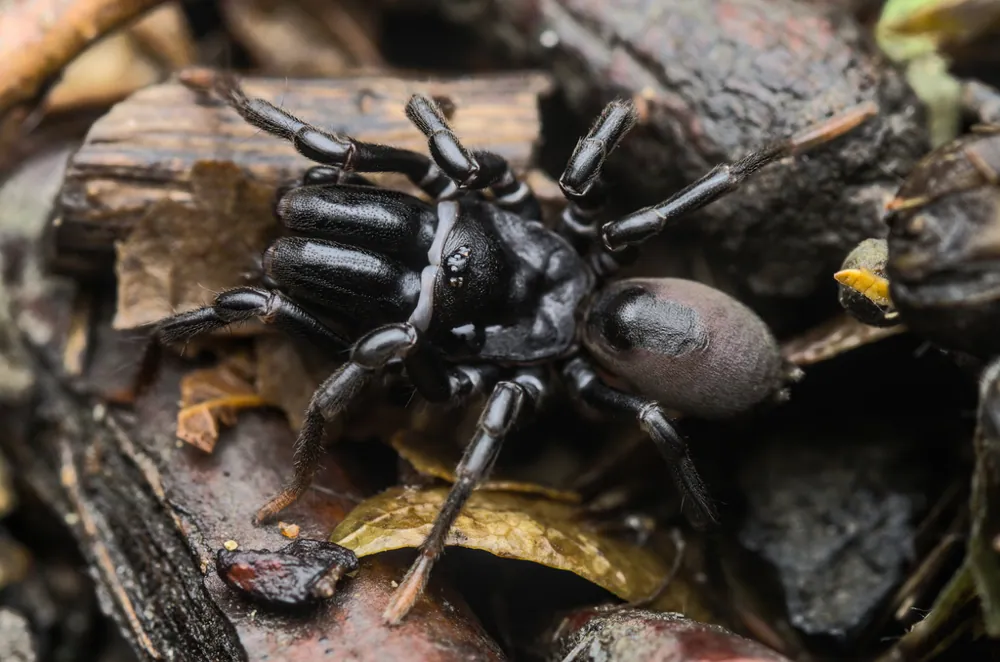
KosuaThe European purseweb spider is a small, hidden spider that lives in the ground. It is found in mainland Europe, Great Britain and North Africa, and it is the only mygalomorph spider found in the Nordic countries and the United Kingdom. It is special because it builds a silk tube partly under the ground and catches insects that walk onto it.1

 Ndenge ya koyeba yango
- Black or brownish in colour1
- Not particularly large: males are 7–9 mm and females are 10–15 mm long1
- Builds a silk tube that is partly underground, with the part above ground covered in leaves and other debris1
- Usually stays inside its web and does not leave except to mate1
- Young spiderlings are often very lightly coloured1
Bakosanaka yango mbala mingi na: It looks much like Atypus piceus. Spiderlings of the European purseweb spider are often very lightly coloured, and its three-part posterior spinnerets do not have a light blot, which helps tell them apart.1
Makasi ya venin
Venin ebimaka na nzela ya mino na yango ntango esui.
Likama na yango mpo na bato ezali boni?
Likama mpo na bato: Ya mokeLokola kotuba ya nzoi to moke koleka. Pene na likama te mpo na bato. Soki esui
- Sukola esika esui mpe pesa yango malili. Luka lisalisi ya monganga soki pasi ezali makasi to moto ayoki nzoto malamu te.
Benga ntango nyonso nimero ya urgence liboso (112, 000, 911). Oyo ezali toli ya lisalisi ya liboso, ezali toli ya monganga te. Makambo ya moboko ya lisalisi ya liboso
 Zala na libateli
- Ata mokolo moko te, simba, kanga to silikisa nyama ya zamba te, ata ya moke, mpe ata soki emonani lokola elali to ekufi.
- Tika yango esika. Soki okutani na moko, zala kimia, zonga sima malembe mpe tika ekende nzela na yango.
- Soki moko esui yo: zala kimia, ningana te, benga nimero ya urgence na yo (112, 000, 911) to kende na lopitalo noki. Kanisa ndenge ezalaki, foto esalisaka.
Ezali koluka yo te. Esalelaka venin na yango mpo na kokanga bilei to komibatela, mpe elingaka mingi kobombama. Makambo mosusu mpo na komibatela
Monene na yango boni?
Molai na yango boni?
 mokuse koleka mosapi na yo ya moke
 ekoki kopota metre 100 na sekonde 330 (moto ya mbangu koleka asengaka 9,6)
European purseweb spider azali monene boni soki tokokanisi na YO?
Kaka ba calcul na navigateur na yo. Eloko moko te ebombamaka to etindamaka esika moko.
Mbangu na yango boni?


Makambo ya solo
Its fangs point straight down rather than crossing, as in other mygalomorph spiders.1
Autumn is its mating season. The male enters the female's burrow, where they live together until the male dies soon after mating.1
It is a mygalomorph spider, and it is the only mygalomorph spider found in the Nordic countries and the United Kingdom.1
It becomes sexually mature at about 4 years old.1
Solo to lokuta?
Lokuta: The European purseweb spider lives in Ireland.
Solo: It was once listed for Ireland, based on a single silk tube found in 1896. This is now thought to be most likely from a plant nursery import, and the species is no longer recognised as living on the island.1
Mpo na ba expert ya venin
Esika makambo euti
- Atypus affinis (Wikipedia (CC BY-SA 4.0))
- Atypus affinis (iNaturalist): bankombo mpe classification.
- Venom Wiki: niveau ya likama, monene ya momesano mpe kokanisa ya mbangu ezali ya biso moko. Tala ndenge tolukaka yango: Ndenge tomekaka likama.
Likambo nyonso na lokasa oyo ezali na nimero oyo elakisi source na yango. Soki tosali libunga, limbisa biso, tozali bato oyo balingaka banyama, zulunale ya siansi te. Yebisa biso na [email protected] mpe tokobongisa yango.
 Scorpion azali na nzala! Venom Wiki ezali mosala ya moto moko: ya ofele, pibilisite te mpe trackers te. Mwa mbongo moke ya kosalisa esalisaka mpo ete etikala na internet.Pesa scorpion bilei
Mosusu ya ebota moko: Ba mygale & ba funnel-web
 Gibraltar funnel-web spiderBa mygale & ba funnel-webEpesaka kaka pasi
 Andalusian tarantulaBa mygale & ba funnel-webEzangi likama
 Sydney funnel-web spiderBa mygale & ba funnel-webEkoki koboma
 Goliath birdeaterBa mygale & ba funnel-webEpesaka kaka pasi
 Mexican redknee tarantulaBa mygale & ba funnel-webEzangi likama
 Northern tree-dwelling funnel-web spiderBa mygale & ba funnel-webEkoki koboma
Ezalaka mpe na: Erópa
 Common European adderBa vipère & ba adderEsengeli monganga
 Spanish flyBanyama mosusu ya poisonEsengeli mongangaKosimba te
 Common waspNzoi, ba guêpe & ba frelonEpesaka kaka pasi
 European hornetNzoi, ba guêpe & ba frelonEpesaka kaka pasi
 Fire salamanderBa grenouille ya poison, ba crapaud & ba tritonEpesaka kaka pasiKosimba te
 Western honey beeNzoi, ba guêpe & ba frelonEpesaka kaka pasi