
 Afrika
 Azia
Azia Erópa
Erópa Amerika ya Sude
 Australia & Océanie
 Antarctique
 Océan Pacifique
 Océan Atlantique
 Océan Indien
 Océan Arctique
 Mer Méditerranée
 Mer Rouge
 Mer des Caraïbes
 Mer de Corail
 Mer de Chine méridionale
 Mer des Philippines
 Mer d'Andaman
 Mer du Nord
 Mer de Timor & Mer d'Arafura
 Golfe du Bengale
 Golfe de Californie
Gooty sapphire tarantula
 Kosua
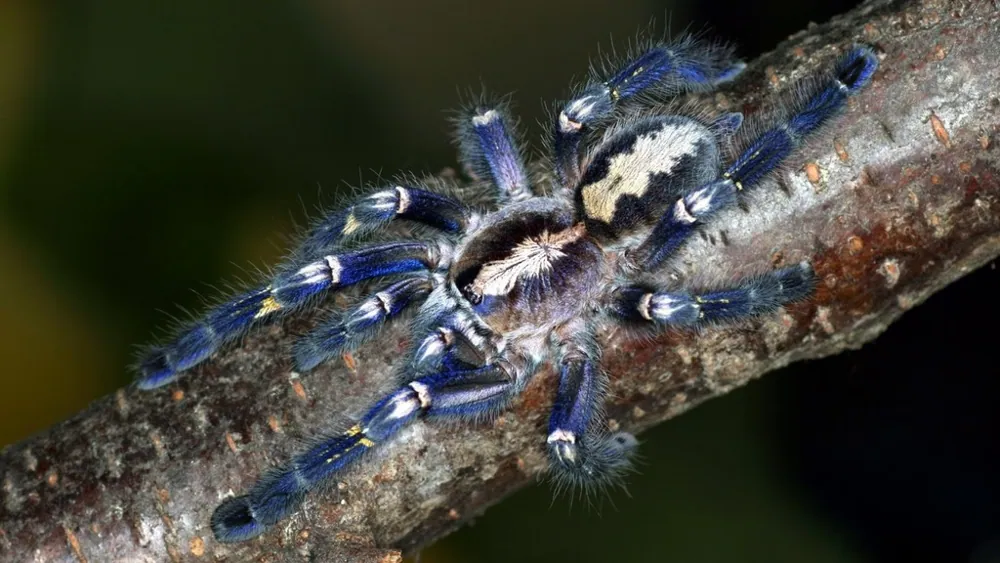
KosuaThe Gooty sapphire tarantula is a large spider with bright blue hair, the only blue species in its genus. It lives in a small patch of forest in southern India, where it makes its home in holes in tall trees. It is critically endangered, so it is rare and needs protection.1

 Ndenge ya koyeba yango
- Covered in blue hair, the only blue species in the genus Poecilotheria1
- An intricate, fractal-like geometric pattern on the abdomen1
- Young spiders are less colourful; the blue becomes stronger as they mature1
- Mature males are more slender, with longer legs than females1
- Full-grown leg span of 15 to 20 cm1
Makasi ya venin
Venin ebimaka na nzela ya mino na yango ntango esui.
Venin na yango esalaka nini?
Its venom may cause intense pain, although this is judged from the experience of keepers bitten by other spiders in the genus. A bite may cause a rise in heart rate, followed by sweating, headache, stinging, cramping or swelling. These effects can last for up to a week.1
Likama na yango mpo na bato ezali boni?
Likama mpo na bato: Ya makasiSoki esui yo, kende epai ya monganga. Kokufa ezalaka mpenza mbala moke.No human death from its bite has ever been recorded. Its bite is still considered medically significant. Most bites are dry bites, where no venom is injected. It can move quickly and may defend itself when cornered.1
Esalaka nini ntango ebangi?
It is skittish and will try to flee first. It also flees from light, as it is sensitive to it. If provoked, it may bite.1
 Soki esui
- Sukola esika esui mpe pesa yango malili. Luka lisalisi ya monganga soki pasi ezali makasi to moto ayoki nzoto malamu te.
Benga ntango nyonso nimero ya urgence liboso (112, 000, 911). Oyo ezali toli ya lisalisi ya liboso, ezali toli ya monganga te. Makambo ya moboko ya lisalisi ya liboso
 Zala na libateli
- Ata mokolo moko te, simba, kanga to silikisa nyama ya zamba te, ata ya moke, mpe ata soki emonani lokola elali to ekufi.
- Tika yango esika. Soki okutani na moko, zala kimia, zonga sima malembe mpe tika ekende nzela na yango.
- Soki moko esui yo: zala kimia, ningana te, benga nimero ya urgence na yo (112, 000, 911) to kende na lopitalo noki. Kanisa ndenge ezalaki, foto esalisaka.
Ezali koluka yo te. Esalelaka venin na yango mpo na kokanga bilei to komibatela, mpe elingaka mingi kobombama. Makambo mosusu mpo na komibatela
Monene na yango boni?
Molai na yango boni?
 molai lokola ba brique ya masano 6 na molongo
 ekoki kopota metre 100 na sekonde 200 (moto ya mbangu koleka asengaka 9,6)
Gooty sapphire tarantula azali monene boni soki tokokanisi na YO?
Kaka ba calcul na navigateur na yo. Eloko moko te ebombamaka to etindamaka esika moko.
Mbangu na yango boni?


Makambo ya solo
Its vivid blue colour comes from tiny structures in its hair that reflect light, so the colour shifts when viewed from different angles.1
Its adult fangs can reach nearly 3/4 of an inch (about 1.9 cm) in length.1
Females typically live for 11 to 12 years, and males live for 3 to 4 years.1
Some blue tarantulas may use their colour in choosing mates or in contests for mates.1
It has been bred in captivity for more than ten years and is popular with tarantula enthusiasts.1
Solo to lokuta?
Lokuta: Its bite is deadly.
Solo: No human death from its bite has ever been recorded, although the bite is considered medically significant.1
Esika makambo euti
- Poecilotheria metallica (Wikipedia (CC BY-SA 4.0))
- Poecilotheria metallica (iNaturalist): bankombo mpe classification.
- Venom Wiki: niveau ya likama, monene ya momesano mpe kokanisa ya mbangu ezali ya biso moko. Tala ndenge tolukaka yango: Ndenge tomekaka likama.
Likambo nyonso na lokasa oyo ezali na nimero oyo elakisi source na yango. Soki tosali libunga, limbisa biso, tozali bato oyo balingaka banyama, zulunale ya siansi te. Yebisa biso na [email protected] mpe tokobongisa yango.
 Scorpion azali na nzala! Venom Wiki ezali mosala ya moto moko: ya ofele, pibilisite te mpe trackers te. Mwa mbongo moke ya kosalisa esalisaka mpo ete etikala na internet.Pesa scorpion bilei
Mosusu ya ebota moko: Ba mygale & ba funnel-web
 Indian ornamental tarantulaBa mygale & ba funnel-webEsengeli monganga
 Cobalt blue tarantulaBa mygale & ba funnel-webEpesaka kaka pasi
 Chinese bird spiderBa mygale & ba funnel-webEsengeli monganga
 Chinese black earth tiger tarantulaBa mygale & ba funnel-webEsengeli monganga
 Fringed ornamental tarantulaBa mygale & ba funnel-webEsengeli monganga
 Japanese funnel-web spiderBa mygale & ba funnel-webEsengeli monganga
 Deathstalker
 Indian cobra
 Indian saw-scaled viper
 King cobra
 Puff adder
 Pili ya Russell