
 Afrika
 Azia
Azia Erópa
Erópa Amerika ya Sude
 Australia & Océanie
 Antarctique
 Océan Pacifique
 Océan Atlantique
 Océan Indien
 Océan Arctique
 Mer Méditerranée
 Mer Rouge
 Mer des Caraïbes
 Mer de Corail
 Mer de Chine méridionale
 Mer des Philippines
 Mer d'Andaman
 Mer du Nord
 Mer de Timor & Mer d'Arafura
 Golfe du Bengale
 Golfe de Californie
South American coral snake
 Kosua
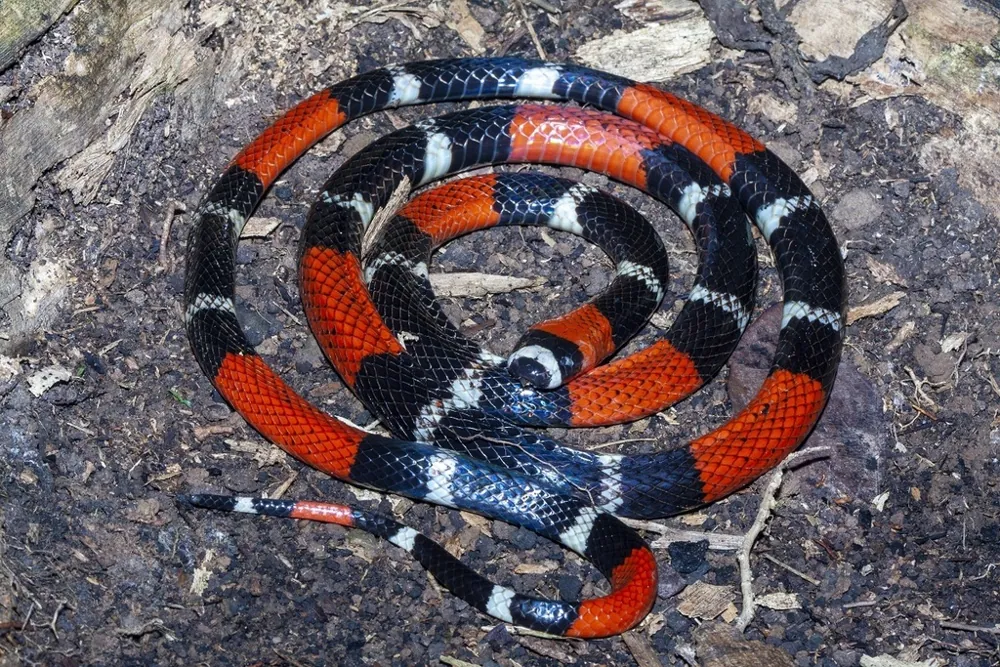
KosuaThe South American coral snake is a thin, brightly coloured venomous snake. It lives only in South America, from Argentina to Venezuela. It is nocturnal, so it is most active at night, and its venom is strong enough to be dangerous to people.1



 Ndenge ya koyeba yango
- The snout is black, followed by a narrow white band in front of the eyes and a wider black band across the eyes.1
- The rest of the head is red, and the body has broad red rings.1
- Between the red rings are 7 to 17 groups of three black and two white rings.1
- The tail has two of these black and white groups.1
- It is thin, and adults are usually 60 to 90 cm long, tail included.1
Makasi ya venin
Venin ebimaka na nzela ya mino na yango ntango esui.
Venin na yango esalaka nini?
Its venom is a strong neurotoxin, which attacks the nerves. It acts both before and after the nerve connects to the muscle, and it causes a strong, permanent block of nerve signals to the muscles in vertebrates. A muscle-damaging toxin called lemnitoxin has also been isolated from the venom.1
Likama na yango mpo na bato ezali boni?
Likama mpo na bato: Likama mingiEkoki koboma moto oyo azwi bosalisi te.It is not aggressive towards people, but it can bite to defend itself. The estimated lethal dose for an adult human is 5 to 7 mg of venom (dry weight). In laboratory milking, the average venom yield was 8 to 10 mg and the largest was 27 mg.1
Esalaka nini ntango ebangi?
It is not aggressive, but it can attack to defend itself when threatened.1
 Soki esui
- Tika moto aningana te mpe azala kimia, mpe kende na lopitalo noki, ata soki esika esui emonani moke: bilembo ekoki kobanda sima ya ngonga ebele.
Benga ntango nyonso nimero ya urgence liboso (112, 000, 911). Oyo ezali toli ya lisalisi ya liboso, ezali toli ya monganga te. Makambo ya moboko ya lisalisi ya liboso
 Zala na libateli
- Ata mokolo moko te, simba, kanga to silikisa nyama ya zamba te, ata ya moke, mpe ata soki emonani lokola elali to ekufi.
- Tika yango esika. Soki okutani na moko, zala kimia, zonga sima malembe mpe tika ekende nzela na yango.
- Soki moko esui yo: zala kimia, ningana te, benga nimero ya urgence na yo (112, 000, 911) to kende na lopitalo noki. Kanisa ndenge ezalaki, foto esalisaka.
Ezali koluka yo te. Esalelaka venin na yango mpo na kokanga bilei to komibatela, mpe elingaka mingi kobombama. Makambo mosusu mpo na komibatela
Monene na yango boni?
Molai na yango boni?
 molai lokola ba pusu ya ndako 3, zolo kino mokila
 molai lokola bitabe 8 oyo etiami moko na sima ya mosusu
 ekoki kopota metre 100 na sekonde 71 (moto ya mbangu koleka asengaka 9,6)
South American coral snake azali monene boni soki tokokanisi na YO?
Kaka ba calcul na navigateur na yo. Eloko moko te ebombamaka to etindamaka esika moko.
Mbangu na yango boni?


Makambo ya solo
The venom of this snake is strong enough to cause paralysis, because it blocks nerve signals to the muscles.1
It is one of the few snakes whose diet includes freshwater eels and gymnotiform fishes.1
It is nocturnal and digs in loose soil or leaf litter, so it spends much of its time hidden underground.1
It can live in disturbed land and near human homes, not only in deep forest.1
Solo to lokuta?
Lokuta: Coral snakes are aggressive and will attack people.
Solo: This snake is not aggressive towards people. It only bites to defend itself.1
Esika makambo euti
- Micrurus lemniscatus (Wikipedia (CC BY-SA 4.0))
- Micrurus lemniscatus (iNaturalist): bankombo mpe classification.
- Venom Wiki: niveau ya likama, monene ya momesano mpe kokanisa ya mbangu ezali ya biso moko. Tala ndenge tolukaka yango: Ndenge tomekaka likama.
Likambo nyonso na lokasa oyo ezali na nimero oyo elakisi source na yango. Soki tosali libunga, limbisa biso, tozali bato oyo balingaka banyama, zulunale ya siansi te. Yebisa biso na [email protected] mpe tokobongisa yango.
 Scorpion azali na nzala! Venom Wiki ezali mosala ya moto moko: ya ofele, pibilisite te mpe trackers te. Mwa mbongo moke ya kosalisa esalisaka mpo ete etikala na internet.Pesa scorpion bilei
Mosusu ya ebota moko: Banyoka corail
 Central American coral snake
 Amazonian coral snake
 Aquatic coral snake
 Argentinian coral snake
 Caatinga coral snake
 Dumeril's coral snake
Ezalaka mpe na: Amerika ya Sude
 Golden poison frogBa grenouille ya poison, ba crapaud & ba tritonEkoki kobomaKosimba te
 TerciopeloBa vipère à fossettesEkoki koboma
 Brazilian wandering spiderBa tandambulaEkoki koboma
 Eyelash viperBa vipère à fossettesEkoki koboma
 Golden lanceheadBa vipère à fossettesEkoki koboma
 South American bushmasterBa vipère à fossettesEkoki koboma