
 Afrika
 Azia
Azia Erópa
Erópa Amerika ya Sude
 Australia & Océanie
 Antarctique
 Océan Pacifique
 Océan Atlantique
 Océan Indien
 Océan Arctique
 Mer Méditerranée
 Mer Rouge
 Mer des Caraïbes
 Mer de Corail
 Mer de Chine méridionale
 Mer des Philippines
 Mer d'Andaman
 Mer du Nord
 Mer de Timor & Mer d'Arafura
 Golfe du Bengale
 Golfe de Californie
Thistledown velvet ant
 Kotuba
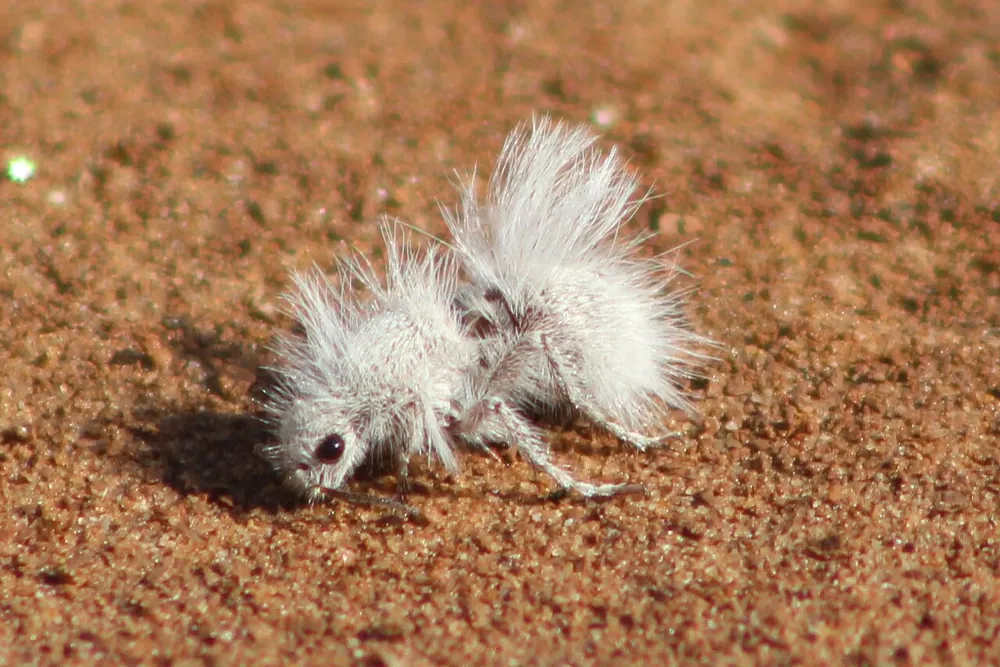
The thistledown velvet ant is a mid-sized member of the Dasymutilla genus, a group known as velvet ants. Its females have no wings and live in hot deserts in the south-western United States and northern Mexico. Females can deliver a very painful sting, so it is best to leave them alone.1
 Ndenge ya koyeba yango
- Only the females are wingless.1
- It is mid-sized for a velvet ant, larger than some of the smallest species but smaller than some of the largest.1
- Females are camouflaged. They look like the fruit of the Creosotebush rather than having the bright warning colours seen in many other velvet ants.1
Bakosanaka yango mbala mingi na: Unlike the orange Dasymutilla species found in the same habitat, this species does not use bright orange or warning colours. Its camouflage helps it blend into the desert plants around it.1
Makasi ya venin
Venin ebimaka na nzela ya nsende ya kotuba.
Likama na yango mpo na bato ezali boni?
Likama mpo na bato: Epesaka pasiEkoki kopesa pasi mingi, kasi pene na ntango nyonso ezalaka likambo monene te.Females can deliver a very painful sting when threatened. Its sting is more powerful than those of most smaller velvet ants, but weaker than those of most larger ones.1
Esalaka nini ntango ebangi?
Females use their sting to defend themselves when threatened.1
 Soki etubi
- Longola nsende ya nzoi na kokokola yango, mpe pesa malili na esika yango.
- Soki moto azali na mpasi ya kopema, elongi to kingo evimbi, to ayoki lokola azali kobunga makanisi, ezali likama ya allergie: benga nimero ya urgence na yo mpe salela stylo na ye ya adrénaline (auto-injecteur) soki azali na yango.
Benga ntango nyonso nimero ya urgence liboso (112, 000, 911). Oyo ezali toli ya lisalisi ya liboso, ezali toli ya monganga te. Makambo ya moboko ya lisalisi ya liboso
 Zala na libateli
- Ata mokolo moko te, simba, kanga to silikisa nyama ya zamba te, ata ya moke, mpe ata soki emonani lokola elali to ekufi.
- Tika yango esika. Soki okutani na moko, zala kimia, zonga sima malembe mpe tika ekende nzela na yango.
- Soki moko etubi yo: zala kimia, ningana te, benga nimero ya urgence na yo (112, 000, 911) to kende na lopitalo noki. Kanisa ndenge ezalaki, foto esalisaka.
Ezali koluka yo te. Esalelaka venin na yango mpo na kokanga bilei to komibatela, mpe elingaka mingi kobombama. Makambo mosusu mpo na komibatela
Monene na yango boni?
Molai na yango boni?
 mokuse koleka mosapi na yo ya moke
Thistledown velvet ant azali monene boni soki tokokanisi na YO?
Kaka ba calcul na navigateur na yo. Eloko moko te ebombamaka to etindamaka esika moko.
Mbangu na yango boni?


Makambo ya solo
Its females are camouflaged to look like Creosotebush fruit, instead of using the bright warning colours common to other velvet ants.1
Its colouring seems to be mainly an adaptation to hot desert conditions, not a defence against predators.1
Its internal and external body temperatures are lower than those of orange Dasymutilla species living in the same habitat.1
Its sting is stronger than those of most smaller velvet ants, but weaker than those of most larger ones.1
Like other velvet ants, only the wingless females have the sting used for defence.1
Esika makambo euti
- Dasymutilla gloriosa (Wikipedia (CC BY-SA 4.0))
- Dasymutilla gloriosa (iNaturalist): bankombo mpe classification.
- Venom Wiki: niveau ya likama, monene ya momesano mpe kokanisa ya mbangu ezali ya biso moko. Tala ndenge tolukaka yango: Ndenge tomekaka likama.
Likambo nyonso na lokasa oyo ezali na nimero oyo elakisi source na yango. Soki tosali libunga, limbisa biso, tozali bato oyo balingaka banyama, zulunale ya siansi te. Yebisa biso na [email protected] mpe tokobongisa yango.
 Scorpion azali na nzala! Venom Wiki ezali mosala ya moto moko: ya ofele, pibilisite te mpe trackers te. Mwa mbongo moke ya kosalisa esalisaka mpo ete etikala na internet.Pesa scorpion bilei
Mosusu ya ebota moko: Nzoi, ba guêpe & ba frelon
 Tarantula hawkNzoi, ba guêpe & ba frelonEpesaka kaka pasi
 Executioner waspNzoi, ba guêpe & ba frelonEsengeli monganga
 Warrior waspNzoi, ba guêpe & ba frelonEsengeli monganga
 Bald-faced hornetNzoi, ba guêpe & ba frelonEpesaka kaka pasi
 Cow killer velvet antNzoi, ba guêpe & ba frelonEpesaka kaka pasi
 Eastern cicada killerNzoi, ba guêpe & ba frelonEzangi likama
Ezalaka mpe na: Amerika ya Nord
 TerciopeloBa vipère à fossettesEkoki koboma
 Eastern coral snakeBanyoka corailEkoki koboma
 Eastern diamondback rattlesnakeBanyoka ya sonnetteEkoki koboma
 Eyelash viperBa vipère à fossettesEkoki koboma
 Timber rattlesnakeBanyoka ya sonnetteEkoki koboma
 Western diamondback rattlesnakeBanyoka ya sonnetteEkoki koboma