
 Afrika
 Asia
Asia Eropah
 Amerika Selatan
 Australia & Oceania
 Antartika
 Lautan Pasifik
 Lautan Atlantik
 Lautan Hindi
 Lautan Artik
 Laut Mediterranean
 Laut Merah
 Laut Caribbean
 Laut Karang
 Laut China Selatan
 Laut Filipina
 Laut Andaman
 Laut Utara
 Laut Timor & Laut Arafura
 Teluk Benggala
 Teluk California
African crested rat
 Racun di kulitnya
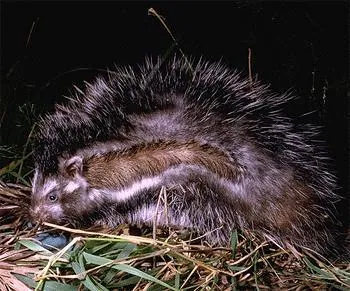
The African crested rat is a large, nocturnal rodent with long hair and a bushy tail. It looks a little like a porcupine. It lives in East Africa, where it is the world's only known poisonous rodent, coating itself in plant toxins to keep predators away.1



 Cara mengenalinya
- Large, nocturnal rodent with long, silver and black-tipped guard hairs over a woolly grey and white undercoat1
- A mane of longer black-and-white banded hairs runs from the top of the head to just beyond the base of the tail1
- A broad, white-bordered strip of glandular skin sits beside the mane, and it becomes visible when the animal is threatened1
- Bushy tail and short black fur on the face and limbs1
- Superficially resembles a porcupine1
Kuasa racun
Kulitnya beracun. Ia berbahaya untuk disentuh, dijilat atau dimakan.
Apa kesan racunnya?
This animal is poisonous rather than venomous, so it does not bite or sting to inject poison. It smears poison from the bark of the poison arrow tree onto the hairs of its glandular skin patch. A predator that bites it can be sickened or even killed by this poison.1
Berapa bahaya ia kepada manusia?
Bahaya kepada manusia: SeriusJika seseorang menyentuh atau memakannya, jumpa doktor. Kematian sangat jarang berlaku.Its poison is a risk to predators that try to bite it. The rat itself is not harmed by the toxins it stores.1
Apa yang ia buat apabila takut?
When threatened or excited, the mane stands up and the glandular strip parts, exposing the skin that carries the poison.1
 Jika seseorang menyentuh atau memakannya
- Jika seseorang memakannya atau ada simptom selepas memakannya: hubungi nombor kecemasan atau pusat racun dengan segera.
Sentiasa hubungi nombor kecemasan dahulu (112, 000, 911). Ini panduan pertolongan cemas umum, bukan nasihat perubatan. Asas pertolongan cemas
 Kekal selamat
- Jangan sesekali sentuh, tangkap atau usik haiwan liar, walaupun yang kecil, dan walaupun ia nampak tidur atau mati.
- Beri ia ruang. Jika kamu terjumpa, bertenang, undur perlahan-lahan dan biarkan ia pergi.
- Jika kamu menyentuh atau memakannya: jangan gosok mata atau mulut, basuh tangan dan dapatkan bantuan perubatan.
Ia bukan mahu memburu kamu. Racunnya ada hanya supaya tiada apa yang memakannya. Lagi tentang keselamatan
Di mana di dunia?
Berapa besar ia?
Berapa panjang ia?
Berapa berat ia?

 sepanjang 10 blok binaan mainan disusun sebaris
 boleh melepasi 100 meter dalam 72 saat (manusia paling laju perlukan 9.6)
Berapa besar African crested rat berbanding KAMU?
Hanya matematik dalam pelayar kamu. Tiada apa yang disimpan atau dihantar ke mana-mana.
Berapa laju ia?


Fakta
It is the world's only known poisonous rodent.1
It is the only rodent known to use and store toxins from a different species in nature to protect itself, and it suffers no known harm from them.1
Its stomach has five anatomically distinct sections, a feature found in very few rodents.1
The skull is covered with small bony projections that give it a pebbled look.1
Its large size may allow microbes in its foregut to break down cellulose from plants by fermentation.1
Pemecah mitos
Mitos: The maned rat was believed to be solitary.
Hakikat: It is now known to be somewhat sociable. Several animals are found in the same territory, and they purr and groom one another, so they may form family groups of a male, a female and their young.1
Untuk pakar bisa
- Nama saintifik
- Lophiomys imhausi
- Kumpulan
- Haiwan beracun lain
- Keluarga
- Muridae2
- Susunan
- Rodentia
- Benua-benua
- Afrika
- Anak
- Litters have 1 to 3 young. The young are slightly haired at birth, their eyes open by day 13, and they are weaned by day 40.1
- Keadaannya di alam liar
- Least Concern1
- Bahaya kepada manusia
- 3 / 5: Serius3
Dari mana fakta datang
- Maned rat (Wikipedia (CC BY-SA 4.0))
- Lophiomys imhausi (iNaturalist): nama dan pengelasan.
- Venom Wiki: tahap bahaya, saiz biasa dan anggaran kelajuan adalah penilaian kami sendiri. Lihat cara kami mengiranya: Cara kami menilai bahaya.
Setiap fakta di halaman ini ada nombor yang menunjuk kepada sumbernya. Jika kami tersilap, maaf, kami peminat haiwan, bukan jurnal sains. Beritahu kami di [email protected] dan kami akan betulkan.
 Kala jengking lapar! Venom Wiki ialah projek seorang lelaki: percuma, tanpa iklan dan tanpa penjejak. Sedikit sumbangan membantu memastikannya terus dalam talian.Beri kala jengking makan
Lagi dari kumpulan yang sama: Haiwan beracun lain
 Common quailHaiwan beracun lainSakit sahaja
 Spur-winged gooseHaiwan beracun lainSakit sahaja
 Fahaka pufferfishHaiwan beracun lainBoleh membunuh
 Red-striped oil beetleHaiwan beracun lainSakit sahajaJangan sentuh
 Ikan buntal JepunHaiwan beracun lainMembawa maut
 Hawksbill sea turtleHaiwan beracun lainBoleh membunuh
 Mamba hitam
 Kala jengking pemburu maut
 Ular tedung Mesir
 Ular puff adder
 Boomslang
 Fat-tailed scorpion