
 Afrika
 Asia
Asia Eropah
 Amerika Selatan
 Australia & Oceania
 Antartika
 Lautan Pasifik
 Lautan Atlantik
 Lautan Hindi
 Lautan Artik
 Laut Mediterranean
 Laut Merah
 Laut Caribbean
 Laut Karang
 Laut China Selatan
 Laut Filipina
 Laut Andaman
 Laut Utara
 Laut Timor & Laut Arafura
 Teluk Benggala
 Teluk California
Blue-lined octopus
 Gigitan
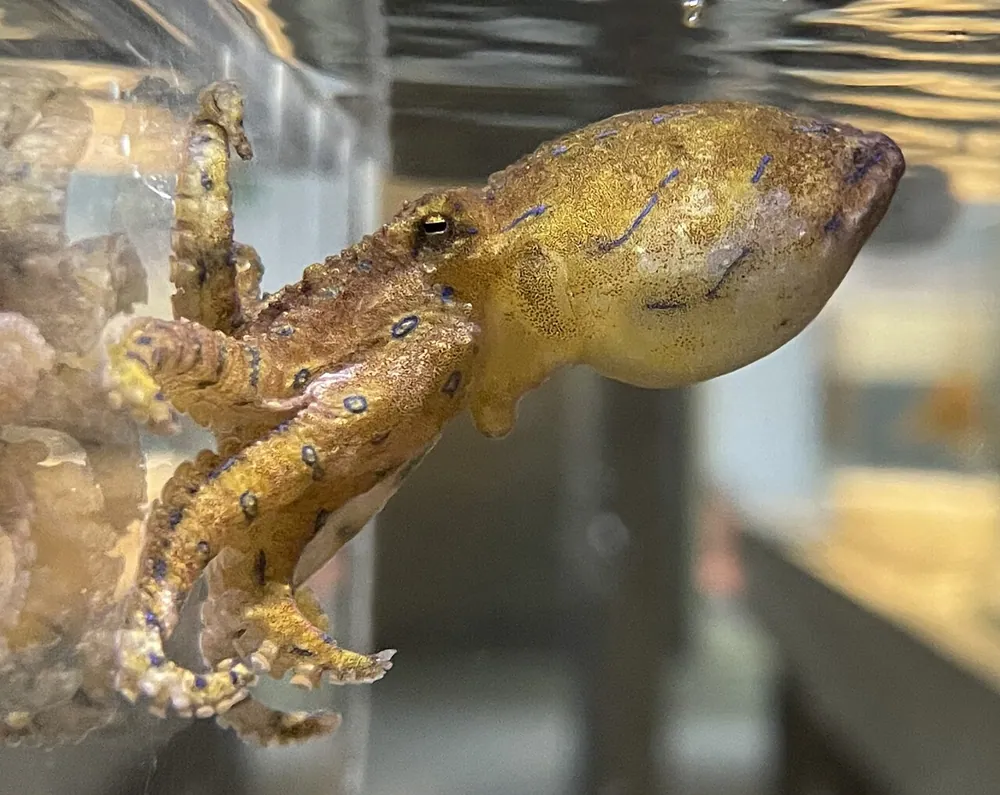
The blue-lined octopus is a small sea creature, about the size of a golf ball, that lives in shallow reefs and rock pools in the Pacific Ocean. It is one of the most dangerous animals in the sea, because its bite contains venom that can be fatal to people. It is shy and usually hides, but its bright blue lines are a clear warning to leave it alone.1
 Cara mengenalinya
- At rest, its body is mottled yellow-brown with dark blue or black streaks, and its underside is paler.1
- When it feels threatened, it shows bright, iridescent blue lines across its body.1
- It is small, with a mantle (main body) up to 45 mm long, about the size of a golf ball.1
- Its blue markings are lines, not rings.1
- The visceral hump (the bulge behind the head) is regularly pointed.1
Sering dikelirukan dengan: The greater blue-ringed octopus, southern blue-ringed octopus and blue-ringed octopus have circular blue rings rather than lines. The blue-lined octopus is also the smallest of the four species in its genus.1
Kuasa bisa
Bisa keluar melalui taring atau giginya apabila ia menggigit.
Apa kesan bisanya?
Its venom is tetrodotoxin (TTX), a neurotoxic venom, which attacks the nerves. A bite may not be felt at first. After some time, symptoms include loss of feeling in the tongue and lips, muscle weakness or paralysis, respiratory failure (breathing failure), and unconsciousness, which can lead to death.1
Berapa bahaya ia kepada manusia?
Bahaya kepada manusia: Membawa mautAntara haiwan paling berbahaya di dunia.It is regarded as one of the most dangerous animals in the sea, and its venom can be fatal to humans. At least three human deaths have been reported. The greatest risk is to people who pick it up or touch it.1
Apa yang ia buat apabila takut?
When threatened, it displays bright blue warning lines to predators, and it is more likely to flee and hide in shelter than to fight.1
 Jika ia menggigit
- Imobilisasi tekanan: balut tempat gigitan dengan pembalut elastik secara kukuh, kemudian teruskan ke atas sepanjang seluruh anggota, pasang bidai, dan pastikan orang itu langsung tidak bergerak sehingga bantuan tiba.
- Kurita cincin biru atau siput kon boleh menghentikan pernafasan seseorang ketika dia masih sedar: panggil bantuan dan bersedia memberi bantuan pernafasan sehingga ambulans mengambil alih.
Sentiasa hubungi nombor kecemasan dahulu (112, 000, 911). Ini panduan pertolongan cemas umum, bukan nasihat perubatan. Asas pertolongan cemas
 Kekal selamat
- Jangan sesekali sentuh, tangkap atau usik haiwan liar, walaupun yang kecil, dan walaupun ia nampak tidur atau mati.
- Beri ia ruang. Jika kamu terjumpa, bertenang, undur perlahan-lahan dan biarkan ia pergi.
- Jika ia menggigit kamu: bertenang, jangan bergerak, hubungi nombor kecemasan (112, 000, 911) atau pergi ke hospital dengan segera. Ingat rupanya, gambar boleh membantu.
Ia bukan mahu memburu kamu. Ia guna bisanya untuk menangkap makanan atau melindungi diri, dan ia lebih suka bersembunyi. Lagi tentang keselamatan
Di mana di dunia?
Berapa besar ia?
Berapa panjang ia?
 lebih pendek daripada jari kelingking kamu
 boleh berenang sepanjang kolam renang besar (50 m) dalam 7.2 saat
Berapa besar Blue-lined octopus berbanding KAMU?
Hanya matematik dalam pelayar kamu. Tiada apa yang disimpan atau dihantar ke mana-mana.
Berapa laju ia?


Fakta
A single 25-gram blue-lined octopus carries enough venom to kill about ten adults weighing 75 kilograms each, according to estimates.1
Male blue-lined octopuses bite the female's aorta during mating, injecting TTX. This paralyses her within about 8 minutes, which lets the male transfer his sperm packets safely.1
Hapalochlaena is the only octopus genus known to produce TTX, a toxin thought to have played an important role in the evolution of the species.1
The blue-lined octopus is the only one of the four blue-ringed species with lined blue markings instead of circular ones.1
Blue-lined octopuses are nocturnal hunters, while the greater blue-ringed octopus hunts during the day.1
Its range has been spreading across the Pacific. Warming ocean water may be shifting suitable habitat, and scientists monitor this for public health and safety.1
Pemecah mitos
Mitos: Because it is so shy, the blue-lined octopus is not really dangerous.
Hakikat: It is extremely shy and usually flees, but its venom can still be fatal to people, and at least three deaths have been reported.1
Untuk pakar bisa
- Nama saintifik
- Hapalochlaena fasciata
- Kumpulan
- Siput kon & sotong kurita
- Keluarga
- Octopodidae2
- Susunan
- Octopoda
- Benua-benua
- Lautan Hindi, Lautan Pasifik, Laut Karang, Lautan
- Anak
- A female lays 50 to 100 large eggs about 30 days after mating, hides them under her arms until they hatch, and then dies. The hatchlings take about two months to develop.1
- Bahaya kepada manusia
- 5 / 5: Membawa maut3
Dari mana fakta datang
- Blue-lined octopus (Wikipedia (CC BY-SA 4.0))
- Hapalochlaena fasciata (iNaturalist): nama dan pengelasan.
- Venom Wiki: tahap bahaya, saiz biasa dan anggaran kelajuan adalah penilaian kami sendiri. Lihat cara kami mengiranya: Cara kami menilai bahaya.
Setiap fakta di halaman ini ada nombor yang menunjuk kepada sumbernya. Jika kami tersilap, maaf, kami peminat haiwan, bukan jurnal sains. Beritahu kami di [email protected] dan kami akan betulkan.
 Kala jengking lapar! Venom Wiki ialah projek seorang lelaki: percuma, tanpa iklan dan tanpa penjejak. Sedikit sumbangan membantu memastikannya terus dalam talian.Beri kala jengking makan
Lagi dari kumpulan yang sama: Siput kon & sotong kurita
 Geography coneSiput kon & sotong kuritaMembawa maut
 Greater blue-ringed octopusSiput kon & sotong kuritaMembawa maut
 Southern blue-ringed octopusSiput kon & sotong kuritaMembawa maut
 Blue sea dragonSiput kon & sotong kuritaSakit sahaja
 Common octopusSiput kon & sotong kuritaTidak berbahaya
 Giant Pacific octopusSiput kon & sotong kuritaTidak berbahaya
Juga hidup di: Lautan Hindi
 Australian box jellyfishObor-obor & penyengat lautMembawa mautJangan sentuh
 Hawksbill sea turtleHaiwan beracun lainBoleh membunuh
 Irukandji jellyfishObor-obor & penyengat lautBoleh membunuhJangan sentuh
 Reef stonefishIkan berbisaBoleh membunuhJangan sentuh
 Crown-of-thorns starfishLandak laut, tapak sulaiman & cacingPerlu jumpa doktorJangan sentuh
 Portuguese man o' warObor-obor & penyengat lautPerlu jumpa doktorJangan sentuh