
 Afrika
 Asia
Asia Eropah
 Amerika Selatan
 Australia & Oceania
 Antartika
 Lautan Pasifik
 Lautan Atlantik
 Lautan Hindi
 Lautan Artik
 Laut Mediterranean
 Laut Merah
 Laut Caribbean
 Laut Karang
 Laut China Selatan
 Laut Filipina
 Laut Andaman
 Laut Utara
 Laut Timor & Laut Arafura
 Teluk Benggala
 Teluk California
Geography cone
 Sengatan
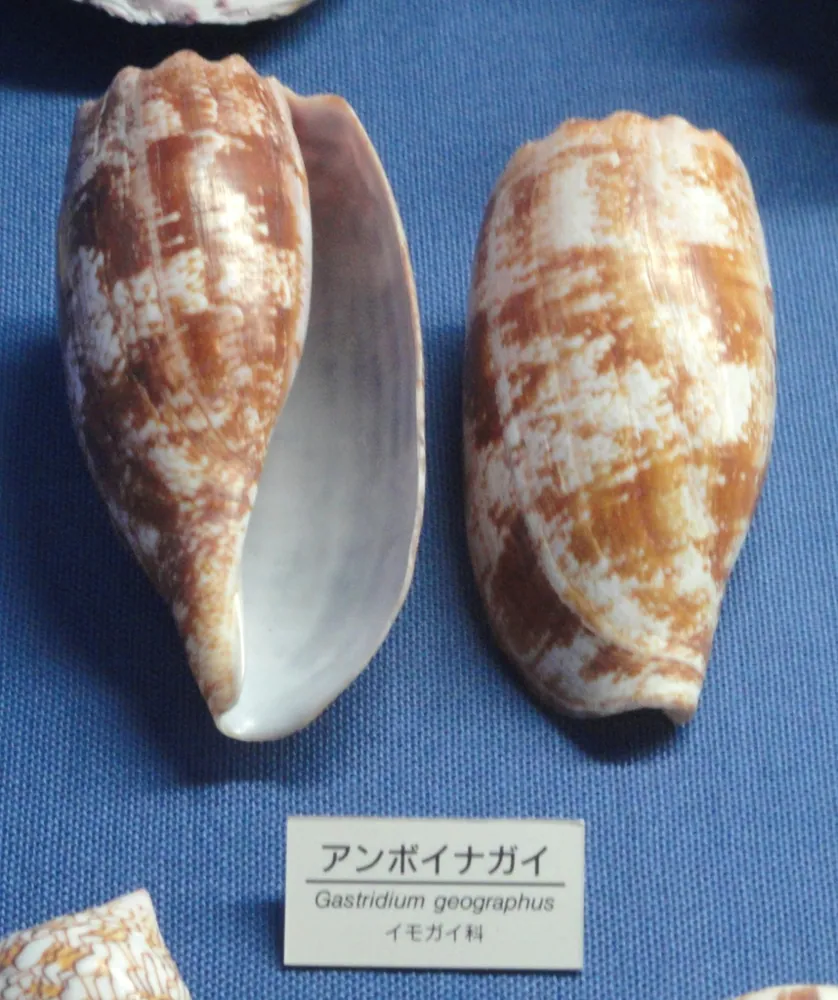
The geography cone is a predatory sea snail that lives on shallow tropical reefs in the Indo-Pacific. It hunts small fish. Its venom is strong enough to kill a person, which makes it one of the most dangerous cone snails.1


 Cara mengenalinya
- Broad, thin shell that is cylindrically inflated, usually 10 to 15 cm long1
- Ground colour is pink or violet-white, sometimes reddish1
- Mottled pattern of chestnut or chocolate brown, usually forming two irregular bands1
- Wide pink or violet-white opening and numerous shoulder ridges or spines1
Sering dikelirukan dengan: Compared with other cone shells of a similar size, the geography cone has a noticeably wider, more convex middle and a flattened spire. Its walls are also thinner and lighter.1
Kuasa bisa
Bisa keluar melalui penyengat.
Apa kesan bisanya?
Its venom is a complex mix of hundreds of different toxins, delivered through the harpoon-like tooth. It has the most toxic sting known among cone snails. Even the most venomous cone snails take about one to five hours to kill a healthy adult, but medical care must still be prompt.1
Berapa bahaya ia kepada manusia?
Bahaya kepada manusia: Membawa mautAntara haiwan paling berbahaya di dunia.There are reports of about 36 human deaths over the past 300 years. Live specimens should be handled with extreme caution.1
Apa yang ia buat apabila takut?
Most of the venom's toxic compounds are believed to be used for defence rather than feeding.1
 Jika ia menyengat
- There is no antivenom for a cone snail sting. Treatment consists of keeping the victim alive until the symptoms wear off, so prompt medical care is essential.1
- Imobilisasi tekanan: balut tempat gigitan dengan pembalut elastik secara kukuh, kemudian teruskan ke atas sepanjang seluruh anggota, pasang bidai, dan pastikan orang itu langsung tidak bergerak sehingga bantuan tiba.
- Kurita cincin biru atau siput kon boleh menghentikan pernafasan seseorang ketika dia masih sedar: panggil bantuan dan bersedia memberi bantuan pernafasan sehingga ambulans mengambil alih.
Sentiasa hubungi nombor kecemasan dahulu (112, 000, 911). Ini panduan pertolongan cemas umum, bukan nasihat perubatan. Asas pertolongan cemas
 Kekal selamat
- Jangan sesekali sentuh, tangkap atau usik haiwan liar, walaupun yang kecil, dan walaupun ia nampak tidur atau mati.
- Beri ia ruang. Jika kamu terjumpa, bertenang, undur perlahan-lahan dan biarkan ia pergi.
- Jika ia menyengat kamu: bertenang, jangan bergerak, hubungi nombor kecemasan (112, 000, 911) atau pergi ke hospital dengan segera. Ingat rupanya, gambar boleh membantu.
Ia bukan mahu memburu kamu. Ia guna bisanya untuk menangkap makanan atau melindungi diri, dan ia lebih suka bersembunyi. Lagi tentang keselamatan
Di mana di dunia?
Berapa besar ia?
Berapa panjang ia?
 sepanjang 5 blok binaan mainan disusun sebaris
 lebih perlahan daripada siput kebun
Berapa besar Geography cone berbanding KAMU?
Hanya matematik dalam pelayar kamu. Tiada apa yang disimpan atau dihantar ke mana-mana.
Berapa laju ia?

Fakta
Its venom contains a form of insulin, which it uses to stun fish. Once the venom passes through a fish's gills, the fish goes into hypoglycaemic shock (a dangerous drop in blood sugar).1
Apart from the tulip cone snail, no other known living thing is known to use its own biological insulin as a weapon.1
Research shows that some proteins from cone snail venom can be up to 10,000 times more effective than morphine as painkillers, without morphine's addictive properties and side effects.1
Of the venom's 100 to 200 toxic peptides, only 15 to 20 are used for feeding.1
Adult geography cones can fall prey to sea turtles, rays, birds and human shell collectors.1
Pemecah mitos
Mitos: The nickname 'cigarette snail' means a sting gives you just enough time to smoke a cigarette before you die.
Hakikat: This is a gallows humour exaggeration. Even the most venomous cone snails take about one to five hours to kill a healthy human.1
Dari mana fakta datang
- Conus geographus (Wikipedia (CC BY-SA 4.0))
- Conus geographus (iNaturalist): nama dan pengelasan.
- Venom Wiki: tahap bahaya, saiz biasa dan anggaran kelajuan adalah penilaian kami sendiri. Lihat cara kami mengiranya: Cara kami menilai bahaya.
Setiap fakta di halaman ini ada nombor yang menunjuk kepada sumbernya. Jika kami tersilap, maaf, kami peminat haiwan, bukan jurnal sains. Beritahu kami di [email protected] dan kami akan betulkan.
 Kala jengking lapar! Venom Wiki ialah projek seorang lelaki: percuma, tanpa iklan dan tanpa penjejak. Sedikit sumbangan membantu memastikannya terus dalam talian.Beri kala jengking makan
Lagi dari kumpulan yang sama: Siput kon & sotong kurita
 Greater blue-ringed octopusSiput kon & sotong kuritaMembawa maut
 Southern blue-ringed octopusSiput kon & sotong kuritaMembawa maut
 Blue sea dragonSiput kon & sotong kuritaSakit sahaja
 Common octopusSiput kon & sotong kuritaTidak berbahaya
 Giant Pacific octopusSiput kon & sotong kuritaTidak berbahaya
 Blue-lined octopusSiput kon & sotong kuritaMembawa maut
Juga hidup di: Lautan Hindi
 Australian box jellyfishObor-obor & penyengat lautMembawa mautJangan sentuh
 Hawksbill sea turtleHaiwan beracun lainBoleh membunuh
 Irukandji jellyfishObor-obor & penyengat lautBoleh membunuhJangan sentuh
 Reef stonefishIkan berbisaBoleh membunuhJangan sentuh
 Crown-of-thorns starfishLandak laut, tapak sulaiman & cacingPerlu jumpa doktorJangan sentuh
 Portuguese man o' warObor-obor & penyengat lautPerlu jumpa doktorJangan sentuh