
 Afrika
 Azië
Azië Europa
 Zuid-Amerika
 Australië & Oceanië
 Antarctica
 Grote Oceaan
 Atlantische Oceaan
 Indische Oceaan
 Noordelijke IJszee
 Middellandse Zee
 Rode Zee
 Caribische Zee
 Koraalzee
 Zuid-Chinese Zee
 Filipijnenzee
 Andamanse Zee
 Noordzee
 Timorzee & Arafurazee
 Golf van Bengalen
 Golf van Californië
Geography cone
 Steken
The geography cone is a predatory sea snail that lives on shallow tropical reefs in the Indo-Pacific. It hunts small fish. Its venom is strong enough to kill a person, which makes it one of the most dangerous cone snails.1


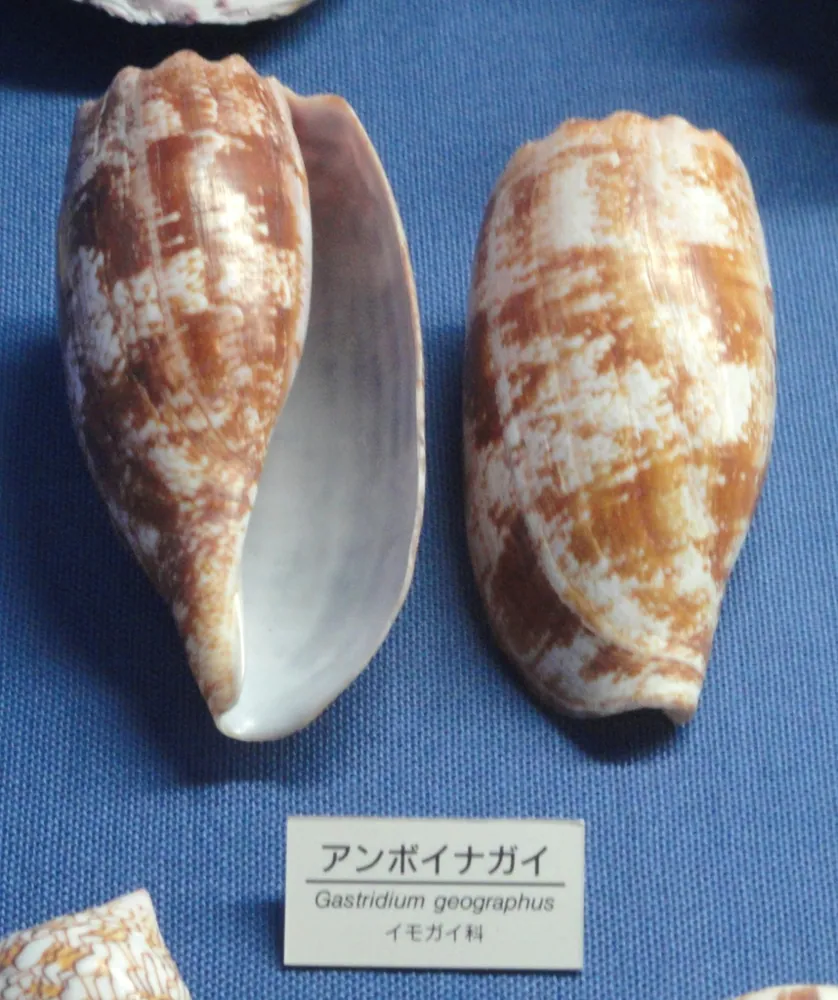
 Zo herken je het
- Broad, thin shell that is cylindrically inflated, usually 10 to 15 cm long1
- Ground colour is pink or violet-white, sometimes reddish1
- Mottled pattern of chestnut or chocolate brown, usually forming two irregular bands1
- Wide pink or violet-white opening and numerous shoulder ridges or spines1
Vaak verward met: Compared with other cone shells of a similar size, the geography cone has a noticeably wider, more convex middle and a flattened spire. Its walls are also thinner and lighter.1
Gifkracht
Het gif komt naar buiten via een angel.
Wat doet zijn gif als het bijt of steekt?
Its venom is a complex mix of hundreds of different toxins, delivered through the harpoon-like tooth. It has the most toxic sting known among cone snails. Even the most venomous cone snails take about one to five hours to kill a healthy adult, but medical care must still be prompt.1
Hoe gevaarlijk is het voor mensen?
Gevaar voor mensen: DodelijkEen van de gevaarlijkste dieren ter wereld.There are reports of about 36 human deaths over the past 300 years. Live specimens should be handled with extreme caution.1
Wat doet het als het bang is?
Most of the venom's toxic compounds are believed to be used for defence rather than feeding.1
 Als het steekt
- There is no antivenom for a cone snail sting. Treatment consists of keeping the victim alive until the symptoms wear off, so prompt medical care is essential.1
- Drukimmobilisatie: wikkel een stevig elastisch verband over de beet en daarna omhoog over de hele arm of het hele been, leg een spalk aan en houd de persoon helemaal stil tot er hulp komt.
- Een blauwgeringde octopus of kegelslak kan iemands ademhaling stilleggen terwijl die nog wakker is: bel om hulp en wees klaar om te beademen tot de ambulance het overneemt.
Bel altijd eerst je alarmnummer (112, 000, 911). Dit is algemene EHBO-informatie, geen medisch advies. EHBO-basis
 Blijf veilig
- Raak een wild dier nooit aan, vang het niet en pest het niet, ook geen kleintje, en ook niet als het lijkt te slapen of dood lijkt.
- Geef het de ruimte. Kom je er een tegen, blijf rustig, stap langzaam achteruit en laat het zijn eigen weg gaan.
- Als er een je steekt: blijf rustig, beweeg niet, bel je alarmnummer (112, 000, 911) of ga snel naar een ziekenhuis. Onthoud hoe het eruitzag, een foto helpt.
Het is niet op jou uit. Het gebruikt zijn gif om voedsel te vangen of zichzelf te beschermen, en verstopt zich veel liever. Meer over veilig blijven
Waar ter wereld?
Hoe groot is het?
Hoe lang is het?
 zo lang als 5 speelgoedbouwsteentjes op een rij
 langzamer dan een tuinslak
Hoe groot is Geography cone vergeleken met JOU?
Alleen rekenwerk in je browser. Er wordt niets opgeslagen of verstuurd.
Hoe snel is het?

Feiten
Its venom contains a form of insulin, which it uses to stun fish. Once the venom passes through a fish's gills, the fish goes into hypoglycaemic shock (a dangerous drop in blood sugar).1
Apart from the tulip cone snail, no other known living thing is known to use its own biological insulin as a weapon.1
Research shows that some proteins from cone snail venom can be up to 10,000 times more effective than morphine as painkillers, without morphine's addictive properties and side effects.1
Of the venom's 100 to 200 toxic peptides, only 15 to 20 are used for feeding.1
Adult geography cones can fall prey to sea turtles, rays, birds and human shell collectors.1
Fabeltjes-checker
Fabel: The nickname 'cigarette snail' means a sting gives you just enough time to smoke a cigarette before you die.
Waarheid: This is a gallows humour exaggeration. Even the most venomous cone snails take about one to five hours to kill a healthy human.1
Waar de feiten vandaan komen
- Conus geographus (Wikipedia (CC BY-SA 4.0))
- Conus geographus (iNaturalist): namen en indeling.
- Venom Wiki: het gevarenniveau, de typische grootte en de geschatte snelheid zijn van onszelf. Zo berekenen we ze: Hoe we gevaar beoordelen.
Elk feit op deze pagina heeft een nummer dat naar de bron wijst. Hebben we iets fout? Sorry, we zijn dierenfans, geen wetenschappelijk tijdschrift. Laat het ons weten via [email protected] en we passen het aan.
 De schorpioen heeft honger! Venom Wiki is een eenmansproject: gratis, zonder reclame en zonder trackers. Een kleine fooi helpt om het online te houden.Voer de schorpioen
Meer uit dezelfde groep: Kegelslakken & octopussen
 Greater blue-ringed octopusKegelslakken & octopussenDodelijk
 Southern blue-ringed octopusKegelslakken & octopussenDodelijk
 Blue sea dragonKegelslakken & octopussenDoet alleen pijn
 Common octopusKegelslakken & octopussenOngevaarlijk
 Giant Pacific octopusKegelslakken & octopussenOngevaarlijk
 Blue-lined octopusKegelslakken & octopussenDodelijk
Leeft ook in: Indische Oceaan
 Australian box jellyfishKwallen & netelende zeedierenDodelijkNiet aanraken
 Hawksbill sea turtleAndere passief giftige dierenKan doden
 Irukandji jellyfishKwallen & netelende zeedierenKan dodenNiet aanraken
 Reef stonefishGiftige vissenKan dodenNiet aanraken
 Crown-of-thorns starfishZee-egels, zeesterren & wormenMoet naar de dokterNiet aanraken
 Portuguese man o' warKwallen & netelende zeedierenMoet naar de dokterNiet aanraken