
 Afrika
 Azië
Azië Europa
 Zuid-Amerika
 Australië & Oceanië
 Antarctica
 Grote Oceaan
 Atlantische Oceaan
 Indische Oceaan
 Noordelijke IJszee
 Middellandse Zee
 Rode Zee
 Caribische Zee
 Koraalzee
 Zuid-Chinese Zee
 Filipijnenzee
 Andamanse Zee
 Noordzee
 Timorzee & Arafurazee
 Golf van Bengalen
 Golf van Californië
Irukandji jellyfish
 Netelende tentakels
The Irukandji jellyfish is a tiny box jellyfish with a sting that can cause a serious illness called Irukandji syndrome. It lives in the open water near Australia, and it is hard to spot because it is so small.1



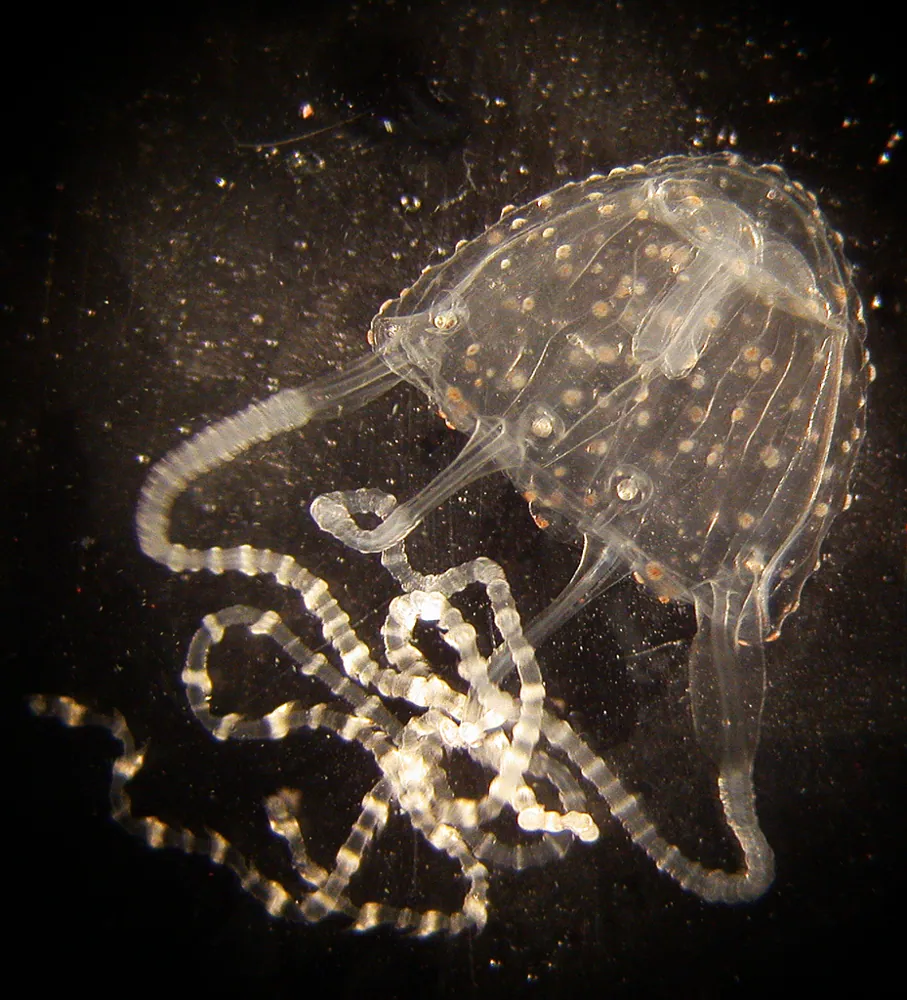
 Zo herken je het
- The bell is square-shaped and very small, about 12 mm high and 30 mm across.1
- It has four long tentacles, one from each corner of the bell.1
- The tentacles range from 5 to 50 cm long.1
- Its small size means it often goes unseen in open water.1
Vaak verward met: The common name Irukandji jellyfish is also used for other Irukandji jellyfish, such as Malo kingi. The name alone does not tell them apart.1
Gifkracht
Duizenden piepkleine netelcellen vuren af als iets ze aanraakt.
Wat doet zijn gif als het bijt of steekt?
This jellyfish is extremely venomous. Its venom comes from stinging cells called nematocysts in its tentacles and bell, and it changes as the jellyfish matures. A sting can cause Irukandji syndrome, with muscle aches, back pain, nausea, headaches, chest and stomach pains, sweating, high blood pressure and difficulty breathing.1
Hoe gevaarlijk is het voor mensen?
Gevaar voor mensen: Heel gevaarlijkHet kan iemand doden die geen behandeling krijgt.Irukandji syndrome can be severe, and the symptoms are described in detail in medical accounts. Most reported incidents have been in Australia during the warm summer season. Because the jellyfish is so small, people often do not see it before they are stung.1
 Als het steekt
- In hospital, patients are given intravenous morphine, hydromorphone or fentanyl for pain. Pethidine is avoided because of its toxic metabolite norpethidine.1
- Kom uit het water en haal alle tentakels eraf (met handschoenen of een doek).
- Bij tropische kubuskwallen: giet minstens 30 seconden azijn op de steken, bel om hulp en wees klaar om te reanimeren. Bij Portugese oorlogsschepen en de meeste andere: spoel met zeewater, daarna heet water tegen de pijn.
Bel altijd eerst je alarmnummer (112, 000, 911). Dit is algemene EHBO-informatie, geen medisch advies. EHBO-basis
 Blijf veilig
- Raak een wild dier nooit aan, vang het niet en pest het niet, ook geen kleintje, en ook niet als het lijkt te slapen of dood lijkt.
- Geef het de ruimte. Kom je er een tegen, blijf rustig, stap langzaam achteruit en laat het zijn eigen weg gaan.
- Als er een je steekt: blijf rustig, beweeg niet, bel je alarmnummer (112, 000, 911) of ga snel naar een ziekenhuis. Onthoud hoe het eruitzag, een foto helpt.
Het is niet op jou uit. Het gebruikt zijn gif om voedsel te vangen of zichzelf te beschermen, en verstopt zich veel liever. Meer over veilig blijven
Waar ter wereld?
Hoe groot is het?
Hoe lang is het?
 korter dan je pinkje
 zou de lengte van een groot zwembad (50 m) in 36 seconden kunnen zwemmen
Hoe groot is Irukandji jellyfish vergeleken met JOU?
Alleen rekenwerk in je browser. Er wordt niets opgeslagen of verstuurd.
Hoe snel is het?
Feiten
Jack Barnes of Cairns, Australia, discovered the species. During an exploration aimed at finding the cause of Irukandji syndrome, he allowed himself, a lifeguard and his 9-year-old son to be stung.1
Irukandji syndrome, which this jellyfish can cause, was first identified after a group of swimmers were stung in open water near North Queensland, Australia.1
Its venom changes in composition as the jellyfish grows, matching its change in prey from invertebrates to fish.1
Its life cycle alternates between a young form that attaches to a reef or rock and an adult form that swims freely in the water.1
This jellyfish is a type of box jellyfish, a group known for potent venom.1
Voor gifexperts
- Wetenschappelijke naam
- Carukia barnesi
- Groep
- Kwallen & netelende zeedieren
- Familie
- Carukiidae2
- Orde
- Carybdeida
- Continenten
- Indische Oceaan, Grote Oceaan, Koraalzee, Timorzee & Arafurazee, De oceanen
- Baby's
- Young jellyfish begin as a swimming planula larva, which settles on a reef or rock and grows into a polyp. The polyp later forms a colony that develops into an adult medusa.1
- Gevaar voor mensen
- 4 / 5: Heel gevaarlijk3
Waar de feiten vandaan komen
- Carukia barnesi (Wikipedia (CC BY-SA 4.0))
- Carukia barnesi (iNaturalist): namen en indeling.
- Venom Wiki: het gevarenniveau, de typische grootte en de geschatte snelheid zijn van onszelf. Zo berekenen we ze: Hoe we gevaar beoordelen.
Elk feit op deze pagina heeft een nummer dat naar de bron wijst. Hebben we iets fout? Sorry, we zijn dierenfans, geen wetenschappelijk tijdschrift. Laat het ons weten via [email protected] en we passen het aan.
 De schorpioen heeft honger! Venom Wiki is een eenmansproject: gratis, zonder reclame en zonder trackers. Een kleine fooi helpt om het online te houden.Voer de schorpioen
Meer uit dezelfde groep: Kwallen & netelende zeedieren
 Australische kubuskwalKwallen & netelende zeedierenDodelijkNiet aanraken
 Portuguese man o' warKwallen & netelende zeedierenMoet naar de dokterNiet aanraken
 Lion's mane jellyfishKwallen & netelende zeedierenDoet alleen pijnNiet aanraken
 Moon jellyfishKwallen & netelende zeedierenOngevaarlijk
 Common kingslayerKwallen & netelende zeedierenKan dodenNiet aanraken
 Hell's fire anemoneKwallen & netelende zeedierenMoet naar de dokterNiet aanraken
Leeft ook in: Indische Oceaan
 Geografische kegelslakKegelslakken & octopussenDodelijk
 Grote blauwgeringde octopusKegelslakken & octopussenDodelijk
 Zuidelijke blauwgeringde octopusKegelslakken & octopussenDodelijk
 Hawksbill sea turtleAndere passief giftige dierenKan doden
 Reef stonefishGiftige vissenKan dodenNiet aanraken
 Crown-of-thorns starfishZee-egels, zeesterren & wormenMoet naar de dokterNiet aanraken