
 Afrika
 Azië
Azië Europa
 Zuid-Amerika
 Australië & Oceanië
 Antarctica
 Grote Oceaan
 Atlantische Oceaan
 Indische Oceaan
 Noordelijke IJszee
 Middellandse Zee
 Rode Zee
 Caribische Zee
 Koraalzee
 Zuid-Chinese Zee
 Filipijnenzee
 Andamanse Zee
 Noordzee
 Timorzee & Arafurazee
 Golf van Bengalen
 Golf van Californië
Gila monster
 Beten
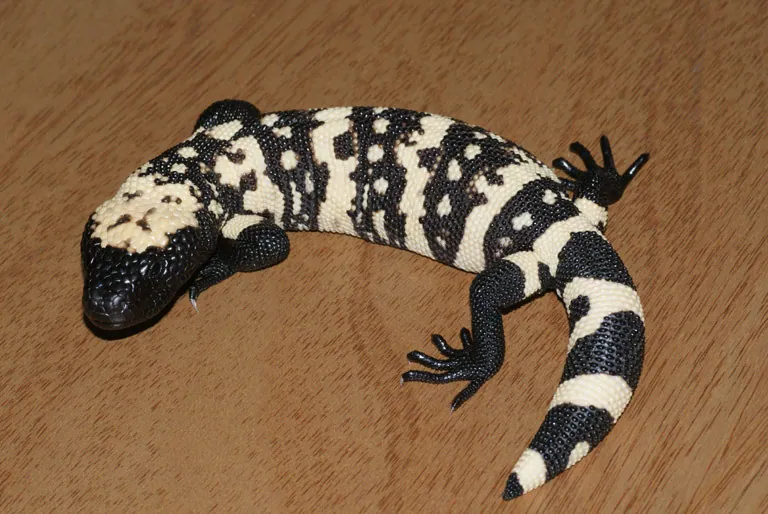
BetenThe Gila monster is a heavy, slow-moving lizard with a venomous bite. It lives in the south-western United States and the Mexican state of Sonora. It is the only venomous lizard native to the United States, but it rarely poses a real threat to people.1



 Zo herken je het
- Adults are yellow to pink on a black background.1
- Hatchlings have a simple, uniform pattern that is less colourful, and it changes over their first 6 months.1
- It has a heavy body, a stout snout and a massive head.1
- Adults can reach 56 cm in total length.1
- Males often have larger, more triangular heads than females.1
Vaak verward met: Its closest relatives are beaded lizards, which live in Mexico and Guatemala. In the United States, the Gila monster is the only venomous lizard.1
Gifkracht
Het gif komt naar buiten via de giftanden of tanden als het bijt.
Wat doet zijn gif als het bijt of steekt?
The venom is made in glands in the lower jaw and flows along grooves in the lower teeth into the bite. It contains more than a dozen peptides and other substances, which cause pain and swelling. Four potentially lethal toxins have been found, which can cause bleeding inside the organs.1
Hoe gevaarlijk is het voor mensen?
Gevaar voor mensen: ErnstigMet een beet moet je naar de dokter. Sterfgevallen zijn heel zeldzaam.The venom is usually not fatal to healthy adults. One death has been confirmed since 1930, on 16 February 2024. Earlier deaths involved adults who were drunk or whose bite was treated badly. Bites are painful and can cause shock, but the lizard is sluggish and rarely a real threat.1
Wat doet het als het bang is?
Its bright colours may warn predators to keep away, because it can inflict pain.1
 Als het bijt
- Bites are painful and need emergency medical care, because the venom may cause shock. Get medical help as quickly as possible.1
- Was de wond, houd de persoon rustig en haal medische hulp.
Bel altijd eerst je alarmnummer (112, 000, 911). Dit is algemene EHBO-informatie, geen medisch advies. EHBO-basis
 Blijf veilig
- Raak een wild dier nooit aan, vang het niet en pest het niet, ook geen kleintje, en ook niet als het lijkt te slapen of dood lijkt.
- Geef het de ruimte. Kom je er een tegen, blijf rustig, stap langzaam achteruit en laat het zijn eigen weg gaan.
- Als er een je bijt: blijf rustig, beweeg niet, bel je alarmnummer (112, 000, 911) of ga snel naar een ziekenhuis. Onthoud hoe het eruitzag, een foto helpt.
Het is niet op jou uit. Het gebruikt zijn gif om voedsel te vangen of zichzelf te beschermen, en verstopt zich veel liever. Meer over veilig blijven
Waar ter wereld?
Hoe groot is het?
Hoe lang is het?
Hoe zwaar is het?
 zo lang als 3 bananen achter elkaar
 zo lang als 18 speelgoedbouwsteentjes op een rij
 zou 100 meter kunnen afleggen in 150 seconden (de snelste mens doet er 9,6 over)
Hoe groot is Gila monster vergeleken met JOU?
Alleen rekenwerk in je browser. Er wordt niets opgeslagen of verstuurd.
Hoe snel is het?


Feiten
Exendin-4, one of the venom's peptides, led to the development of GLP-1 receptor agonists, which treat type 2 diabetes and obesity.1
Young Gila monsters can swallow up to half of their body weight in a single meal.1
It can store fat in its tail and survive a whole season on three to four large meals in spring.1
Its venom is thought to have evolved mainly for defence, because its prey is mostly eggs, small animals and other helpless prey.1
It can climb trees, cacti and fairly straight, rough-surfaced walls.1
Its teeth are replaced throughout its life, and broken teeth are replaced by the teeth behind them.1
Fabeltjes-checker
Fabel: Its bite is always fatal, and its breath is poisonous.
Waarheid: The venom is usually not fatal to healthy adult humans. One death has been confirmed since 1930.1
Waar de feiten vandaan komen
- Gila monster (Wikipedia (CC BY-SA 4.0))
- Heloderma suspectum (iNaturalist): namen en indeling.
- Venom Wiki: het gevarenniveau, de typische grootte en de geschatte snelheid zijn van onszelf. Zo berekenen we ze: Hoe we gevaar beoordelen.
Elk feit op deze pagina heeft een nummer dat naar de bron wijst. Hebben we iets fout? Sorry, we zijn dierenfans, geen wetenschappelijk tijdschrift. Laat het ons weten via [email protected] en we passen het aan.
 De schorpioen heeft honger! Venom Wiki is een eenmansproject: gratis, zonder reclame en zonder trackers. Een kleine fooi helpt om het online te houden.Voer de schorpioen
Meer uit dezelfde groep: Giftige hagedissen
 Mexican beaded lizardGiftige hagedissenMoet naar de dokter
 Chiapan beaded lizardGiftige hagedissenMoet naar de dokter
 Guatemalan beaded lizardGiftige hagedissenMoet naar de dokter
 Rio Fuerte beaded lizardGiftige hagedissenMoet naar de dokter
 Komodo dragonGiftige hagedissenKan doden
 Desert monitorGiftige hagedissenDoet alleen pijn
 Terciopelo
 Eastern coral snake
 Eastern diamondback rattlesnake
 Eyelash viper
 Timber rattlesnake
 Western diamondback rattlesnake