
 Afrika
 Azië
Azië Europa
 Zuid-Amerika
 Australië & Oceanië
 Antarctica
 Grote Oceaan
 Atlantische Oceaan
 Indische Oceaan
 Noordelijke IJszee
 Middellandse Zee
 Rode Zee
 Caribische Zee
 Koraalzee
 Zuid-Chinese Zee
 Filipijnenzee
 Andamanse Zee
 Noordzee
 Timorzee & Arafurazee
 Golf van Bengalen
 Golf van Californië
Rusty-winged tarantula hawk
 Steken
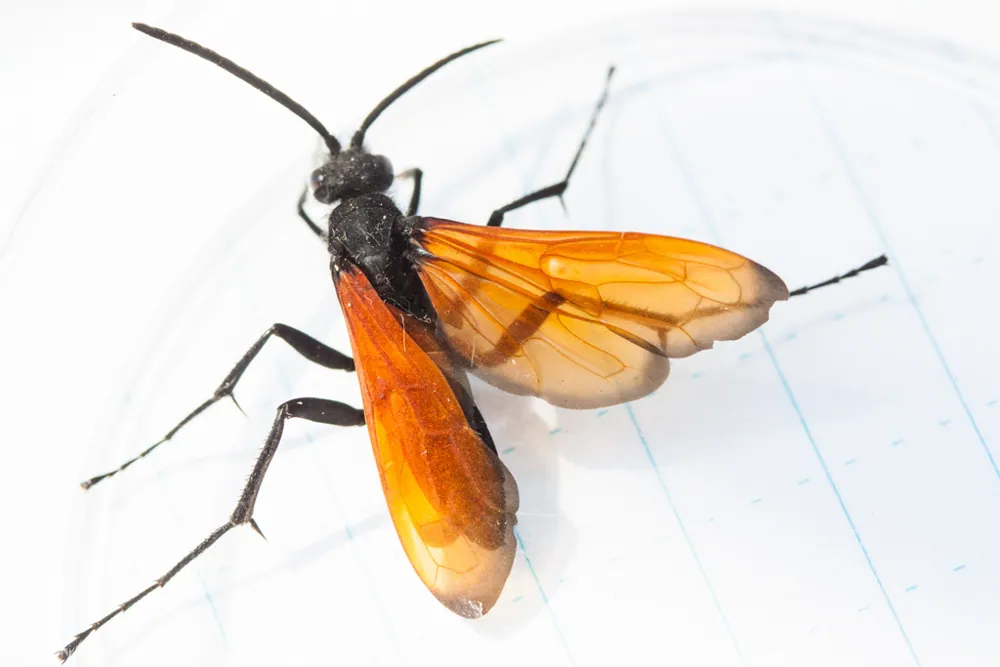
The rusty-winged tarantula hawk is a large wasp, with a matte black body and rust-orange wings. It lives in the dry Southwestern United States. Its sting is strong enough to paralyse a tarantula, which the wasp then uses to feed its young.1


 Zo herken je het
- Matte black body with rust-orange wings1
- Grows up to 5 cm long, among the largest wasps of its order1
- Long legs, used to grapple with prey1
- Males are smaller and more slender than females, with a more vibrant wing colour1
- The antenna has twelve segments1
Vaak verward met: Its relatives in the genus Pepsis look very similar. Pepsis wasps are more metallic black, with deep-blue striped patterns. The only reliable way to tell them apart is by the pattern of veins in their wings.1
Gifkracht
Het gif komt naar buiten via een angel.
Wat doet zijn gif als het bijt of steekt?
Its sting paralyses a tarantula but keeps it alive, so the spider stays fresh food for the larva. The sting is described as powerful and debilitating. It is ranked among the most painful stings in the insect world on the Schmidt sting pain index.1
Hoe gevaarlijk is het voor mensen?
Gevaar voor mensen: PijnlijkHet kan echt pijn doen, maar het is bijna nooit ernstig.Its sting is among the most painful known from insects and is described as debilitating. The sting deters nearly all predators, including birds and lizards.1
Wat doet het als het bang is?
Its painful sting deters nearly all predators.1
 Als het steekt
- Schraap een bijenangel eruit en koel de plek.
- Als de persoon moeite heeft met ademen, een opgezwollen gezicht of keel heeft, of zich flauw voelt, is het een allergisch noodgeval: bel je alarmnummer en gebruik de adrenaline-auto-injector (adrenalinepen) van de persoon als die er een heeft.
Bel altijd eerst je alarmnummer (112, 000, 911). Dit is algemene EHBO-informatie, geen medisch advies. EHBO-basis
 Blijf veilig
- Raak een wild dier nooit aan, vang het niet en pest het niet, ook geen kleintje, en ook niet als het lijkt te slapen of dood lijkt.
- Geef het de ruimte. Kom je er een tegen, blijf rustig, stap langzaam achteruit en laat het zijn eigen weg gaan.
- Als er een je steekt: blijf rustig, beweeg niet, bel je alarmnummer (112, 000, 911) of ga snel naar een ziekenhuis. Onthoud hoe het eruitzag, een foto helpt.
Het is niet op jou uit. Het gebruikt zijn gif om voedsel te vangen of zichzelf te beschermen, en verstopt zich veel liever. Meer over veilig blijven
Waar ter wereld?
Hoe groot is het?
Hoe lang is het?
 korter dan je pinkje
 zou in 9 seconden over een heel voetbalveld kunnen vliegen
Hoe groot is Rusty-winged tarantula hawk vergeleken met JOU?
Alleen rekenwerk in je browser. Er wordt niets opgeslagen of verstuurd.
Hoe snel is het?


Feiten
The larva eats its living host from the inside. It hollows out the tarantula until the spider dies, once feeding reaches the bases of its legs.1
After paralysing a tarantula, the female may drag it up to 100 m to a burrow or cavity, where she seals it in with her egg.1
Males fight for territory in mid-air. The two wasps clash wings and spiral upwards, and larger males usually win and push smaller males off the best perches.1
Males gather on mountain ridges in great numbers during the breeding season, while females are rarely seen.1
Adult wasps do not grow after they emerge, so smaller males are at a permanent disadvantage when competing with larger ones.1
Voor gifexperts
- Wetenschappelijke naam
- Hemipepsis ustulata
- Groep
- Bijen, wespen & hoornaars
- Familie
- Pompilidae2
- Orde
- Hymenoptera
- Continenten
- Noord-Amerika
- Baby's
- The female lays one egg on each tarantula she has paralysed. The egg is about 5 mm long, and the larva that hatches from it feeds on the spider.1
- Gevaar voor mensen
- 2 / 5: Pijnlijk3
Waar de feiten vandaan komen
- Hemipepsis ustulata (Wikipedia (CC BY-SA 4.0))
- Hemipepsis ustulata (iNaturalist): namen en indeling.
- Venom Wiki: het gevarenniveau, de typische grootte en de geschatte snelheid zijn van onszelf. Zo berekenen we ze: Hoe we gevaar beoordelen.
Elk feit op deze pagina heeft een nummer dat naar de bron wijst. Hebben we iets fout? Sorry, we zijn dierenfans, geen wetenschappelijk tijdschrift. Laat het ons weten via [email protected] en we passen het aan.
 De schorpioen heeft honger! Venom Wiki is een eenmansproject: gratis, zonder reclame en zonder trackers. Een kleine fooi helpt om het online te houden.Voer de schorpioen
Meer uit dezelfde groep: Bijen, wespen & hoornaars
 Tarantula hawkBijen, wespen & hoornaarsDoet alleen pijn
 Executioner waspBijen, wespen & hoornaarsMoet naar de dokter
 Warrior waspBijen, wespen & hoornaarsMoet naar de dokter
 Bald-faced hornetBijen, wespen & hoornaarsDoet alleen pijn
 Cow killer velvet antBijen, wespen & hoornaarsDoet alleen pijn
 Eastern cicada killerBijen, wespen & hoornaarsOngevaarlijk
 Terciopelo
 Eastern coral snake
 Eastern diamondback rattlesnake
 Eyelash viper
 Timber rattlesnake
 Western diamondback rattlesnake