
 Afrika
 Azië
Azië Europa
 Zuid-Amerika
 Australië & Oceanië
 Antarctica
 Grote Oceaan
 Atlantische Oceaan
 Indische Oceaan
 Noordelijke IJszee
 Middellandse Zee
 Rode Zee
 Caribische Zee
 Koraalzee
 Zuid-Chinese Zee
 Filipijnenzee
 Andamanse Zee
 Noordzee
 Timorzee & Arafurazee
 Golf van Bengalen
 Golf van Californië
South American sea nettle
 Netelende tentakels
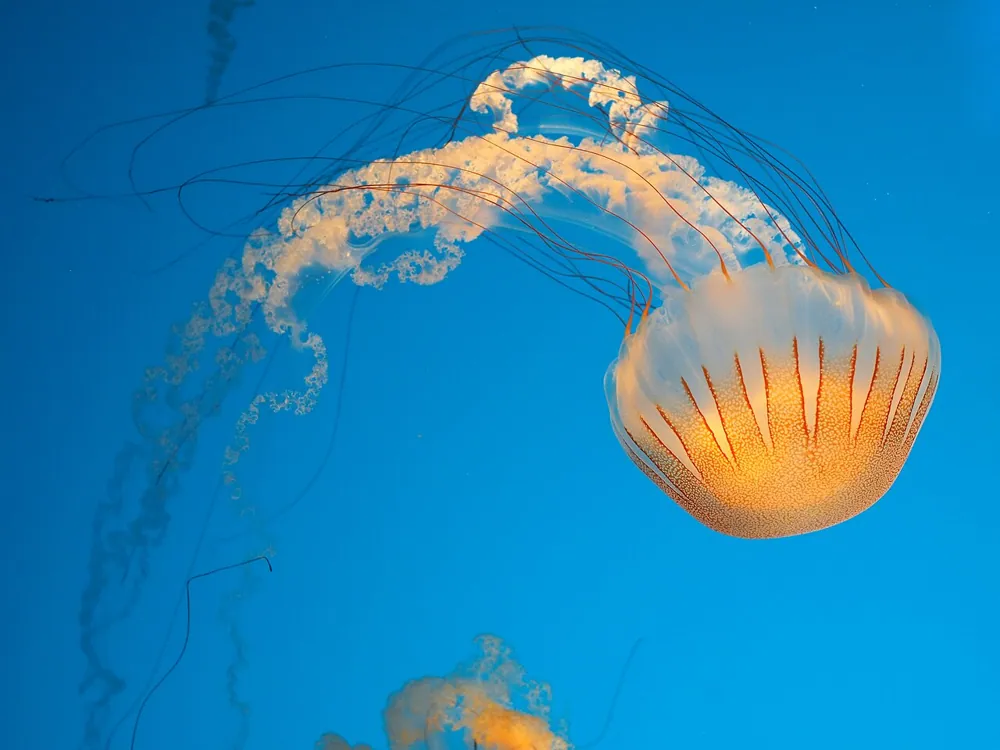
The South American sea nettle is a large jellyfish with a red-brown bell and long, spiralling arms. It drifts in the open ocean along both the Pacific and Atlantic coasts of South America. Its stinging tentacles catch the tiny animals it eats.1

 Zo herken je het
- Red-brown bell1
- Long, spiralling arms1
- Thin outer tentacles that surround inner tentacles which are often white and fluffy in appearance1
- Most mature individuals have a bell 25 to 40 cm across1
Vaak verward met: It was historically confused with C. hysoscella. That species is now known to be restricted to the northeast Atlantic, so it is not found in South American waters.1
Gifkracht
Duizenden piepkleine netelcellen vuren af als iets ze aanraakt.
Hoe gevaarlijk is het voor mensen?
Gevaar voor mensen: PijnlijkHet kan echt pijn doen, maar het is bijna nooit ernstig. Als het steekt
- Kom uit het water en haal alle tentakels eraf (met handschoenen of een doek).
- Bij tropische kubuskwallen: giet minstens 30 seconden azijn op de steken, bel om hulp en wees klaar om te reanimeren. Bij Portugese oorlogsschepen en de meeste andere: spoel met zeewater, daarna heet water tegen de pijn.
Bel altijd eerst je alarmnummer (112, 000, 911). Dit is algemene EHBO-informatie, geen medisch advies. EHBO-basis
 Blijf veilig
- Raak een wild dier nooit aan, vang het niet en pest het niet, ook geen kleintje, en ook niet als het lijkt te slapen of dood lijkt.
- Geef het de ruimte. Kom je er een tegen, blijf rustig, stap langzaam achteruit en laat het zijn eigen weg gaan.
- Als er een je steekt: blijf rustig, beweeg niet, bel je alarmnummer (112, 000, 911) of ga snel naar een ziekenhuis. Onthoud hoe het eruitzag, een foto helpt.
Het is niet op jou uit. Het gebruikt zijn gif om voedsel te vangen of zichzelf te beschermen, en verstopt zich veel liever. Meer over veilig blijven
Hoe groot is het?
Hoe lang is het?
 zo lang als 2 huiskatten van neus tot staart
 zo lang als 6 bananen achter elkaar
 zou de lengte van een groot zwembad (50 m) in 160 seconden kunnen zwemmen
Hoe groot is South American sea nettle vergeleken met JOU?
Alleen rekenwerk in je browser. Er wordt niets opgeslagen of verstuurd.
Hoe snel is het?


Feiten
Its bell can grow up to 1 metre across, but most adults are much smaller.1
Crab larvae may form a parasitic relationship with it, using it for food and shelter.1
A single polyp can produce between 3 and 10 young jellyfish called ephyrae in about 7 to 10 days.1
Its population has increased in recent years, which may be linked to climate change and major changes to ocean ecosystems.1
Its stinging tentacles are used to catch its prey, and the adults are eaten by sea turtles and some fish.1
Fabeltjes-checker
Fabel: It is the only sea nettle found in South America.
Waarheid: Despite its common name, it is not the only sea nettle in the region. C. lactea is another sea nettle found there.1
Voor gifexperts
- Wetenschappelijke naam
- Chrysaora plocamia
- Groep
- Kwallen & netelende zeedieren
- Familie
- Pelagiidae2
- Orde
- Semaeostomeae
- Continenten
- Atlantische Oceaan, De oceanen
- Baby's
- Fertilised eggs drift in the ocean, and often attach to the arms of adults for safety. They develop into swimming larvae called planulae, which later settle and grow into polyps.1
- Gevaar voor mensen
- 2 / 5: Pijnlijk3
Waar de feiten vandaan komen
- Chrysaora plocamia (Wikipedia (CC BY-SA 4.0))
- Chrysaora plocamia (iNaturalist): namen en indeling.
- Venom Wiki: het gevarenniveau, de typische grootte en de geschatte snelheid zijn van onszelf. Zo berekenen we ze: Hoe we gevaar beoordelen.
Elk feit op deze pagina heeft een nummer dat naar de bron wijst. Hebben we iets fout? Sorry, we zijn dierenfans, geen wetenschappelijk tijdschrift. Laat het ons weten via [email protected] en we passen het aan.
 De schorpioen heeft honger! Venom Wiki is een eenmansproject: gratis, zonder reclame en zonder trackers. Een kleine fooi helpt om het online te houden.Voer de schorpioen
Meer uit dezelfde groep: Kwallen & netelende zeedieren
 Australische kubuskwalKwallen & netelende zeedierenDodelijkNiet aanraken
 Irukandji jellyfishKwallen & netelende zeedierenKan dodenNiet aanraken
 Portuguese man o' warKwallen & netelende zeedierenMoet naar de dokterNiet aanraken
 Lion's mane jellyfishKwallen & netelende zeedierenDoet alleen pijnNiet aanraken
 Moon jellyfishKwallen & netelende zeedierenOngevaarlijk
 Common kingslayerKwallen & netelende zeedierenKan dodenNiet aanraken
Leeft ook in: Atlantische Oceaan
 Hawksbill sea turtleAndere passief giftige dierenKan doden
 Blue sea dragonKegelslakken & octopussenDoet alleen pijn
 Greenland sharkAndere passief giftige dierenDoet alleen pijn
 Common octopusKegelslakken & octopussenOngevaarlijk
 Common stingrayGiftige vissenMoet naar de dokter
 Greater weeverGiftige vissenMoet naar de dokterNiet aanraken