
 Afrika
 Azië
Azië Europa
 Zuid-Amerika
 Australië & Oceanië
 Antarctica
 Grote Oceaan
 Atlantische Oceaan
 Indische Oceaan
 Noordelijke IJszee
 Middellandse Zee
 Rode Zee
 Caribische Zee
 Koraalzee
 Zuid-Chinese Zee
 Filipijnenzee
 Andamanse Zee
 Noordzee
 Timorzee & Arafurazee
 Golf van Bengalen
 Golf van Californië
Spotted ratfish
 Giftige stekels
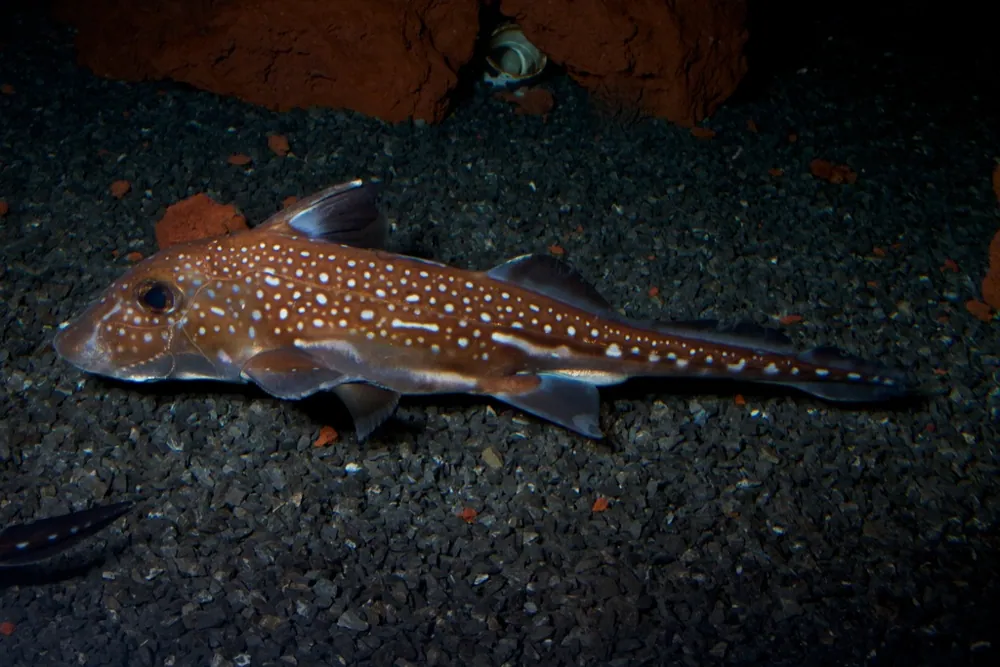
The spotted ratfish is a chimaera, a cartilage fish related to sharks and rays. It lives in the northeastern Pacific Ocean, and divers often see it at night in the Pacific Northwest. It gets its name from its pointed, rat-like tail.1



 Zo herken je het
- Smooth, scaleless skin that is silvery-bronze, often with gold, blue and green shine1
- Speckled white spots along the back1
- Large, triangular pectoral fins that stick straight out from the sides, like airplane wings1
- A pointed, rat-like tail that makes up almost half of its total length1
- Large emerald green eyes and a duckbill-shaped snout1
Gifkracht
Scherpe stekels bevatten het gif. Erop stappen of het vastpakken doet pijn.
Wat doet zijn gif als het bijt of steekt?
The spine on the leading edge of its dorsal fin is grooved and connected to a venom gland at its base. The venom is mildly toxic. A sting from the spine causes a painful wound.1
Hoe gevaarlijk is het voor mensen?
Gevaar voor mensen: PijnlijkHet kan echt pijn doen, maar het is bijna nooit ernstig.It does not present a serious danger to humans, but its spines can cause painful wounds. Harbor seals have been known to die after swallowing spotted ratfish, when a spine pierced the stomach or esophagus.1
Wat doet het als het bang is?
It usually keeps a safe distance from divers and is not aggressive, but it will defend its territory with the spine on its dorsal fin if it feels invaded.1
 Als zijn stekels je prikken
- Houd de wond in heet water, zo heet als de persoon kan verdragen zonder zich te verbranden (test het met je eigen hand), 30 tot 90 minuten lang. Haal medische hulp, vooral bij steenvissen en pijlstaartroggen.
Bel altijd eerst je alarmnummer (112, 000, 911). Dit is algemene EHBO-informatie, geen medisch advies. EHBO-basis
 Blijf veilig
- Raak een wild dier nooit aan, vang het niet en pest het niet, ook geen kleintje, en ook niet als het lijkt te slapen of dood lijkt.
- Geef het de ruimte. Kom je er een tegen, blijf rustig, stap langzaam achteruit en laat het zijn eigen weg gaan.
- Als zijn stekels je prikken: blijf rustig, beweeg niet, bel je alarmnummer (112, 000, 911) of ga snel naar een ziekenhuis. Onthoud hoe het eruitzag, een foto helpt.
Het is niet op jou uit. Het gebruikt zijn gif om voedsel te vangen of zichzelf te beschermen, en verstopt zich veel liever. Meer over veilig blijven
Waar ter wereld?
Hoe groot is het?
Hoe lang is het?
 zo lang als 2 huiskatten van neus tot staart
 zo lang als 5 bananen achter elkaar
 zou de lengte van een groot zwembad (50 m) in 12 seconden kunnen zwemmen
Hoe groot is Spotted ratfish vergeleken met JOU?
Alleen rekenwerk in je browser. Er wordt niets opgeslagen of verstuurd.
Hoe snel is het?

Feiten
Adult males have a club-like cephalic clasper on the head, an organ not found in any other vertebrate, which they use to hold on to females during courtship.1
Its large eyes reflect light, much like the eyes of a cat.1
It swims with its large pectoral fins, and its barrel rolls and corkscrew turns have been described as aquatic flight.1
Its teeth are plate-shaped, mineralised and permanent, unlike the easily replaced teeth of sharks, and they help it grind prey.1
Its ampullary organs on the head detect electric fields, and they are homologous to the ampullae of Lorenzini found in sharks and rays.1
Its meat is not typically eaten by humans and it is not commercially caught.1
Voor gifexperts
- Wetenschappelijke naam
- Hydrolagus colliei
- Groep
- Giftige vissen
- Familie
- Chimaeridae2
- Orde
- Chimaeriformes
- Continenten
- Grote Oceaan, Golf van Californië, De oceanen
- Baby's
- Like some sharks, it lays eggs; the female releases up to two fertilised eggs every 10–14 days in spring to autumn, and development can take up to a year.1
- Gevaar voor mensen
- 2 / 5: Pijnlijk3
Waar de feiten vandaan komen
- Spotted ratfish (Wikipedia (CC BY-SA 4.0))
- Hydrolagus colliei (iNaturalist): namen en indeling.
- Venom Wiki: het gevarenniveau, de typische grootte en de geschatte snelheid zijn van onszelf. Zo berekenen we ze: Hoe we gevaar beoordelen.
Elk feit op deze pagina heeft een nummer dat naar de bron wijst. Hebben we iets fout? Sorry, we zijn dierenfans, geen wetenschappelijk tijdschrift. Laat het ons weten via [email protected] en we passen het aan.
 De schorpioen heeft honger! Venom Wiki is een eenmansproject: gratis, zonder reclame en zonder trackers. Een kleine fooi helpt om het online te houden.Voer de schorpioen
Meer uit dezelfde groep: Giftige vissen
 Reef stonefishGiftige vissenKan dodenNiet aanraken
 Red lionfishGiftige vissenMoet naar de dokterNiet aanraken
 Estuarine stonefishGiftige vissenKan dodenNiet aanraken
 Short-tail stingrayGiftige vissenKan doden
 Striped eel catfishGiftige vissenKan dodenNiet aanraken
 Bluespotted ribbontail rayGiftige vissenMoet naar de dokter
Leeft ook in: Grote Oceaan
 Australian box jellyfishKwallen & netelende zeedierenDodelijkNiet aanraken
 Geography coneKegelslakken & octopussenDodelijk
 Greater blue-ringed octopusKegelslakken & octopussenDodelijk
 Japanese pufferfishAndere passief giftige dierenDodelijk
 Southern blue-ringed octopusKegelslakken & octopussenDodelijk
 Hawksbill sea turtleAndere passief giftige dierenKan doden