
 Afryka
 Azja
Azja Europa
 Ameryka Południowa
 Australia i Oceania
 Antarktyda
 Ocean Spokojny
 Ocean Atlantycki
 Ocean Indyjski
 Ocean Arktyczny
 Morze Śródziemne
 Morze Czerwone
 Morze Karaibskie
 Morze Koralowe
 Morze Południowochińskie
 Morze Filipińskie
 Morze Andamańskie
 Morze Północne
 Morze Timor i Morze Arafura
 Zatoka Bengalska
 Zatoka Kalifornijska
Gaboon viper
 Ugryzienia
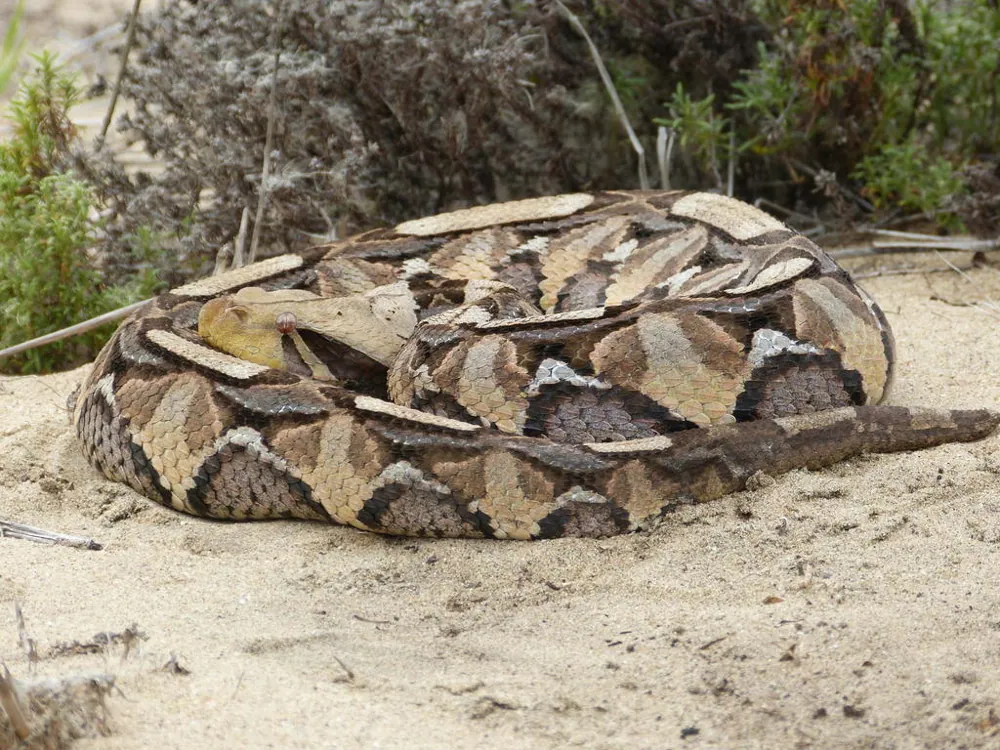
The Gaboon viper is a large, heavy snake with a striking pattern of pale and dark markings. It lives in the rainforests and savannas of sub-Saharan Africa. It is one of the most venomous snakes in the world, so knowing what it looks like matters.1


 Jak je rozpoznać
- A large, heavy, stout body, with a large triangular head and a neck much narrower than the head1
- A series of pale, rectangular blotches down the centre of the back, with dark hourglass markings edged in yellow1
- A white or cream head with a fine dark central line and a dark blue-black triangle behind and below each eye1
- Small raised 'horns' between the nostrils, which are tiny in this species1
- Its camouflage works well among dead leaves under trees, so it can be hard to see1
Często mylone z: The Congolese giant toad (Sclerophrys channingi) may be a mimic of this snake. Its head appears to resemble the viper's head, while its body is darker.1
Siła jadu
Jad wydostaje się przez kły lub zęby, gdy zwierzę gryzie.
Jak działa jego jad?
The venom is cytotoxic, which means it damages cells, and cardiotoxic, which means it harms the heart. Each bite can deliver a large amount of venom, because the snake does not release its grip after biting.1
Jak bardzo jest niebezpieczne dla ludzi?
Zagrożenie dla ludzi: Bardzo niebezpieczneMoże zabić człowieka, który nie dostanie leczenia.Bites are extremely rare, because the snake is seldom aggressive and lives mostly in rainforest areas. Most bites happen when people accidentally step on it. Even an average bite from an average-sized snake is potentially fatal.1
 Dobra wiadomość: lekarze mają na to lek (surowicę przeciwjadową) albo leczenie.1
Co robi, gdy się boi?
When threatened it hisses loudly in a deep, steady rhythm and flattens its head slightly with each breath. It is unlikely to strike unless it is severely provoked.1
 Jeśli ugryzie
- Any bite should be treated as a serious medical emergency. Antivenom should be given as soon as possible to save the limb or the person's life.1
- Trzymaj poszkodowanego w bezruchu i spokoju, trzymaj ugryzioną kończynę na wysokości serca, zdejmij pierścionki i to, co ciasne, i jak najszybciej dotrzyj do szpitala.
Zawsze najpierw dzwoń na numer alarmowy (112, 000, 911). To ogólne wskazówki pierwszej pomocy, a nie porada medyczna. Podstawy pierwszej pomocy
 Uważaj na siebie
- Nigdy nie dotykaj, nie łap ani nie drażnij dzikiego zwierzęcia, nawet małego, i nawet jeśli wygląda, jakby spało albo było martwe.
- Zostaw mu miejsce. Jeśli je spotkasz, zachowaj spokój, powoli się wycofaj i pozwól mu odejść.
- Jeśli cię ugryzie: zachowaj spokój, nie ruszaj się, zadzwoń na numer alarmowy (112, 000, 911) albo jak najszybciej dotrzyj do szpitala. Zapamiętaj, jak wyglądało, zdjęcie pomaga.
Nie poluje na ciebie. Używa jadu, żeby złapać jedzenie albo się bronić, i dużo bardziej woli się schować. Więcej o bezpieczeństwie
Jakie jest duże?
Jakie jest długie?
Ile waży?
 długie jak 4 kotów domowych od nosa do ogona
 długie jak 10 bananów ułożonych jeden za drugim
 100 metrów w 90 s (najszybszy człowiek potrzebuje 9,6)
Gaboon viper: jak duże jest w porównaniu z TOBĄ?
Zwykła matematyka w twojej przeglądarce. Nic nie jest zapisywane ani nigdzie wysyłane.
Jak szybkie jest?


Fakty
A 1.8 m specimen caught in 1973 weighed 11.3 kg with an empty stomach. It is the heaviest venomous snake in Africa.1
Its eyes can move in unusual ways. If its head is turned 360°, one eye tilts up and the other tilts down.1
Although it is one of the fastest-striking snakes in the world, it usually tolerates handling and rarely bites or hisses.1
Unlike many African vipers, such as the puff adder, it does not release its grip after biting.1
Males fight by intertwining their necks and pushing. The winner pushes the other's head to the ground and raises his own head by 20–30 cm.1
Pogromca mitów
Mit: Because it is calm and tolerant, it is safe to handle.
Prawda: Some writers have described it as so docile it can be handled as freely as a harmless snake. This is absolutely not recommended: it is one of the fastest-striking snakes, and bites by bad-tempered individuals do occur.1
Skąd pochodzą fakty
- Gaboon viper (Wikipedia (CC BY-SA 4.0))
- Bitis gabonica (iNaturalist): nazwy i klasyfikacja.
- Venom Wiki: poziom zagrożenia, typowy rozmiar i szacowana prędkość to nasze własne oceny. Zobacz, jak je ustalamy: Jak oceniamy zagrożenie.
Każdy fakt na tej stronie ma numer, który wskazuje jego źródło. Jeśli coś pomyliliśmy, przepraszamy, jesteśmy fanami zwierząt, a nie czasopismem naukowym. Napisz do nas na [email protected], a poprawimy to.
 Skorpion jest głodny! Venom Wiki to projekt jednej osoby: darmowy, bez reklam i bez śledzenia. Mały napiwek pomaga utrzymać go w sieci.Nakarm skorpiona
 Puff adder
 Northeast African carpet viper
 West African carpet viper
 Rhinoceros viper
 West African Gaboon viper
 Horned adder
 Black mamba
 Deathstalker
 Egyptian cobra
 Boomslang
 Fat-tailed scorpion
 Western honey bee