
 Afryka
 Azja
Azja Europa
 Ameryka Południowa
 Australia i Oceania
 Antarktyda
 Ocean Spokojny
 Ocean Atlantycki
 Ocean Indyjski
 Ocean Arktyczny
 Morze Śródziemne
 Morze Czerwone
 Morze Karaibskie
 Morze Koralowe
 Morze Południowochińskie
 Morze Filipińskie
 Morze Andamańskie
 Morze Północne
 Morze Timor i Morze Arafura
 Zatoka Bengalska
 Zatoka Kalifornijska
Green and black poison dart frog
 Trucizna w skórze
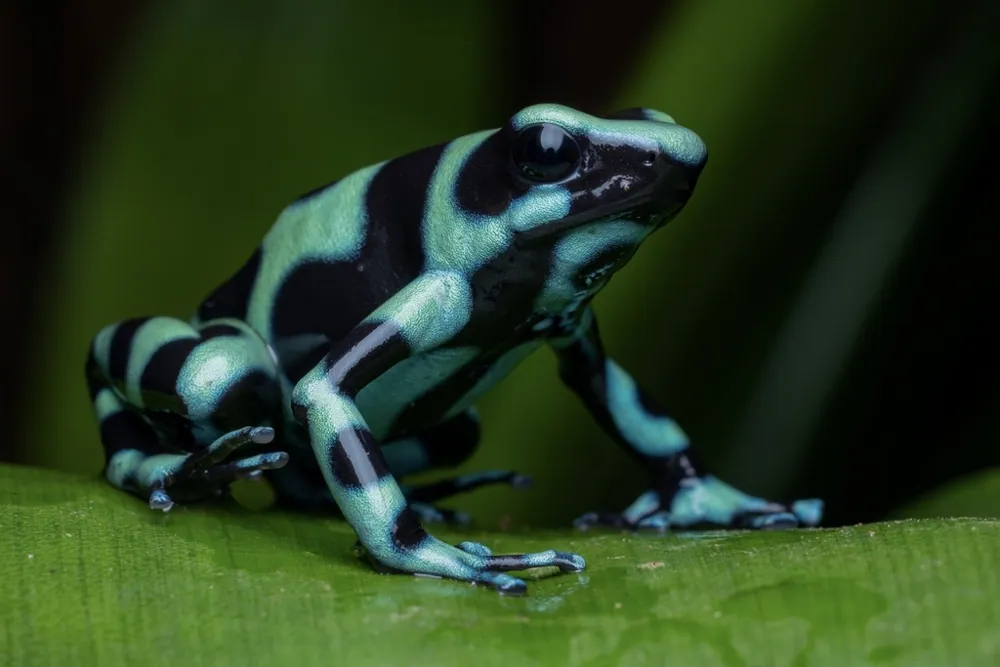
The green-and-black poison dart frog is a small, brightly coloured frog from the forests of southern Central America and north-western Colombia. It is poisonous, not venomous: it gets its toxins from the tiny insects it eats. It is also one of the most variable poison frogs in colour and pattern.1

 Jak je rozpoznać
- Usually a mint-green background with a spotted or banded pattern1
- Dark or dull splotches, most often blackish, that can look like large spots, blotches or a splashed pattern1
- Colour varies a lot: some are darker green, lime, emerald, turquoise, blue, whitish or pale yellow, and some have no green or no black1
- Some variants are entirely black, or dark with only a few small green spots or streaks1
- Small adults: males about 1.9 cm, females about 2.5 cm or longer1
Siła trucizny
Jego skóra jest trująca. Niebezpiecznie jest jej dotykać, lizać ją albo ją jeść.
Jak działa jego trucizna?
Its skin holds alkaloid poisons, which are not venom injected by a bite. These poisons interfere with the ion channels and nicotinic acetylcholine receptors that nerves and muscles rely on. In extreme cases, this can cause numbness, loss of muscle control, convulsions, cardiac arrest and death.1
Jak bardzo jest niebezpieczne dla ludzi?
Zagrożenie dla ludzi: BolesneMoże naprawdę boleć, ale prawie nigdy nie jest groźne.Its poisons can cause serious effects, including death, in cases of extreme poisoning.1
 Jeśli ktoś je dotknął lub zjadł
- Jeśli ktoś go dotknął: dokładnie umyj ręce i nie dotykaj oczu ani ust. Jeśli dziecko lub zwierzę domowe je polizało albo zjadło: zadzwoń do ośrodka toksykologicznego albo na numer alarmowy.
Zawsze najpierw dzwoń na numer alarmowy (112, 000, 911). To ogólne wskazówki pierwszej pomocy, a nie porada medyczna. Podstawy pierwszej pomocy
 Uważaj na siebie
- Nigdy nie dotykaj, nie łap ani nie drażnij dzikiego zwierzęcia, nawet małego, i nawet jeśli wygląda, jakby spało albo było martwe.
- Zostaw mu miejsce. Jeśli je spotkasz, zachowaj spokój, powoli się wycofaj i pozwól mu odejść.
- Po dotknięciu lub zjedzeniu: nie trzyj oczu ani ust, umyj ręce i szukaj pomocy medycznej.
Nie poluje na ciebie. Jego trucizna jest tylko po to, żeby nikt go nie zjadł. Więcej o bezpieczeństwie
Jakie jest duże?
Jakie jest długie?
 mniej więcej długości spinacza
 100 metrów w 97 s (najszybszy człowiek potrzebuje 9,6)
Green and black poison dart frog: jak duże jest w porównaniu z TOBĄ?
Zwykła matematyka w twojej przeglądarce. Nic nie jest zapisywane ani nigdzie wysyłane.
Jak szybkie jest?


Fakty
Hundreds of different alkaloid poisons have been identified in this frog.1
Parents carry tadpoles into the treetops and place them in bromeliad pools, where the tadpoles sometimes eat each other because food is scarce.1
Unlike other poison frogs, it gathers in large groups before mating, and males fight over small patches of ground.1
It was intentionally introduced to Oahu, Hawaii, in 1932 to help control mosquitoes.1
Its toe pads have small sucker-like discs that give it a mildly sticky grip when climbing.1
Pogromca mitów
Mit: Poison dart frogs are poisonous in every case, because of their own nature.
Prawda: They are not poisonous by nature. They become poisonous from the alkaloids in their diet of ants and mites. Captive frogs fed on crickets and fruit flies are non-toxic.1
Dla znawców jadu
- Nazwa naukowa
- Dendrobates auratus
- Grupa
- Drzewołazy, ropuchy i traszki
- Rodzina
- Dendrobatidae2
- Kolejność
- Anura
- Kontynenty
- Ameryka Północna, Ameryka Południowa
- Młode
- The female lays eggs at a site chosen by the male, and he fertilises them. The eggs hatch into tadpoles in about 14 days, and the parent, typically the male, carries them up into the canopy.1
- Jak sobie radzi na wolności
- Least Concern (IUCN)1
- Zagrożenie dla ludzi
- 2 / 5: Bolesne3
Skąd pochodzą fakty
- Green and black poison dart frog (Wikipedia (CC BY-SA 4.0))
- Dendrobates auratus (iNaturalist): nazwy i klasyfikacja.
- Venom Wiki: poziom zagrożenia, typowy rozmiar i szacowana prędkość to nasze własne oceny. Zobacz, jak je ustalamy: Jak oceniamy zagrożenie.
Każdy fakt na tej stronie ma numer, który wskazuje jego źródło. Jeśli coś pomyliliśmy, przepraszamy, jesteśmy fanami zwierząt, a nie czasopismem naukowym. Napisz do nas na [email protected], a poprawimy to.
 Skorpion jest głodny! Venom Wiki to projekt jednej osoby: darmowy, bez reklam i bez śledzenia. Mały napiwek pomaga utrzymać go w sieci.Nakarm skorpiona
Więcej z tej samej grupy: Drzewołazy, ropuchy i traszki
 Liściołaz żółtyDrzewołazy, ropuchy i traszkiŚmiertelnie groźneNie dotykaj
 Cane toadDrzewołazy, ropuchy i traszkiWymaga lekarzaNie dotykaj
 Dyeing poison dart frogDrzewołazy, ropuchy i traszkiTylko boliNie dotykaj
 Strawberry poison-dart frogDrzewołazy, ropuchy i traszkiTylko boliNie dotykaj
 Black-legged poison frogDrzewołazy, ropuchy i traszkiMoże zabićNie dotykaj
 California newtDrzewołazy, ropuchy i traszkiMoże zabićNie dotykaj
 Żararaka szorstka
 Eastern coral snake
 Eastern diamondback rattlesnake
 Eyelash viper
 Timber rattlesnake
 Western diamondback rattlesnake