
 África
 Ásia
Ásia Europa
 América do Sul
 Austrália e Oceania
 Antártida
 Oceano Pacífico
 Oceano Atlântico
 Oceano Índico
 Oceano Ártico
 Mar Mediterrâneo
 Mar Vermelho
 Mar do Caribe
 Mar de Coral
 Mar do Sul da China
 Mar das Filipinas
 Mar de Andamão
 Mar do Norte
 Mar de Timor e de Arafura
 Golfo de Bengala
 Golfo da Califórnia
Eastern green mamba
 Mordidas
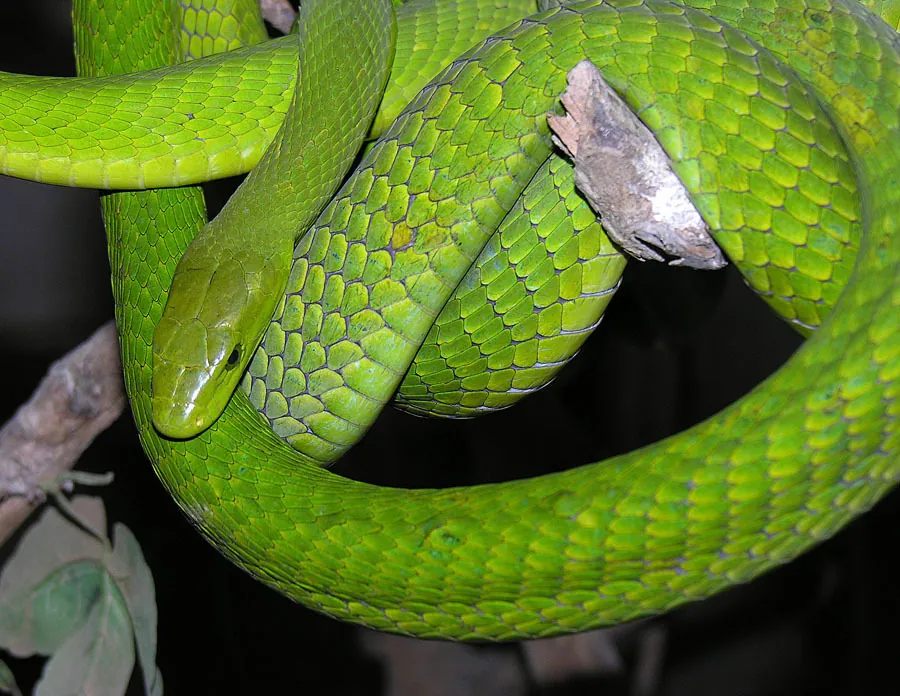
The eastern green mamba is a highly venomous snake with a slender body and bright green back. It lives in trees along the coasts of southern and East Africa. Although it is one of the most common green mambas, it is shy and usually hidden in leaves, so it is rarely seen.1



 Como reconhecer
- Bright green upperparts, sometimes with a few isolated yellow scales.1
- Pale yellow-green belly.1
- Juveniles are blue-green and turn bright green at about 75 cm long.1
- Long, slender, coffin-shaped head. It can flatten its neck into a slight hood when threatened.1
- The inside of the mouth is white or bluish-white.1
Muitas vezes confundido com: Green forms of the boomslang are often called green mambas in Southern Africa. They have larger eyes and shorter heads. Green bush snakes of the genus Philothamnus are often confused with smaller eastern green mambas. The boomslang is also venomous.1
Poder do veneno
O veneno sai pelas presas ou pelos dentes quando ele morde.
O que o veneno dele faz?
Its venom contains neurotoxins, which attack the nerves, and cardiotoxins, which damage the heart. Symptoms include swelling at the bite, dizziness, nausea, dehydration, laboured breathing and difficulty swallowing. These can progress to irregular heartbeat, convulsions and respiratory paralysis, which stops breathing and can be fatal. Paralysis may be mild or absent.1
Qual é o perigo para as pessoas?
Perigo para as pessoas: MortalUm dos animais mais perigosos do mundo.A survey in southern Africa from 1957 to 1979 recorded 17 bites confirmed as eastern green mambas. Ten of these caused systemic envenomation, and no victims died. Bites are most common from September to February, the breeding season, when the snake is most irritable. The average dose able to kill a human is about 18 to 20 mg of venom, and one bite can deliver 60 to 95 mg (dry weight). In 2024, a YouTuber died after being bitten, following anaphylactic shock.1
O que ele faz quando está com medo?
It is shy and avoids people and predators, attacking only when it feels threatened, and it can flatten its neck into a hood.1
 Se ele morder
- Severe bites must be treated immediately on site, as they can quickly prove deadly.1
- Mantenha a pessoa parada e calma, tire anéis e coisas apertadas e leve-a rápido para um hospital: o tratamento é o soro antiveneno.
Sempre ligue primeiro para o número de emergência (112, 000, 911). Estas são orientações gerais de primeiros socorros, não um conselho médico. Primeiros socorros básicos
 Fique em segurança
- Nunca toque, pegue ou provoque um animal selvagem, mesmo que seja pequeno, e mesmo que pareça estar dormindo ou morto.
- Dê espaço a ele. Se encontrar um, fique calmo, dê alguns passos para trás devagar e deixe que ele siga o caminho dele.
- Se um deles morder você: fique calmo, fique parado, ligue para o número de emergência (112, 000, 911) ou vá rápido para um hospital. Lembre como ele era, uma foto ajuda.
Ele não está atrás de você. Usa o veneno para pegar comida ou se proteger, e prefere muito mais se esconder. Mais sobre como ficar em segurança
Em que lugar do mundo?
Qual é o tamanho dele?
Qual é o comprimento dele?
 tem o comprimento de 2,5 cachorros do focinho à cauda
 tem o comprimento de 14 bananas enfileiradas
 poderia percorrer 100 metros em 43 segundos (o humano mais rápido precisa de 9,6)
Qual é o tamanho de Eastern green mamba comparado com VOCÊ?
Só contas no seu navegador. Nada é salvo nem enviado para lugar nenhum.
Quão rápido ele é?


Informações
Males fight each other during the breeding season, usually entwining and pushing to pin each other's heads down. These fights can last several hours, but the snakes do not bite each other.1
Unlike most elapid snakes, which hunt actively, it often waits in ambush for its prey, a style more common among vipers.1
On average, an individual moves only about 5.4 metres per day, and it can stay in the same place for days.1
It has the least toxic venom of the three green mamba species, but it is still highly venomous.1
The oldest recorded eastern green mamba was a captive snake that lived 18.8 years.1
Caça-mitos
Mito: It is an aggressive, fast-moving 'people-chaser'.
Verdade: It is shy and elusive, usually hidden in trees, and it generally avoids people. It attacks only when it feels threatened.1
Para especialistas em veneno
- Nome científico
- Dendroaspis angusticeps
- Grupo
- Najas, mambas e kraits
- Família
- Elapidae2
- Ordem
- Squamata
- Continentes
- África
- Filhotes
- The female lays 4 to 17 eggs, usually 10 to 15, in leaf litter in hollow trees, from October to November. The young measure about 30 to 45 cm in the wild.1
- Tempo de vida
- uns 18,8 anos1
- Perigo para as pessoas
- 5 / 5: Mortal3
De onde vêm as informações
- Eastern green mamba (Wikipedia (CC BY-SA 4.0))
- Dendroaspis angusticeps (iNaturalist): nomes e classificação.
- Venom Wiki: o nível de perigo, o tamanho típico e o palpite de velocidade são nossos. Veja como calculamos: Como avaliamos o perigo.
Cada informação desta página tem um número que leva à fonte. Se a gente errou alguma coisa, desculpe, somos fãs de animais, não uma revista científica. Avise a gente em [email protected] e nós corrigimos.
 O escorpião está com fome! O Venom Wiki é um projeto de uma pessoa só: grátis, sem anúncios e sem rastreadores. Uma pequena contribuição ajuda a manter o site no ar.Alimente o escorpião
 Mamba-negra
 Naja-egípcia
 Cape cobra
 Jameson's mamba
 Western green mamba
 Ashe's spitting cobra
 Escorpião-amarelo-palestino
 Víbora-bufadora
 Boomslang
 Fat-tailed scorpion
 Gaboon viper
 Western honey bee