
 África
 Ásia
Ásia Europa
 América do Sul
 Austrália e Oceania
 Antártida
 Oceano Pacífico
 Oceano Atlântico
 Oceano Índico
 Oceano Ártico
 Mar Mediterrâneo
 Mar Vermelho
 Mar do Caribe
 Mar de Coral
 Mar do Sul da China
 Mar das Filipinas
 Mar de Andamão
 Mar do Norte
 Mar de Timor e de Arafura
 Golfo de Bengala
 Golfo da Califórnia
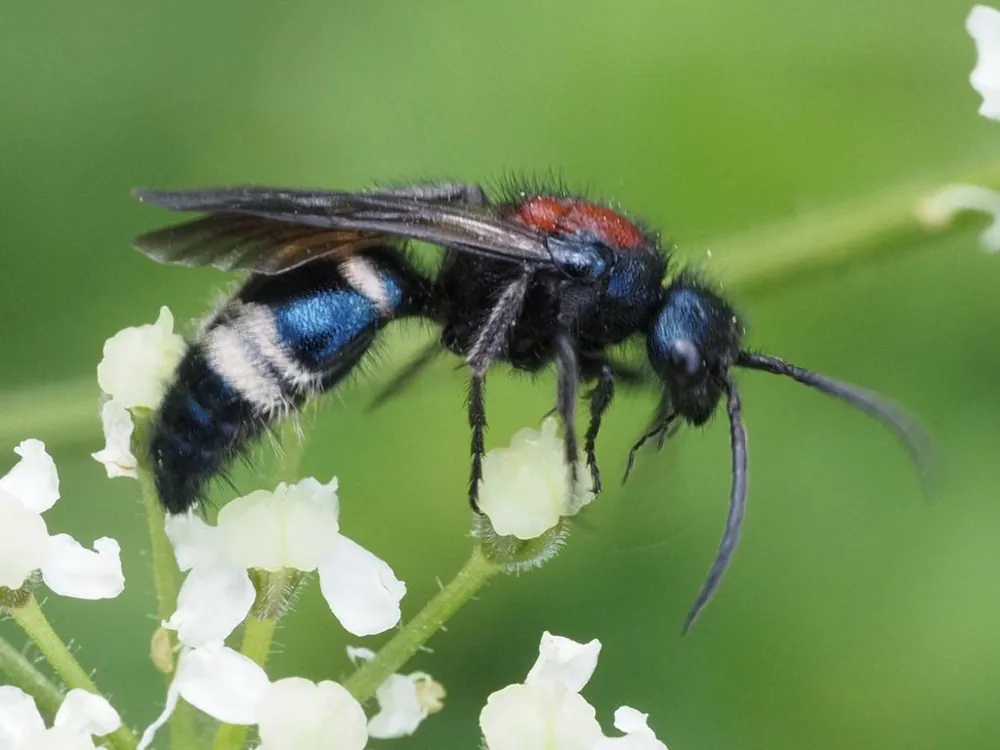
Large velvet ant
 Picadas
The large velvet ant is not really an ant. It is a wasp, and the females have no wings and look like fuzzy ants. It lives in parts of Europe, Asia and North Africa, in heaths, moors, grasslands and woodland. Its sting is painful, but it is not aggressive.1


 Como reconhecer
- Males are dark red on the tip of the mandibles (jaws) and on the thorax.1
- The first and second segments of the abdomen have bands of long silver bristles.1
- The tip of the abdomen and much of the body are covered in long black bristles.1
- Females have a red mesonotum (the upper middle part of the thorax) and silver-spotted flanks along the abdomen.1
- Some males are completely black, and colour varies between individuals.1
Poder do veneno
O veneno sai por um ferrão.
O que o veneno dele faz?
The sting is painful. Its venom is much less toxic than the venom of a honeybee.1
Qual é o perigo para as pessoas?
Perigo para as pessoas: DolorosoPode doer bastante, mas quase nunca é grave.The wasp is not aggressive and only stings people when handled. Its sting is painful but less toxic than a honeybee's.1
O que ele faz quando está com medo?
When threatened, it stridulates by rubbing a raised structure called the plectrum over ridges on its abdomen, which makes a sound.1
 Se ele picar
- Raspe o ferrão da abelha para tirar e esfrie o local.
- Se a pessoa tem dificuldade para respirar, inchaço no rosto ou na garganta, ou se sente desmaiar, é uma emergência alérgica: ligue para o número de emergência e use a caneta de adrenalina dela, se ela tiver uma.
Sempre ligue primeiro para o número de emergência (112, 000, 911). Estas são orientações gerais de primeiros socorros, não um conselho médico. Primeiros socorros básicos
 Fique em segurança
- Nunca toque, pegue ou provoque um animal selvagem, mesmo que seja pequeno, e mesmo que pareça estar dormindo ou morto.
- Dê espaço a ele. Se encontrar um, fique calmo, dê alguns passos para trás devagar e deixe que ele siga o caminho dele.
- Se um deles picar você: fique calmo, fique parado, ligue para o número de emergência (112, 000, 911) ou vá rápido para um hospital. Lembre como ele era, uma foto ajuda.
Ele não está atrás de você. Usa o veneno para pegar comida ou se proteger, e prefere muito mais se esconder. Mais sobre como ficar em segurança
Em que lugar do mundo?
Qual é o tamanho dele?
Qual é o comprimento dele?
 tão pequeno que cabe na sua unha
Qual é o tamanho de Large velvet ant comparado com VOCÊ?
Só contas no seu navegador. Nada é salvo nem enviado para lugar nenhum.
Quão rápido ele é?


Informações
Their thick, armoured skin is so strong that related species in North America have been reported to escape from the mouths of lizards and frogs.1
Females can sneak into the nests of paper wasps and steal their food stores, possibly because they can disguise their scent so the paper wasps cannot detect them.1
The size of the adult wasp depends partly on the size of its host: wasps raised in honeybees are smaller than those raised in bumblebees.1
Females are wingless, but males have wings.1
Males die soon after emerging in autumn, while females hibernate over winter, sometimes in the host nest or at the roots of low plants.1
Caça-mitos
Mito: The nickname "cow killer" means the sting can kill cows.
Verdade: The nickname is inappropriate. Its sting is painful, but its venom is much less toxic than a honeybee's, and it is not aggressive.1
De onde vêm as informações
- Mutilla europaea (Wikipedia (CC BY-SA 4.0))
- Mutilla europaea (iNaturalist): nomes e classificação.
- Venom Wiki: o nível de perigo, o tamanho típico e o palpite de velocidade são nossos. Veja como calculamos: Como avaliamos o perigo.
Cada informação desta página tem um número que leva à fonte. Se a gente errou alguma coisa, desculpe, somos fãs de animais, não uma revista científica. Avise a gente em [email protected] e nós corrigimos.
 O escorpião está com fome! O Venom Wiki é um projeto de uma pessoa só: grátis, sem anúncios e sem rastreadores. Uma pequena contribuição ajuda a manter o site no ar.Alimente o escorpião
 Asian giant hornet
 Common wasp
 European hornet
 Western honey bee
 Giant honey bee
 Asian hornet
 Common European adder
 Spanish fly
 Fire salamander
 Blunt-nosed viper
 Nose-horned viper
 Ottoman viper