
 África
 Ásia
Ásia Europa
 América do Sul
 Austrália e Oceania
 Antártida
 Oceano Pacífico
 Oceano Atlântico
 Oceano Índico
 Oceano Ártico
 Mar Mediterrâneo
 Mar Vermelho
 Mar do Caribe
 Mar de Coral
 Mar do Sul da China
 Mar das Filipinas
 Mar de Andamão
 Mar do Norte
 Mar de Timor e de Arafura
 Golfo de Bengala
 Golfo da Califórnia
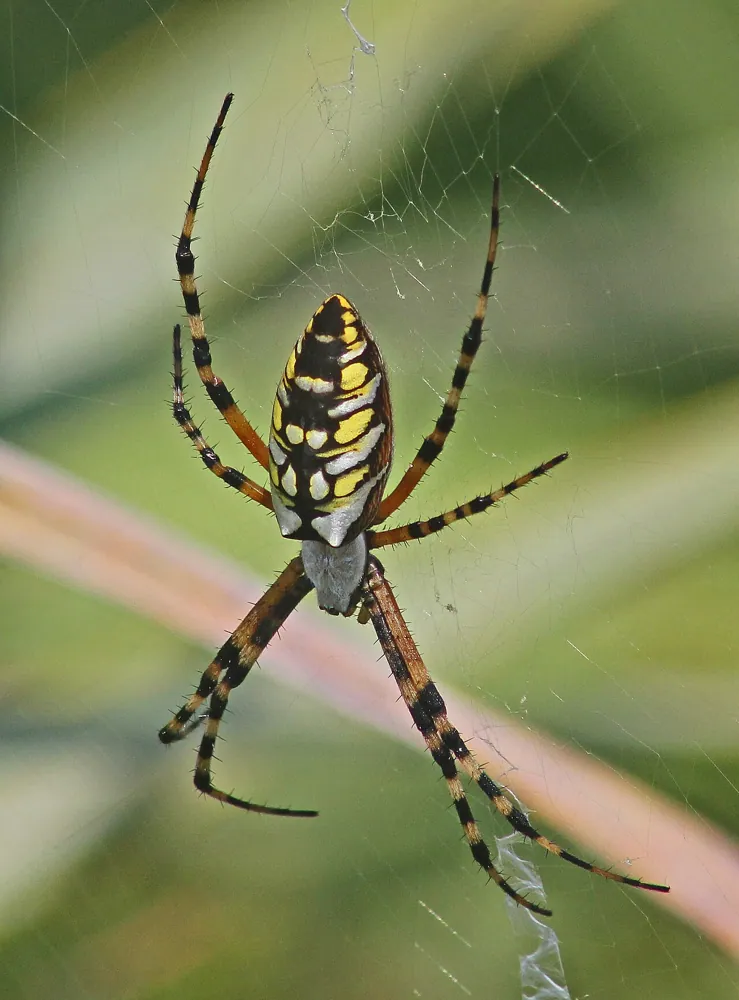
Yellow garden spider
 Mordidas
The yellow garden spider is a large, colourful spider with yellow and black markings on its abdomen. It builds big round webs in sunny fields, gardens and along the eaves of houses in North America, Mexico and Central America. It bites only if disturbed or handled, and its bite is comparable to a bee sting.1


 Como reconhecer
- Yellow and black markings on the abdomen (the rear part of the body).1
- A mostly white front body section (cephalothorax).1
- A large, circular web up to 60 cm across, with a dense zigzag of silk in the centre.1
- The female sits in the centre of the web, usually facing straight down.1
- Females measure 19–28 mm in body length, while males are much smaller at 5–9 mm.1
Poder do veneno
O veneno sai pelas presas ou pelos dentes quando ele morde.
O que o veneno dele faz?
The venom contains polyamine toxins, including one called argiotoxin ArgTX-636, which are being studied for possible medical uses. For most people the venom is harmless, and a bite causes redness and swelling, similar to a bee sting. It is harmless to people who are not allergic.1
Qual é o perigo para as pessoas?
Perigo para as pessoas: LeveComo uma picada de abelha ou menos. Praticamente inofensivo para as pessoas.These spiders are not aggressive and only bite if grabbed or disturbed. For a healthy adult, a bite is not considered an issue. People who are very young, elderly, or have weakened immune systems should take the same care they would around a beehive or hornet nest.1
O que ele faz quando está com medo?
If disturbed by a possible predator, the female may drop from her web and hide on the ground nearby, and she can shake the web vigorously while staying attached in the centre.1
 Se ele morder
- Lave a mordida e coloque uma bolsa de gelo para a dor. Procure ajuda médica se a dor for forte, se espalhar ou a pessoa se sentir mal.
Sempre ligue primeiro para o número de emergência (112, 000, 911). Estas são orientações gerais de primeiros socorros, não um conselho médico. Primeiros socorros básicos
 Fique em segurança
- Nunca toque, pegue ou provoque um animal selvagem, mesmo que seja pequeno, e mesmo que pareça estar dormindo ou morto.
- Dê espaço a ele. Se encontrar um, fique calmo, dê alguns passos para trás devagar e deixe que ele siga o caminho dele.
- Se um deles morder você: fique calmo, fique parado, ligue para o número de emergência (112, 000, 911) ou vá rápido para um hospital. Lembre como ele era, uma foto ajuda.
Ele não está atrás de você. Usa o veneno para pegar comida ou se proteger, e prefere muito mais se esconder. Mais sobre como ficar em segurança
Em que lugar do mundo?
Qual é o tamanho dele?
Qual é o comprimento dele?
 mais ou menos o comprimento de um clipe de papel
 poderia percorrer 100 metros em 280 segundos (o humano mais rápido precisa de 9,6)
Qual é o tamanho de Yellow garden spider comparado com VOCÊ?
Só contas no seu navegador. Nada é salvo nem enviado para lugar nenhum.
Quão rápido ele é?


Informações
The female can shake her web vigorously to make it harder for wasps and birds to target her, and to fully tangle an insect before it cuts itself free.1
After mating, the male often dies and is sometimes eaten by the female, as he inserts his second palpal bulb.1
The zigzag silk in the web, called a stabilimentum, may camouflage the spider, attract prey, or warn birds away, but its purpose is still disputed.1
In a case observed in Georgia, a European hornet cut free prey caught in a yellow garden spider's web, and the spider did not fight it, probably because it dropped from the web and hid.1
Caça-mitos
Mito: Yellow garden spiders are dangerous and their bite can seriously harm a healthy adult.
Verdade: The venom is harmless to people who are not allergic. A bite is comparable to a bumblebee sting and is not considered an issue for healthy adults.1
Para especialistas em veneno
- Nome científico
- Argiope aurantia
- Grupo
- Aranhas
- Família
- Araneidae2
- Ordem
- Araneae
- Continentes
- América do Norte
- Filhotes
- Each female produces one to four egg sacs, each holding perhaps over a thousand eggs, and in spring the tiny spiderlings emerge and some are carried away on silk strands by the breeze.1
- Perigo para as pessoas
- 1 / 5: Leve3
De onde vêm as informações
- Argiope aurantia (Wikipedia (CC BY-SA 4.0))
- Argiope aurantia (iNaturalist): nomes e classificação.
- Venom Wiki: o nível de perigo, o tamanho típico e o palpite de velocidade são nossos. Veja como calculamos: Como avaliamos o perigo.
Cada informação desta página tem um número que leva à fonte. Se a gente errou alguma coisa, desculpe, somos fãs de animais, não uma revista científica. Avise a gente em [email protected] e nós corrigimos.
 O escorpião está com fome! O Venom Wiki é um projeto de uma pessoa só: grátis, sem anúncios e sem rastreadores. Uma pequena contribuição ajuda a manter o site no ar.Alimente o escorpião
 Brown recluse
 Southern black widow
 Northern black widow
 Western black widow
 Bold jumping spider
 Golden silk orb-weaver
 Terciopelo
 Eastern coral snake
 Eastern diamondback rattlesnake
 Eyelash viper
 Timber rattlesnake
 Western diamondback rattlesnake