
 África
 Ásia
Ásia Europa
 América do Sul
 Austrália e Oceânia
 Antártida
 Oceano Pacífico
 Oceano Atlântico
 Oceano Índico
 Oceano Ártico
 Mar Mediterrâneo
 Mar Vermelho
 Mar das Caraíbas
 Mar de Coral
 Mar da China Meridional
 Mar das Filipinas
 Mar de Andamão
 Mar do Norte
 Mar de Timor e de Arafura
 Golfo de Bengala
 Golfo da Califórnia
Daddy long-legs spider
 Mordeduras
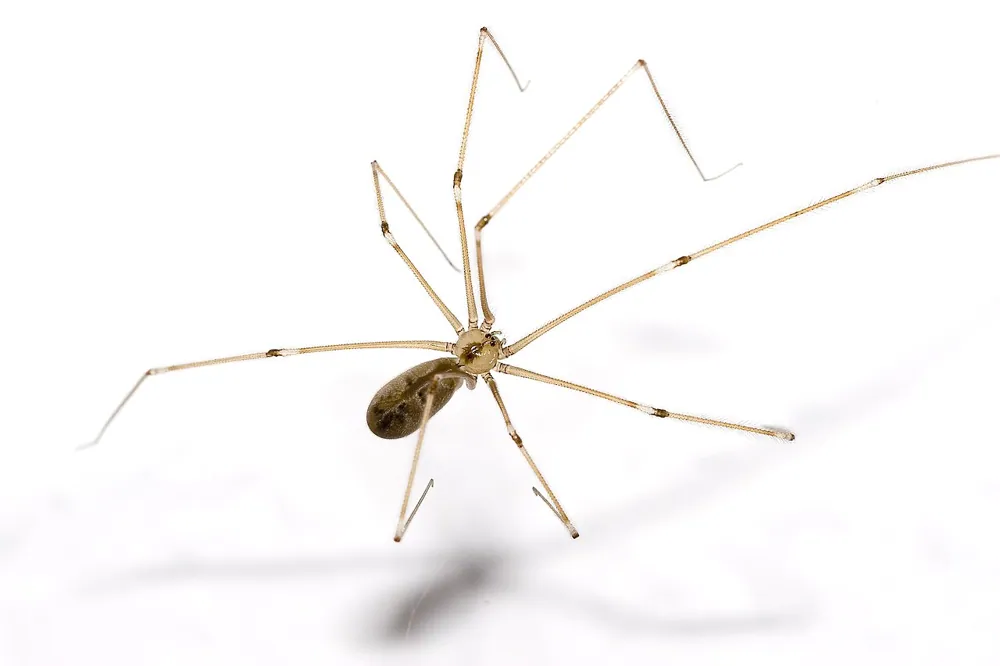
The daddy long-legs spider is a small spider with very long, thin legs. It lives indoors in quiet, dim corners of homes, cellars and garages, and it is found in most temperate countries on every continent. It is valued because it hunts other spiders, including the dangerous redback spider.1


 Como reconhecê-lo
- Small body, about 6 to 10 mm long in males and 7 to 8 mm on average in females, not counting the legs.1
- Eight very long, thin legs covered in fine grey bristles. The legs are about 5 to 6 times the length of the body.1
- Translucent grey or pale brown body, with a dark spot on the back of the front body part and dark, blurred spots on the top of the rear body part.1
- Eight eyes: a pair of small dark eyes at the front, followed by three rows of pairs of larger eyes.1
- Loose, horizontal webs with many irregularities, often tangled with the webs of other spiders.1
Muitas vezes confundido com: It is often called 'daddy long-legs', a name also used for crane flies and harvestmen. Crane flies are insects, and harvestmen belong to a different group of arachnids (the order Opiliones), so they are not spiders.1
Poder do veneno
O veneno sai pelas presas ou pelos dentes quando morde.
O que faz o seu veneno?
Its venom is used to subdue prey, and it can bite. According to researchers, its venom has negligible effects on humans and other mammals. A bite causes a mild stinging sensation with no long-term health effects.1
Quão perigoso é para as pessoas?
Perigo para as pessoas: LigeiroComo uma picada de abelha ou menos. Praticamente inofensivo para as pessoas.It is considered harmless to humans. Bites are hardly ever reported, and a bite causes only mild stinging.1
O que faz quando tem medo?
When it senses danger, it swings its body round in a circle repeatedly while its legs stay fixed on the web, a movement called whirling.1
 Se morder
- Lava a mordedura e põe gelo para a dor. Procura ajuda médica se a dor for forte, se espalhar ou se a pessoa se sentir mal.
Liga sempre primeiro para o teu número de emergência (112, 000, 911). Isto são orientações gerais de primeiros socorros, não conselho médico. Primeiros socorros básicos
 Fica em segurança
- Nunca toques, apanhes ou provoques um animal selvagem, mesmo pequeno, e mesmo que pareça a dormir ou morto.
- Dá-lhe espaço. Se encontrares um, mantém a calma, recua devagar e deixa-o seguir o seu caminho.
- Se te morder: mantém a calma, fica quieto, liga para o teu número de emergência (112, 000, 911) ou vai depressa para um hospital. Lembra-te de como era, uma foto ajuda.
Não anda atrás de ti. Usa o veneno para caçar ou para se proteger, e prefere muito mais esconder-se. Mais sobre como estar seguro
Que tamanho tem?
Quanto mede?
 tão comprido como 2 peças de construção em fila
 conseguia percorrer 100 metros em 280 segundos (o humano mais rápido precisa de 9,6)
Que tamanho tem Daddy long-legs spider comparado contigo?
São só contas no teu navegador. Nada é guardado nem enviado para lado nenhum.
Quão rápido é?


Factos
It hunts redback spiders, which are among the most venomous spiders in the world.1
It fakes the vibrations of a trapped insect in its web, then waits on its long legs until the prey touches one of them before attacking.1
Its whirling defence can last several hours or even days when it is threatened by jumping spiders.1
Its silk has been reported to have potential medicinal uses.1
Caça-mitos
Mito: Daddy long-legs spiders cannot bite humans because their fangs cannot get through human skin.
Verdade: Their fangs are about 0.25 mm long, and human skin is about 0.1 mm thick, so they can bite. Bites are very rarely reported, and they cause only mild stinging.1
De onde vêm os factos
- Pholcus phalangioides (Wikipedia (CC BY-SA 4.0))
- Pholcus phalangioides (iNaturalist): nomes e classificação.
- Venom Wiki: o nível de perigo, o tamanho típico e a velocidade estimada são nossos. Vê como os calculamos: Como avaliamos o perigo.
Cada facto desta página tem um número que aponta para a sua fonte. Se nos enganámos em alguma coisa, desculpa, somos fãs de animais, não uma revista científica. Diz-nos em [email protected] e nós corrigimos.
 O escorpião tem fome! A Venom Wiki é um projeto de uma só pessoa: gratuito, sem anúncios e sem rastreadores. Uma pequena gorjeta ajuda a mantê-la online.Alimenta o escorpião
Mais do mesmo grupo: Aranhas
 Mediterranean black widow
 Diving bell spider
 European yellow sac spider
 Noble false widow
 Tarantula wolf spider
 European garden spider
Também vive em: Europa
 Common European adderVíborasPrecisa de médico
 Spanish flyOutros animais tóxicosPrecisa de médicoNão tocar
 Common waspAbelhas, vespas e vespõesSó dói
 European hornetAbelhas, vespas e vespõesSó dói
 Fire salamanderRãs venenosas, sapos e tritõesSó dóiNão tocar
 Western honey beeAbelhas, vespas e vespõesSó dói